

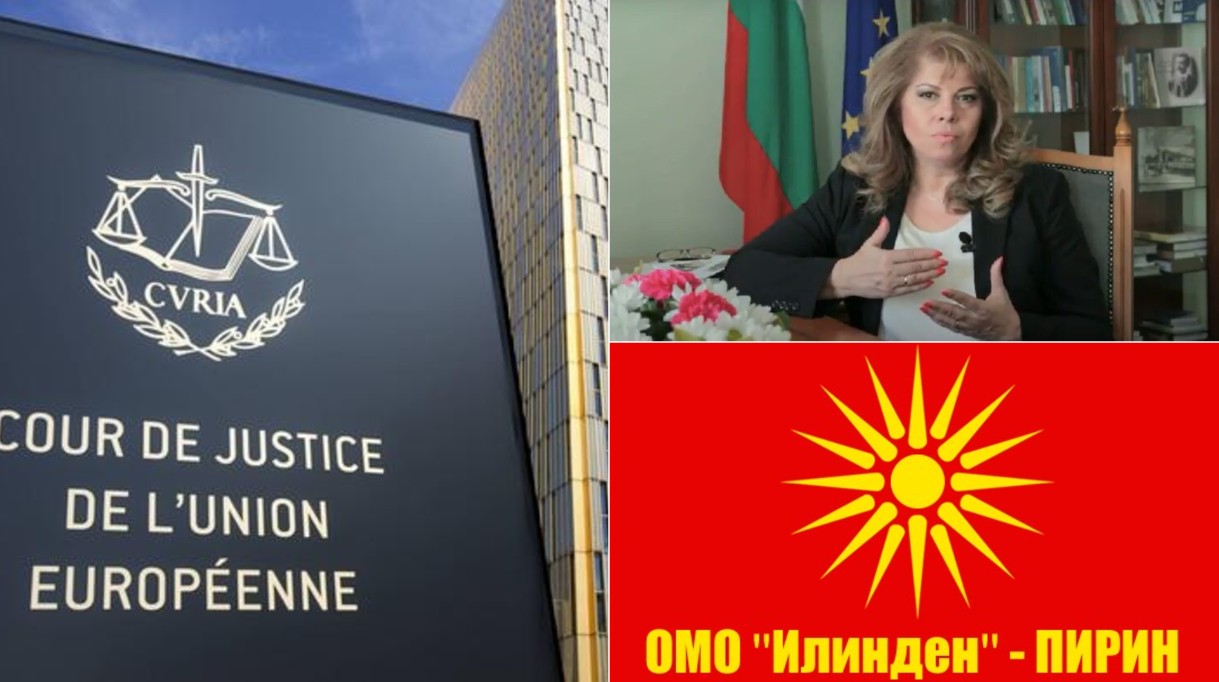
UMO “ILINDEN,” THE MACEDONIAN LANGUAGE AND EUROPE’S GREAT TEST:
CAN A STATE ASK EUROPE TO COUNT THE OBLIGATIONS OF OTHERS WHILE FORGETTING ITS OWN?
By Slobodan Tomić

“When the law is applied differently to different people, the problem is no longer the law itself, but the way it is applied.”
— Gustav Radbruch
Strasbourg has once again become the stage for a question that long ago moved beyond the narrow confines of Sofia and Skopje.
The question is no longer simply whether UMO “Ilinden”–Pirin will finally be registered as an organisation.
The real question is far larger:
What does the European rule of law mean when judgments of the European Court of Human Rights remain under supervision for years?
And there is an even more uncomfortable question:
Can one state demand that another amend its Constitution in the name of European standards while remaining under European supervision over the implementation of judgments concerning the rights of Macedonians?
That is the heart of the matter.
This is not a question of day-to-day politics.
It is not a matter of political sympathies.
Nor is it about whether anyone in Skopje likes or dislikes Sofia.
It is a question of a fundamental European principle:
the same rules must apply to everyone.
YOTOVA IN STRASBOURG: A POLITICAL MESSAGE, BUT AN INSTITUTIONAL TEST
Bulgarian President Iliana Iotova has stated in Strasbourg that Bulgaria has implemented the recommendations relating to the UMO “Ilinden” cases and that legislative amendments now make it possible for such associations to obtain registration.
Her position is clear:
the legal framework has been changed, while the remaining problem lies in applicants repeatedly submitting incomplete documentation.
Iotova expects the supervision of the cases to come to an end.
That is the Bulgarian government’s position.
But there is an institutional reality that matters far more than the political statement of any president:
Bulgaria does not decide by itself whether the case is closed.
That assessment belongs to the Committee of Ministers of the Council of Europe, which supervises the execution of judgments of the European Court of Human Rights.
And this is precisely why the Council of Europe’s statement of 16 September matters. It said that more than 160 judgments and decisions against Bulgaria are still awaiting full implementation, while the UMO “Ilinden and Others v. Bulgaria” group is among the cases under consideration during the 15–17 September meeting.
The distinction is fundamental.
Iotova may present Bulgaria’s position.
But Strasbourg assesses the situation under European law.
That is the institutional difference.
“A DOCUMENT IS MISSING” — OR IS THE PROBLEM SYSTEMIC?
This is where the most difficult part of the story begins.
Iotova says:
documents are missing.
UMO “Ilinden” says:
documents are not missing; instead, new requirements keep appearing.
But this dispute does not have to be settled either in Skopje or in Sofia.
There are European documents.
And they are considerably more important than political statements.
The Council of Europe has repeatedly documented problems concerning the registration of associations connected with UMO “Ilinden” and similar organisations.
In earlier decisions, the Committee of Ministers raised concerns about inconsistent and overly formalistic approaches to registration requirements and called for applications to be examined fully in accordance with the Convention.
At the same time, in an official submission in 2026, the Bulgarian authorities defended the opposite position: that previous refusals were based on formal deficiencies and that the new legal framework is sufficient.
Bulgaria therefore argues that supervision should now be closed.
And here lies the real European dilemma:
Does changing the law automatically mean changing the practice?
No.
The rule of law cannot be measured solely by what is written in legislation.
It must also be measured by how that legislation is applied.
THE EUROPEAN COURT HAS ALREADY ANSWERED THE FUNDAMENTAL QUESTION
In the group of cases known as “UMO Ilinden and Others v. Bulgaria,” the European Court of Human Rights found violations of Article 11 of the European Convention on Human Rights — the right to freedom of association.
The cases concern refusals to register associations whose objectives included, among other things, advocating recognition of a Macedonian minority in Bulgaria.
That is the crucial point.
The issue is not whether Sofia must agree with every historical interpretation advanced by an association.
It is not whether the Bulgarian state must endorse a particular historical narrative.
The fundamental question is much simpler:
Do citizens have the right to organise peacefully and pursue their objectives within a democratic order?
The European Court has long established that principle.
And the Council of Europe has repeatedly pointed to a broader problem where refusals have been linked to objections to the very objectives pursued by such associations.
That is the European nerve of this entire story.
YOU DO NOT HAVE TO RECOGNISE SOMEONE ELSE’S HISTORY TO RESPECT THEIR RIGHTS
This may be the most important sentence in the entire analysis.
A state does not have to accept another person’s historical interpretation in order to respect that person’s freedom of association.
It does not have to endorse a particular view of history.
It does not have to endorse a political programme.
It does not have to embrace an ideological position.
But when political objectives and opinions are expressed peacefully and within the law, European standards require restrictions on freedom of association to be justified, proportionate and foreseeable.
That is the essence of Article 11.
And this is why the argument that an organisation pursues objectives considered “unwelcome” by a state’s historical or political establishment cannot, by itself, be sufficient.
The Council of Europe has already documented precisely this dimension of the UMO “Ilinden” cases.
NOW COMES THE SECOND FRONT: THE MACEDONIAN LANGUAGE
While Iotova speaks in Strasbourg about the fulfilment of European obligations, another issue is unfolding in the same European political space:
the Macedonian language.
On 11 September 2026, Bulgarian politician Kostadin Kostadinov of the Revival party advanced an initiative concerning the constitutional definition of the Bulgarian language in a manner that would treat Macedonian as a regional written norm or dialect.
It is important to be precise:
this was a political initiative, not an adopted constitutional amendment.
But political initiatives matter when viewed in their broader context.
Only days later, European Commissioner for Enlargement Marta Kos told Bulgarian National Television that she expects Macedonia to fulfil its commitment to include Bulgarians in its Constitution in order for the accession process to move forward.
And this is where the European debate becomes considerably more complicated.
MARTA KOS AND THE QUESTION EUROPE MUST ASK ITSELF
There is no dispute that constitutional amendments form part of the agreed accession framework.
But European policy cannot become a one-way street:
Macedonia fulfils; Bulgaria demands.
The European Union is not a club in which one side has obligations while the other side has only conditions to impose.
If Brussels insists on the rule of law, human rights, good-neighbourly relations and minority protection, then those principles must be universal rather than selective.
That leads to a legitimate question for European institutions:
Where is the same political weight when it comes to the implementation of judgments of the European Court of Human Rights in Bulgaria?
It is not enough to respond:
“These are different issues.”
Yes.
Legally, they are different.
But the underlying political principle is the same:
European obligations must apply to everyone.
AUSTRIA AND SLOVENIA: A EUROPEAN EXAMPLE THAT CANNOT BE IGNORED
There is an instructive European comparison.
Not because the cases are identical.
They are not.
But because it demonstrates how European principles operate when minority rights are at stake.
Article 7 of the 1955 Austrian State Treaty guarantees specific rights to the Slovene and Croatian minorities in Austria, including rights concerning their own organisations, meetings and press in their own language, as well as certain linguistic rights in administration and the courts.
Is that story perfect?
No.
Far from it.
In February 2026, the Slovenian Government strongly reacted after a Slovene member of the Carinthian provincial parliament was reprimanded for using the Slovene language in the regional legislature.
Slovenia pointed out that, even decades after the Austrian State Treaty, questions remain regarding the full exercise of the rights of the Slovene minority.
But the important point is this:
Austria does not resolve the dispute by claiming that the minority question does not exist.
Slovenia does not resolve it through silence.
The European system addresses such disputes through:
treaties, institutions, political pressure, dialogue and legal mechanisms.
That is the difference between a functioning European framework and a Balkan politics of endlessly shifting responsibility.
BULGARIA AND AN UNCOMFORTABLE EUROPEAN FACT
In 2025, the Parliamentary Assembly of the Council of Europe again noted that the Macedonian ethnic community in Bulgaria is not recognised by the Bulgarian authorities as a national minority.
But the same European framework makes an important point:
formal state recognition as a “national minority” is not a prerequisite for protection under the Framework Convention.
That is legally significant.
The debate, therefore, should not be reduced to one question:
“Does Bulgaria recognise a Macedonian minority?”
The more precise question is:
Do people who identify as Macedonians enjoy the rights to which they are entitled as citizens and as individuals — including freedom of association, freedom of expression and the right to preserve and express their cultural identity?
That is the European test.
THE PROBLEM IS NOT ONLY UMO “ILINDEN”
That is why this story should not be treated merely as a dispute concerning one organisation.
The Council of Europe has placed the issue within a broader context.
Its reports have raised concerns regarding the participation of Macedonians in minority-related programmes, representation in certain consultative structures, and the availability of opportunities to preserve and develop their language, literature and history.
At the same time, the implementation of judgments in the UMO “Ilinden” group remains a central concern.
This is not a political construction invented in Skopje.
It is an issue documented within European institutions themselves.
AND HERE WE REACH THE CORE QUESTION: CAN IDENTITY BECOME A CONDITION FOR EUROPE?
The European project was built on the opposite premise.
People do not have to be identical in order to be equal.
They do not have to share the same historical interpretation.
They do not have to speak the same language.
They do not have to possess the same national identity.
Quite the opposite.
European civilisation has sought to create a political and legal space in which differences are not resolved by erasing them, but by protecting them through law.
That is why any attempt to compel a people to accept that its language is merely a “dialect” of another language should be understood primarily as a political and historical claim — not as something that can be settled by parliamentary decree.
And here the line must be drawn.
A politician may hold an opinion about history.
A state must not turn that opinion into a system of inequality.
THE MACEDONIAN LANGUAGE IS NOT A MATTER FOR A VOTE IN SOFIA
The Bulgarian Parliament may debate whatever it wishes.
Bulgarian politicians may advance their own interpretations of history.
But no parliament can erase, by political decree, the reality that Macedonian is a codified standard language and the official language of the Macedonian state.
That is a reality of contemporary Europe.
Macedonian exists in institutions, education, literature, media, scholarship, diplomacy and international communication.
For that reason, turning the language dispute into an instrument for redefining Macedonian identity is something fundamentally different from a legitimate scholarly debate in linguistics.
It is politics.
EUROPE MUST NOT BECOME AN ARBITER OF NATIONAL IDENTITIES
This may be the greatest danger.
If the European Union begins to decide which language is “real,” which nation is “real,” or which identity is “acceptable,” Europe will move away from its own foundations.
The European Union can legitimately demand:
the rule of law;
an independent judiciary;
human rights;
equality;
good-neighbourly relations;
and respect for international commitments.
But its task is not to manufacture national identities.
Still less should the enlargement process become a vehicle through which one EU member state imposes its own historical interpretation as a condition for the future of another country.
THEREFORE, THE QUESTION TO MARTA KOS IS SIMPLE
If Macedonia has an obligation to respect the rights of Bulgarians in Macedonia, it should do so.
Without fear.
Without discrimination.
Without double standards.
But Bulgaria must demonstrate the same commitment.
Not merely on paper.
Not merely through legislative amendments.
Not merely through statements made in Strasbourg.
But in practice.
Through registration.
Through freedom of association.
Through compliance with judgments.
Through equal treatment.
Through respect for the right to self-identification.
Through respect for language and cultural identity.
And through institutional accountability.
That is Europe.
UMO “ILINDEN” IS FAR MORE THAN ONE ORGANISATION
UMO “Ilinden” may be a relatively small organisation.
But the number of people involved in a group can never determine the value of their human rights.
If one person has the right to freedom of association, that right does not become smaller because an organisation has one hundred members rather than one hundred thousand.
That is precisely why European human-rights law exists.
To protect the individual and the minority — including when their views are unpopular with the majority.
AND HERE WE ARRIVE AT THE GREAT PARADOX
Bulgaria asks Macedonia to include Bulgarians in its Constitution.
Macedonia maintains that the rights of Bulgarians can and should be guaranteed within its constitutional order.
At the same time, Bulgaria remains under European supervision concerning cases involving the registration of Macedonian associations.
This creates a political problem that Europe cannot resolve with slogans.
European integration cannot mean only that the candidate must fulfil obligations.
It must also mean that member states uphold the same European standards.
Otherwise, Europe risks sending a dangerous message:
that there is one set of standards for those waiting outside the door and another for those already inside.
That is not European equality.
MACEDONIA IS NOT ASKING FOR A PRIVILEGE
In the end, the entire argument can be reduced to one sentence:
Macedonia is not asking for a European discount.
It is asking for a European principle.
If Bulgarians in Macedonia have the right to their identity, language, culture, association and institutional protection, those rights should be guaranteed.
If Macedonians in Bulgaria possess the same human rights, then those rights must be real in practice, not merely theoretical on paper.
When the European Court issues a judgment, it is not issuing a suggestion.
It is establishing a legal obligation.
And when the Committee of Ministers exercises supervision, a political declaration that “everything has been resolved” cannot substitute for an institutional determination.
FROM STRASBOURG TO SKOPJE: EUROPE’S REAL TEST
Therefore, the real question today is not:
Who is louder — Sofia or Skopje?
The real question is:
What will prevail — political interest or European law?
Strasbourg exists precisely for this reason.
So that the stronger side does not decide.
So that the larger side does not decide.
So that the majority does not decide.
But the law does.
And if Europe genuinely wants to remain Europe, the same standard must apply to everyone:
to Macedonia,
to Bulgaria,
to Austria,
to Slovenia,
to every member state,
to every candidate country,
to every minority,
to every individual.
PROTECTING ONE PEOPLE IS NOT AN ATTACK ON ANOTHER
Macedonians do not have to deny Bulgarian identity in order to defend their own.
Bulgarians do not have to deny Macedonian identity in order to defend theirs.
Europe does not have to choose between the two peoples.
It must defend the principle that allows both peoples to exist with dignity.
That is why the real European question is not:
“Who will convince whom that their history is the true one?”
It is:
“How can two different historical and national perspectives coexist without either side possessing the power to erase the other?”
That is the civilisational question.
EPILOGUE: WHEN A PEOPLE CANNOT BE ERASED BY SILENCE
History cannot be erased by an administrative decision.
A language does not disappear because a parliament chooses to define it differently.
An identity does not disappear because a politician refuses to recognise it.
A people does not cease to exist because someone writes that it does not.
But Europe can lose something far more valuable if such politics become normal:
it can lose its own moral authority.
That is why UMO “Ilinden” is not merely a story about registration.
It is a test of the European principle that human rights do not depend on the size of a nation, the political power of a state, or whether a majority approves of a minority’s identity.
The Macedonian language is not a political bargaining chip.
Macedonian identity is not a negotiating instrument.
Macedonian culture is not an administrative category.
And Macedonian history is not someone else’s property.
They are part of Europe’s living cultural inheritance.
That is why the greatest message from Strasbourg should be neither Bulgarian nor Macedonian.
It should be European:
No one is above the law.
Not the candidate.
Not the member state.
Not the president.
Not the government.
Not the majority.
And that is why, once a judgment has been delivered in Strasbourg, the real question is not whether someone likes it.
The question is whether it will be implemented.
A THOUGHT FOR THE WORLD
“Freedom is always the freedom of the person who thinks differently.”
— Rosa Luxemburg
And that is why Europe is not defended by the power to force the other person into silence.
Europe is defended by the power to allow the other person to speak.
And when that person speaks in their own language, preserves their culture, defends their identity and claims the right to associate freely, Europe should not ask:
“Why do you exist?”
It should guarantee:
“You have the right to exist.”
