

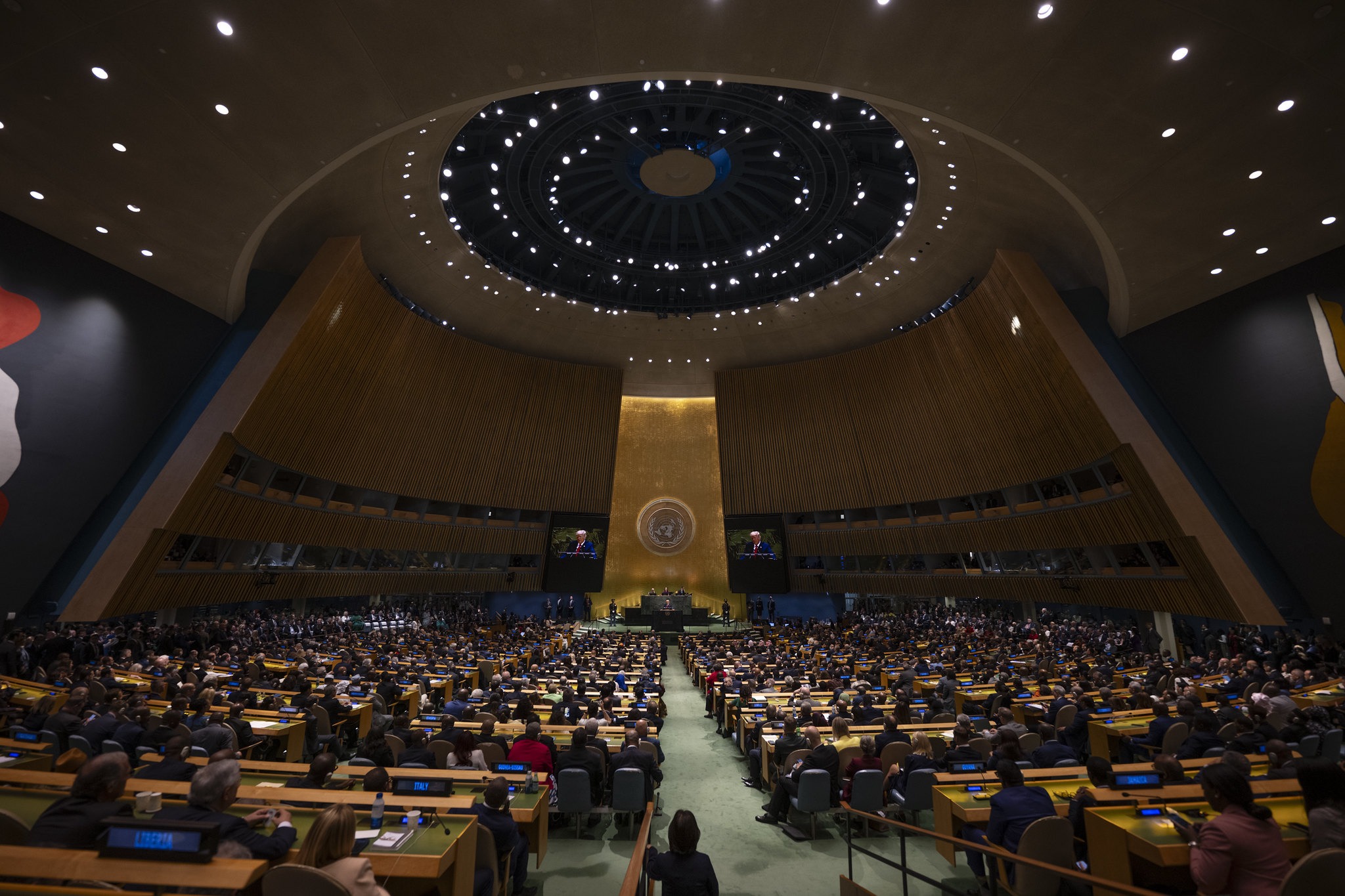
THE 81ST UN GENERAL ASSEMBLY AS A TEST OF TIME, POWER AND JUSTICE IN THE INTERNATIONAL ORDER

“The strength of justice is not measured by the size of the country it defends, but by the principle it upholds.”
The world’s largest diplomatic stage is open once again.
In New York, the general debate of the 81st session of the United Nations General Assembly is underway under a theme that reads almost like a question addressed to the entire international system:
“Restoring Trust, Managing Transformation: A United Nations That Delivers for All.”
The high-level debate is taking place from September 22 through September 28, 2026, bringing world leaders to UN Headquarters in New York.
But behind the diplomatic protocol lies a much larger question:
Can an organization created to safeguard international peace, security, human rights and the sovereign equality of states remain strong enough to protect those that do not possess the power to protect themselves?
That is the deeper test of the 81st session.
Because today’s world is not defined by war alone.
It is defined by military power, economic power, technological power, artificial intelligence, energy dependence, political conditionality and geopolitical pressure.
And that is precisely why Macedonia’s presence in New York should not be viewed merely as another item on the diplomatic calendar.
It is part of a much larger question:
What remains of the principle of sovereign equality when powerful states can impose conditions while smaller states are expected to absorb them?
THE UNITED NATIONS: FROM THE WARS OF THE STARS TO THE WAR OF INTELLIGENCE
Eight decades ago, the international community created an institution around a historic proposition: disputes between states should be resolved not through the force of arms, but through the force of law, diplomacy and international cooperation.
Today, that proposition is being tested again.
Wars continue.
Conflicts spread.
Civilians pay the price.
Climate change is generating new security risks, while artificial intelligence is raising questions that, only a decade ago, would have sounded like science fiction.
The President of the 81st General Assembly, Khalilur Rahman, has organized his programme around six interlocking pillars: peace and security; sustainable development; climate resilience; human rights and humanitarian protection; innovation and artificial intelligence; and renewed multilateralism.
UN Secretary-General António Guterres, meanwhile, has warned of deepening fractures in the international system, linking today’s crises to questions of power, war and peace, inequality, climate disruption and the technological revolution.
That is the real backdrop to New York in 2026.
And it is against that backdrop that the Macedonian question enters the conversation.
A SMALL STATE WITH AN UNUSUALLY HIGH TOLERANCE FOR PRESSURE
Macedonia has gone through a political experience that is difficult to compare with that of most European states.
Over the past decades, it has experienced changes to state symbols, constitutional amendments, a change of its constitutional name and a series of political conditions connected to its European path.
And this is where the fundamental question emerges:
Where does European integration end and bilateral conditionality begin?
That is not an anti-European question.
Quite the opposite.
It is a question about Europe itself.
If European integration is ultimately about the rule of law, predictability, equality and respect for states and their citizens, then those principles must also apply to candidate countries.
The European Council has reiterated in 2026 that the adoption of the agreed constitutional amendments remains the necessary next step toward formally opening accession negotiations.
But Prime Minister Hristijan Mickoski is raising a different question:
What happens if one concession is followed by another condition?
And that is where his diplomatic strategy becomes significant.
THE THIRD PARTY: CAN BRUSSELS SIT AT THE TABLE WITH SKOPJE AND SOFIA?
This is, in my view, the central point of the new Macedonian diplomatic approach.
Mickoski is not rejecting the European perspective.
He continues to affirm it.
What he is challenging is whether the European Union should remain merely the institution that sets the conditions, or whether it should also participate in defining and guaranteeing the framework within which those conditions are implemented.
The proposed formula is different from the traditional:
Skopje–Sofia.
It seeks to establish:
Skopje–Sofia–Brussels.
In other words, the European Union would have a place at the table.
Mickoski has argued that Macedonia is prepared to discuss the Action Plan concerning minority rights, but with international participation and a European representative present at the table.
That is more than a technical diplomatic proposal.
It is an attempt to place a bilateral dispute back inside a European institutional framework.
And here lies perhaps the most consequential element of the argument:
If the condition is European, should the process for fulfilling it not also have a European framework?
THE FIGHT IS NOT AGAINST EUROPE — BUT FOR A PREDICTABLE EUROPE
This is the essential distinction.
Mickoski’s message in New York is not that Macedonia is abandoning the European Union.
It is the opposite.
He continues to affirm the country’s commitment to European integration, reforms and alignment with European legislation.
At the same time, he is raising the question of whether the accession process can become a vehicle for resolving bilateral disputes that go beyond the substance of institutional reform.
That is a political position expressed by the prime minister.
But the question it raises is European in scope:
Can the enlargement process remain credible if the conditions attached to it are perceived as changing over time?
This is why the call for European involvement in the process carries additional weight.
The issue is not whether Macedonia should reform.
It is whether the rules governing the path to membership should be sufficiently clear that a candidate state knows what is required of it — and what it can reasonably expect in return.
BULGARIA: FROM A BILATERAL DISPUTE TO A EUROPEAN TEST
This is where Macedonia confronts the most sensitive part of its European story.
Bulgaria insists on implementation of the agreed framework and on the constitutional amendments that would include Bulgarians among the communities recognized in the Constitution.
European institutions have likewise identified the constitutional amendments as a condition for moving forward with the accession process.
Macedonia, however, is asking for something alongside the condition:
predictability.
That is the heart of its position.
The issue is not simply one parliamentary vote.
It is the larger question:
Will one concession be the final step — or will it become the basis for another demand?
That question cannot be resolved by political slogans.
It requires a mechanism.
It requires guarantees.
It requires a clear European framework.
And that is precisely why the idea of the EU becoming a third participant at the table has become one of the most consequential elements of Macedonia’s current diplomatic position.
WHAT ABOUT THE DOMESTIC POLITICAL BATTLE?
Here, New York connects directly to Skopje.
While the prime minister presents Macedonia’s position internationally, the opposition continues to argue that the constitutional amendments should be adopted.
SDSM leader Venko Filipche has publicly advocated the position that the constitutional amendments are necessary for the country’s European path.
That is a legitimate political position.
But the political conflict becomes substantive when one side argues:
“The EU must not become a pretext for additional bilateral conditions.”
While the other argues:
“Without constitutional amendments, there can be no progress toward European integration.”
The real answer should not be sought in insults.
Not in labels.
Not in declaring political opponents traitors.
It lies in a much simpler question:
What arrangement can preserve Macedonia’s European perspective while also providing a predictable framework for the country?
That is the strategic debate.
THE QUESTION OF “TREASON” MUST REMAIN LEGAL — NOT PARTISAN
This is where the analysis must remain particularly precise.
Macedonia’s Criminal Code contains the offence of high treason, but the existence of such a provision does not mean that every political decision with which someone disagrees can automatically be described as treason.
Article 305 sets out specific legal elements concerning the use of force or a serious threat and an attempt to alter the constitutional order or overthrow the highest state authorities.
The democratic question is therefore different:
Do institutions apply the law equally, regardless of who holds power?
That is a far more serious question than partisan name-calling.
And it points to another unfinished chapter in Macedonia’s democratic development:
accountability cannot depend on political affiliation.
FROM “WAITING” TO “BUILDING”
The strongest element of Mickoski’s message is not simply his criticism of conditionality.
It is the second part of his argument:
Macedonia is not waiting with folded arms.
The government’s strategy links European integration with the country’s strategic partnership with the United States, NATO, energy security, infrastructure and economic development.
Energy infrastructure, including interconnections with neighbouring countries, is presented as part of a broader effort to position Macedonia as a regional energy and transport crossroads.
The strategic importance of Corridors VIII and X is similarly framed as an asset.
Energy becomes security.
Infrastructure becomes geopolitics.
And economic capacity becomes diplomatic capital.
That is a fundamentally different concept from Macedonia as a country whose only objective is to have the next door opened.
The message is:
Macedonia wants to be a partner.
AMERICA, NATO AND EUROPE: THREE ADDRESSES, ONE STRATEGIC FRAMEWORK
Washington is not a random element in this equation.
Mickoski has sought to connect Macedonia’s strategic partnership with the United States to NATO, energy, critical minerals, defence and infrastructure.
This reflects a broader geopolitical reality in which smaller states can no longer afford to rely on a single institutional framework.
Macedonia is therefore attempting to widen its strategic space:
Europe — as the strategic destination.
America — as a strategic partner.
NATO — as the security pillar.
The United Nations — as the universal diplomatic platform.
And at the centre of all four:
Macedonia.
AND HERE THE REAL BATTLE BEGINS
The question is not whether Macedonia is “for” or “against” Europe.
That debate is already politically settled at the level of the country’s declared strategic objective.
European integration remains the state’s official strategic goal.
The real question is:
UNDER WHAT CONDITIONS?
Will membership be a process of institutional reform?
Will the conditions be clearly defined in advance?
Can bilateral disputes repeatedly alter the European horizon?
Will the EU merely demand compliance, or will it also help guarantee predictability?
And, ultimately:
Who guarantees that the final concession will actually be the final concession?
This is where Mickoski is attempting to move the diplomatic ball.
Not by saying:
“We do not want Europe.”
But by saying:
“We want Europe — but we also want to know the rules by which the game is being played.”
THE 81ST GENERAL ASSEMBLY AS A MIRROR
In New York, the great powers speak about war.
About peace.
About artificial intelligence.
About climate change.
About a new distribution of global power.
And a small European state is asking an old but fundamental question:
Are the rules the same for everyone?
That may be the ultimate test of any international order.
If law applies only to the powerful, it ceases to be law.
If principles apply only to the strong, they cease to be principles.
And if smaller states are expected to place their trust in the system, they have a legitimate interest in demanding predictability from that system.
That is why Macedonia’s position in New York should be read as something larger than the daily contest of domestic party politics.
It is part of a broader dilemma:
How can a small state preserve its European future while defending its political, constitutional and national space?
There will be no easy answer.
But that is precisely why diplomacy matters.
FILIPCHE AND MICKOSKI: TWO POLITICAL STRATEGIES BEFORE ONE STATE
The domestic disagreement should not be concealed.
One position argues that the constitutional step should be taken in order to preserve momentum toward the European Union.
The other argues that without a clear and predictable European mechanism, every additional concession risks opening the door to another demand.
This is not a dispute that should be settled through political insults.
It is a dispute over strategy.
And that is precisely why the proposal for the EU to become a third participant matters.
If Brussels has a role in defining the European path, then Brussels also has a natural institutional interest in ensuring that the process remains predictable, verifiable and credible.
MACEDONIA IS NOT ASKING FOR A SHORTER ROAD — IT IS ASKING FOR RULES ALONG THE ROAD
This may be the most precise formulation of the entire argument emerging from New York.
Not:
“Give us membership without reforms.”
But:
“Give us a fair process, clear rules and a predictable framework.”
That is the essence of the message Mickoski is advancing.
And such a formula can ultimately be tested only through institutions.
Brussels.
Sofia.
Skopje.
And, finally:
The Parliament of Macedonia.
FINALE: FROM NEW YORK TO SKOPJE
The 81st session of the United Nations General Assembly is unfolding against the backdrop of a world that is losing confidence in some of the rules that once appeared settled.
Wars are testing peace.
Artificial intelligence is testing humanity’s capacity to govern technological power.
Climate change is testing the ability of nations to act collectively.
Great powers are testing multilateralism.
And smaller states are testing the principle of sovereign equality.
In such a world, Macedonia has a right to speak.
But more importantly, it has an obligation to speak wisely, precisely and with the language of statecraft.
Not with anger.
Not with fear.
Not with hatred.
But with documents, arguments, diplomacy and a clearly articulated national position.
That is why the proposal that the European Union should sit at the table as a third participant between Macedonia and Bulgaria carries significance beyond the immediate political dispute.
It is, fundamentally, a demand that the European process itself provide a European framework for predictability.
Whether Brussels will accept such a model remains an open political question.
But until that question is answered, Macedonia has something else it can do:
It can refuse to stand still.
It can pursue reforms.
Build its economy.
Strengthen its energy security.
Develop its strategic corridors.
Deepen its alliances.
And, in every European and international forum, continue to ask the same fundamental question:
“If Europe is a community of rules, then show us the rules that apply equally to all.”
That is the question coming out of New York.
But it is also the question facing Macedonia’s future.
Not whether it will move toward Europe.
But how it will get there — under what rules, with what guarantees, and with what measure of national dignity.
