

By M-r Slobodan TOMIC

“The greatest glory in living lies not in never falling, but in rising every time we fall.” – Nelson Mandela
There are professions without which modern medicine simply cannot function, yet the public often notices them only when it needs them.
The radiological technologist is one of them.
We encounter these professionals in X-ray departments, computed tomography, mammography, angiography and magnetic resonance imaging. We see them beside sophisticated equipment, yet we rarely stop to ask:
Who is the person behind the machine?
Under what conditions does that person work?
What responsibility do they carry?
What professional risks do they assume?
And who protects them?
As a patient who has relied on the services of radiological technologists for years, I feel a responsibility to say this publicly:
THE RADIOLOGICAL TECHNOLOGIST IS NOT AN INVISIBLE PERSON.
VEDRIT IBUSHOSKI OPENED THE DOOR
Before I continue, I made a promise that I would not stop at a single story.
Today, I am keeping that promise.
Because behind every image, every diagnosis and every therapeutic decision lies a larger story—the story of the people who stand every day on the front line of the struggle against disease.
Today, I want to introduce the place where that struggle takes place every day:
The Public Health Institution University Clinic for Radiotherapy and Oncology — Skopje.
This is where medicine confronts some of the most dangerous shadows that can enter a human life.
The shadows of fear.
The shadows of uncertainty.
The shadows of danger.
And their name is one of the most difficult words a human being can ever hear:
cancer.
But where disease brings fear, medicine must bring knowledge.
Where uncertainty brings silence, the physician must bring an answer.
Where a human being sees danger, the team must bring the determination to fight.
And this is precisely where the two stories I am bringing together today meet:
the radiological technologist and the oncology team.
One creates the image.
Another interprets the disease.
A third determines the treatment.
And the patient—the human being for whom the entire system exists—faces the hardest battle of all.
VEDRIT IBUSHOSKI OPENED THE DOOR — BUT HUNDREDS OF PROFESSIONALS STAND BEHIND IT
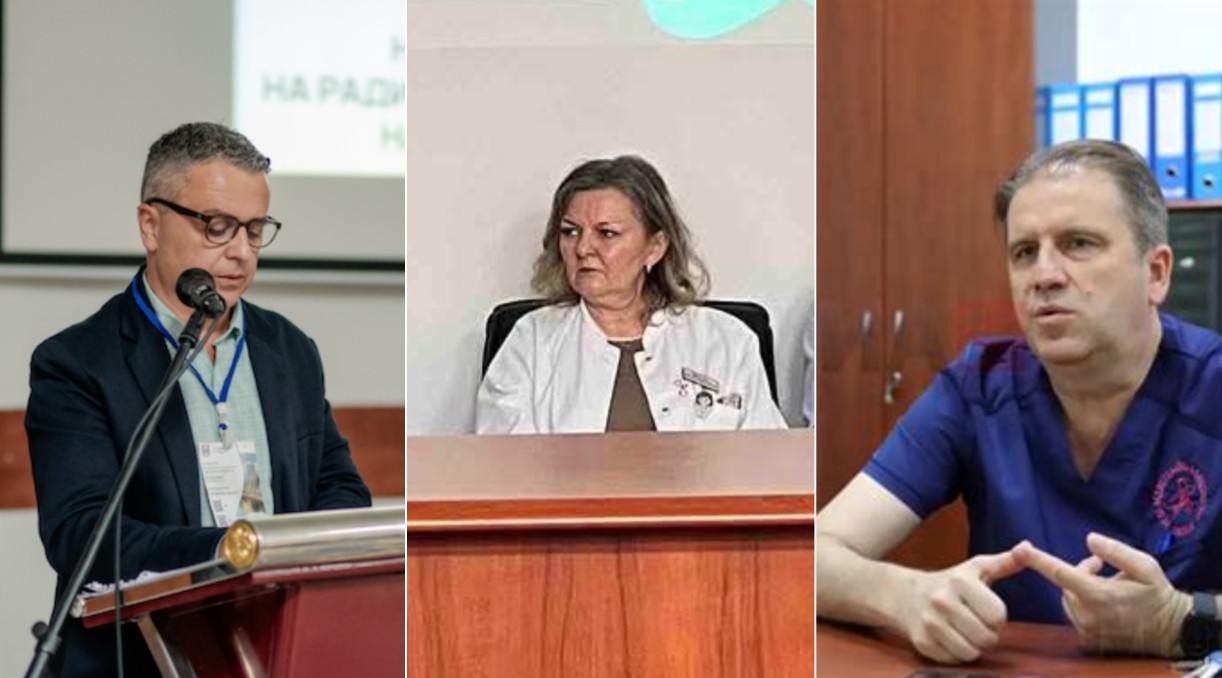
The appearance of Vedrit Ibushoski, President of the Association of Radiological Technologists of Macedonia, on the television programme Tema na Denot on TV Sitel brought into the public arena a question that has been pushed into the background for far too long.
And today, 23 September 2026, that question has been given another public platform.
This is not merely a question about one profession.
It is a question about the people on whom diagnosis, medical treatment and patient safety depend every day.
Approximately 200 professionals gathered at the Association’s 12th Congress in Struga.
That is an indication of a serious professional community, a commitment to education, experience and continuous development.
But there is something even more important.
Ibushoski emphasized cooperation with the Macedonian Association of Radiologists, the Macedonian Association of Radiation Oncology Therapists and specialists in nuclear medicine.
That is the true picture of contemporary medicine:
not isolated professions, but one multidisciplinary team.
The modern radiological technologist is not someone who merely “stands beside a machine.”
Behind every high-quality image stand knowledge, concentration, experience and professional responsibility.
Proper patient preparation, selection of the appropriate procedure, positioning, adherence to protocols and the delivery of high-quality medical care.
The equipment may cost millions.
But the machine does not work by itself.
It is the human being who gives the machine its medical value.
WHEN THE RADIOLOGICAL TECHNOLOGIST AND THE ONCOLOGIST MEET IN THE SAME BATTLE
This is where I want to say something from personal experience.
As an oncology patient, I know that the fight against cancer is not the work of one person.
No one can do it alone.
There is no single physician who can carry the entire weight of an oncology diagnosis alone.
It takes a team.
It takes knowledge.
It takes technology.
It takes diagnostics.
It takes monitoring.
It takes treatment.
And perhaps most importantly of all, it takes trust.
In my own battle, a special place belongs to my primary oncologist, Prim. Dr. Vita Stojmenova.
I am not saying this as an advertisement.
I am saying it as a patient.
My health is in her hands.
Her professional judgment forms part of my medical battle.
And when a person enters the world of oncology, they begin to understand that a physician is not simply a person in a white coat.
The physician becomes the person to whom you entrust the most precious thing you possess:
your life.
That is why I want the name of Vita Stojmenova to stand in this story with respect.
As the name of a physician who has a special place in my own struggle.
And not merely because she is my primary oncologist.
But because, for a patient, the oncologist becomes one of the most important people during one of the most difficult periods of life.
VITA STOJMENOVA — THE PHYSICIAN BEHIND THE DIFFICULT DECISIONS
Oncology is not a medicine of easy answers.
Here, a result is not merely a number.
An image is not merely a picture.
A laboratory result is not merely a value.
Every result can open a new question, and every question may require a new medical decision.
That is why an oncologist must have knowledge, experience, vigilance and the ability to guide a patient through a long and demanding process.
In my case, that trust is connected to Dr. Vita Stojmenova.
And that is why today I want to say publicly:
Thank you, Doctor.
Not only for the treatment.
Not only for the medical documentation.
Not only for the examinations and follow-up.
But also for remembering that behind every medical result there is a human being, not merely a diagnosis.
That is the difference between medicine as a procedure and medicine as a profession devoted to the human being.
IGOR STOJKOVSKI — RESPONSIBILITY AT THE HELM OF THE CLINIC
In this story, I cannot—and do not want to—overlook the person who carries institutional responsibility at the head of the Clinic.
Prof. Dr. Igor Stojkovski, Director of the Public Health Institution University Clinic for Radiotherapy and Oncology — Skopje.
The Clinic’s official website identifies him as its director and also lists him as Head of the Department for Malignant Tumours of the Central Nervous System, Bone Tumours and Skin Cancer.
The Clinic officially describes its work as providing long-standing treatment for patients with malignant diseases, while continuously renewing its technologies and knowledge through training, seminars and congresses.
That matters.
Because oncology cannot afford to live in the past.
Cancer changes.
Medicine advances.
Technology advances.
Therapies advance.
And the system must be capable of keeping pace with that development.
Prof. Dr. Igor Stojkovski carries responsibility for an institution in which all these professions meet.
And this is where I see the larger picture:
The director carries the institution, the oncologist follows the patient, the radiological technologist carries the technology, and the entire team carries the fight.
TWO PHYSICIANS — ONE TEAM
In my personal experience, Dr. Vita Stojmenova and Prof. Dr. Igor Stojkovski represent two different, yet interconnected, faces of the same medical responsibility.
One side is the immediate relationship with the patient.
The other is responsibility for the institution and the team.
One perspective is focused on the individual human being.
The other encompasses the system as a whole.
But the objective is the same:
that the patient should never be left alone in the face of disease.
That is perhaps the most powerful metaphor for a modern oncology clinic.
It is not one person.
It is not one machine.
It is not one therapy.
It is an orchestra.
Every instrument has its own sound.
But music is created only when they play together.
That is what a medical team should be.
And at the centre of that orchestra is not the director.
It is not the physician.
It is not the technologist.
At the centre is the patient.
MEDICINE IS EVOLVING. HAS THE SYSTEM KEPT PACE?
Today, the profession also has a higher-education dimension.
In Macedonia, there is an academic programme for qualified radiological technologists—radiographers.
Medicine has changed.
Technology has changed.
Responsibility has increased.
The question is:
Has the system kept pace with that development?
RADIATION MUST BE MEASURED — NOT MINIMISED
In workplaces involving occupational exposure to ionizing radiation, risk must be assessed, measured, monitored and controlled.
That is why the discussion of the professional status of radiological technologists cannot be reduced to administrative formulations.
It must be grounded in facts.
What is the level of exposure?
What do the dosimetric data show?
Which workplaces involve occupational risk?
Under what conditions and shift patterns do professionals work?
What level of professional responsibility do they carry?
What does contemporary scientific and professional knowledge tell us about long-term risk?
Only then can we have a serious discussion about the status of a particular workplace.
ENHANCED SERVICE CREDIT MUST NOT BE A TABOO SUBJECT
This is one of the most sensitive questions.
For years, different accounts have circulated publicly about when and how the status of radiological technologists has changed.
But precision is essential here.
We should not accuse anyone without documentation.
We should ask for the document.
Which act changed the status?
When was the change made?
Who made the decision?
What professional assessment was it based on?
And what do current data show about the risk?
Enhanced service credit should not be a political gift.
But neither should professional risk be administratively erased without a scientific and professional basis.
If the conditions have changed, let the evidence demonstrate it.
If the risk remains, let the evidence demonstrate that as well.
LET PROFESSIONAL EXPERTISE DECIDE — NOT ASSUMPTION
THIS IS NOT ONLY A LABOUR-RIGHTS ISSUE
The question of the radiological technologist is not merely a question of salary, employment status or retirement.
It is also a question of the patient.
When a patient enters a CT scanner, an X-ray room, a mammography unit or another procedure, that patient expects the professional standing before them to be properly trained, focused, rested and protected.
Therefore:
PROTECTING THE RADIOLOGICAL TECHNOLOGIST ALSO MEANS PROTECTING THE PATIENT.
If we want a safe healthcare system, we must also care for the people who carry that system on their shoulders.
FROM THE RADIOLOGICAL IMAGE TO THE ONCOLOGICAL DECISION
This brings us back to the heart of the matter.
The radiological technologist does not stand on one side of medicine while the oncologist stands on the other.
They are parts of the same process.
An image may be one of the key elements in medical assessment.
Medical assessment may lead to a diagnostic or therapeutic decision.
Treatment requires monitoring.
Monitoring, in turn, requires further diagnostics.
And the cycle continues.
That is why modern medicine is team medicine.
The Association of Radiological Technologists itself reflects this reality through cooperation with radiologists, radiation oncologists and specialists in nuclear medicine.
That is the bridge I want to build through this analysis.
From Vedrit Ibushoski to Vita Stojmenova.
From the radiological technologist to the oncologist.
From the machine to the diagnosis.
From the diagnosis to the treatment.
From the treatment to hope.
MY INSTITUTIONAL PLAN
This issue must not end with a statement before a television camera.
I call on the competent institutions to initiate a formal process and provide a clear, professional and publicly verifiable answer.
- A COMPLETE REVIEW OF THE DOCUMENTATION
The competent institutions should publish and systematize:
— all existing acts regulating the status of radiological technologists;
— the dates and reasons for the changes;
— the workplaces covered by those acts;
— the professional assessments on which the decisions were based;
— the current status under applicable regulations.
No political interpretations.
Documents. - AN INDEPENDENT PROFESSIONAL ASSESSMENT
An independent commission should be established, bringing together representatives of radiological technologists, radiologists, medical physicists, radiation-protection specialists, occupational-medicine experts, academia and the competent institutions.
The commission should examine the actual conditions of the workplaces and prepare a professional report.
Not as a formality.
But on the basis of measurable data. - DOSIMETRIC DATA
Actual occupational-exposure data should be analysed by workplace and by type of work.
It should be established where the risk is greatest and whether differences exist between different workplaces and modalities.
What can be measured must be measured. - A NEW CLASSIFICATION WHERE JUSTIFIED
If professional analysis demonstrates that certain workplaces meet the requirements for enhanced service credit, the institutions should act in accordance with the applicable legal procedure.
Not as a favour.
But as a systemic solution based on risk and professional criteria. - CONTINUOUS MONITORING
Regular assessments should be introduced covering working conditions, dosimetric data, protective equipment and professional standards.
This issue must not be reopened only after another decade has passed. - A PUBLIC ANSWER AND A CLEAR DEADLINE
The competent institutions should publish:
— what has been established;
— what the professional assessment shows;
— what will be changed;
— within what timeframe action will be taken.
Not a promise.
Not a political message.
But a concrete document, a decision and a deadline for implementation
TO VEDRIT IBUSHOSKI — A GREAT THANK YOU
As a journalist, I have the right to ask questions.
As a patient, I have the right to seek answers.
But as a human being, I also have an obligation to say:
Thank you.
To all radiological technologists who work every day with patients who arrive frightened, anxious and uncertain about what lies ahead.
With children.
With older people.
With emergency cases.
With seriously ill patients.
With oncology patients.
You are there when people need professionalism, concentration and humanity most.
And that is why the voice raised by Vedrit Ibushoski deserves to be heard.
Not because he is asking for something only for himself.
But because he has opened a question concerning an entire profession.
And because behind that profession stand human beings.
People who work every day with technology, while every day confronting the very human reality of fear.
WHO PROTECTS THE PEOPLE WHO PROTECT US?
That is the question.
We are not asking for privilege for one profession. We are asking the system to measure reality.
We are not asking for a political decision.
We are asking for a professional decision.
We are not asking for a gift.
We are asking for documentation, analysis and clear criteria.
Because if the risk exists, it must be acknowledged.
If it does not, the evidence should demonstrate why.
But the worst possible outcome is to have neither analysis nor an answer.
And that is precisely why I would add the sentence that captures the essence of this entire initiative:
Because a profession entrusted with protecting patient safety deserves a system that protects its own safety.
That is not a demand for privilege.
It is a demand for responsibility, evidence and fairness.
Because the safety of patients and the safety of the professionals who care for them are not competing interests.
They are part of the same responsibility for healthcare.
BEHIND EVERY IMAGE, THERE IS A HUMAN BEING
Behind every image stands a person.
Behind every medical procedure stands a professional.
Behind every machine stands knowledge, and behind every healthcare worker there must be a system that protects them.
The radiological technologist is not auxiliary staff.
The radiological technologist is part of medical safety.
Not invisible.
Not unimportant.
And not to be forgotten.
This is their profession.
This is their dignity.
But above all, this is also about our health.
BEHIND THE RADIOLOGICAL TECHNOLOGIST STANDS AN ENTIRE MEDICAL ARMY
When the patient leaves the radiology room, the story does not end.
Quite the opposite.
It continues with the physicians.
With specialists.
With oncologists.
With radiation oncologists.
With medical physicists.
With nurses.
With pharmacists.
With the entire team.
And that is precisely why we must not separate these professions.
We must connect them.
Vedrit Ibushoski is speaking today about the dignity and safety of radiological technologists.
I, as a patient, know where their work ends and where my next medical decision begins.
And that is precisely where I see the beauty of modern medicine:
one person creates the image, another interprets it, a third determines the treatment, and together they help restore hope to the patient.
TO VITA STOJMENOVA AND IGOR STOJKOVSKI
And finally, I want to say something personal.
To Prim. Dr. Vita Stojmenova, my primary oncologist:
Thank you for seeing a patient, rather than merely a diagnosis, in front of you during the most difficult medical battle of my life.
My health is in your hands.
And that is precisely why every word spoken by a physician carries a weight that someone who has never experienced an oncological battle can hardly understand.
And to Prof. Dr. Igor Stojkovski, Director of the Public Health Institution University Clinic for Radiotherapy and Oncology:
Thank you for carrying responsibility for an institution whose doors are entered every day by people confronting perhaps the greatest fear a human being can face.
The Clinic officially emphasizes the importance of keeping pace with modern technologies, knowledge, training and the professional development of its staff, and I would add:
the greatest value of a clinic lies not only in the machines it possesses, but in the people who know how to turn those machines into an opportunity for the patient.
That is why, to me, Vita Stojmenova and Igor Stojkovski represent two important pillars within a much broader story of team-based medicine.
Not alone.
But together with the entire medical team.
And together with all the radiological technologists who stand on the front line of diagnosis and treatment.
ONE CLINIC. ONE TEAM. ONE BATTLE.
Cancer does not ask who you are.
It does not ask where you come from.
It does not ask what you do for a living.
It does not ask whose door it will knock on.
But medicine must never distinguish between human beings when it comes to human dignity and professional care.
When a patient enters an oncology clinic, that patient should not have to ask about political affiliation.
The patient should be looking for a physician.
For expertise.
For treatment based on medical indication.
For a team.
And for the assurance that an entire system of professionals stands behind them.
That is the meaning of modern healthcare.
Not the party.
Not privilege.
Not connections.
But medicine.
And therefore, if we truly want to speak about a modern Macedonia, we must also speak about modern healthcare.
About contemporary therapies.
About modern diagnostics.
About modern radiotherapy.
About radiological technologies.
About professionals who continually educate themselves and advance their expertise.
And about a system in which the patient is the priority.
THE RADIOLOGICAL TECHNOLOGIST IS NOT AN INVISIBLE PERSON
The radiological technologist is one of the people without whom modern healthcare cannot function, and a state that sees the machine but fails to see the person behind it sees only half of its own healthcare system.
They are not asking for privilege.
They are asking for fairness.
They are not asking for praise.
They are asking for recognition of professional responsibility.
They are not asking to stand above other healthcare professions.
They are asking to be recognized as part of the same team.
And I would end this story with one thought:
“In medicine, the most powerful instrument is not the machine. The most powerful instrument is the human being who knows how to use it to help another human being.”
And therefore:
Vedrit Ibushoski opened the door.
The radiological technologists stand behind it.
The oncologists carry the battle forward.
And the patient is the reason they all exist.
That is the real team.
That is genuine cooperation.
That is medicine.
And medicine must never be invisible.
“We are not asking for privilege for one profession. We are asking the system to measure reality.”
“Because a profession entrusted with protecting patient safety deserves a system that protects its own safety.”
m-r Slobodan TOMIC
Analyst and publicist
Author of the political television magazine “The Voice of the People”
