

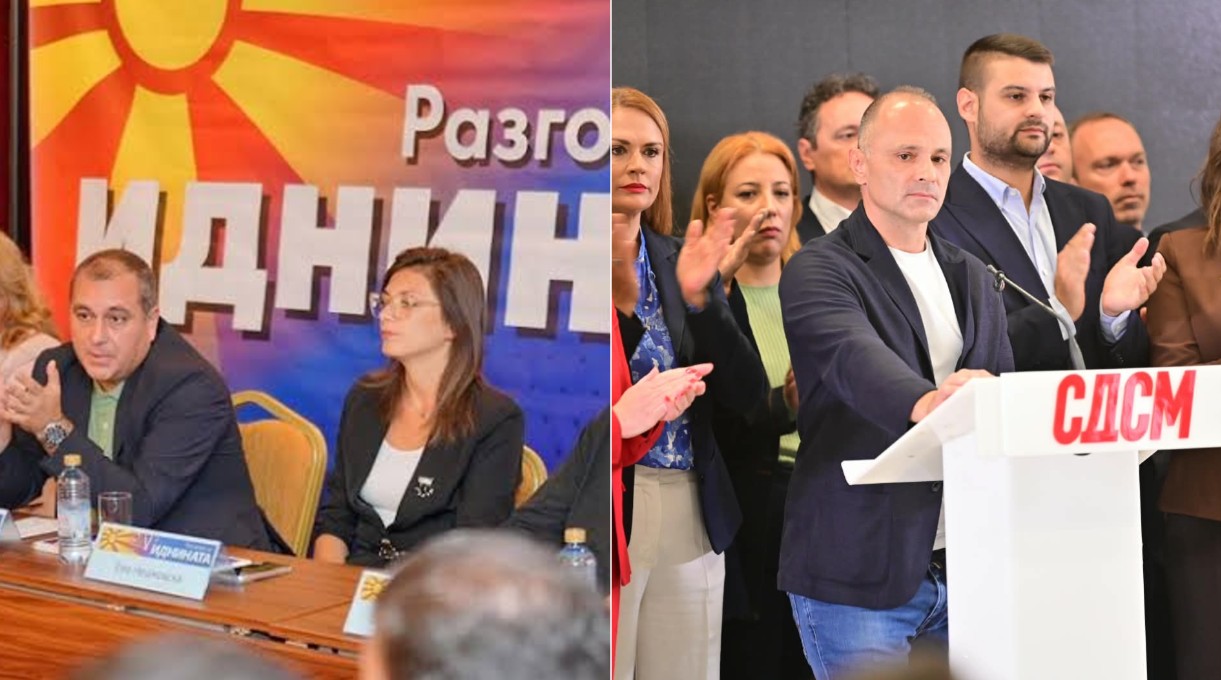
When the war inside SDSM stops being an internal party dispute and becomes a battle over who will write the future of the opposition
By M.Sc. Slobodan TOMIC, political analyst and commentator

A political earthquake does not always begin in parliament.
Sometimes it begins inside the house itself.
And when that house is SDSM, its internal fractures are no longer merely an affair of party politics. They become part of the broader political architecture of Macedonia.
What is unfolding today between Bihaćka Street and the “Conversations for the Future at 12:05” platform ceased long ago to be an ordinary internal party dispute.
This is now a political battle over the interpretation of the past, control of the present, and the future of the opposition space.
On one side stands the current leadership of SDSM, headed by Venko Filipche.
On the other are those gathered around “12:05,” speaking of reform, consolidation and a new political agreement.
And each side argues that the other is the problem.
That is the essence of:
KRAMER VS. KRAMER
BIHAĆKA VS. 12:05
Venko Filipche’s press conferences on September 27 raised the internal conflict to a new level.
Filipche used exceptionally harsh language. He described people around the initiative as “schemers,” “putschists” and “gravediggers,” while portraying the process as a “VMRO scheme” and claiming that they would make “a pact with the devil” for personal interests. He also linked the current developments to earlier divisions within SDSM, the formation of ZNAM, alleged attempts at a putsch and the “Racket” affair.
Filipche further argued that some of those gathered around “12:05” had been part of SDSM structures until 2024 and that their actions had contributed, in his assessment, to the party’s decline in support. He specifically cited the Criminal Code amendments, the political role of Artan Grubi and the French proposal as examples of political mistakes.
But this raises a simple journalistic question:
Where does political criticism end and political disqualification begin?
Because “putschist,” “schemer,” “gravedigger,” “paid operative” or “satellite” are political labels.
They are not evidence in themselves.
And that is precisely where the real analysis begins.
WHEN THE INTERNAL OPPONENT BECOMES THE “ENEMY”
A political party can survive different opinions.
It can survive factions.
It can survive criticism.
It can survive defeats.
What is much harder to survive is the moment when every internal critic becomes an enemy.
When disagreement becomes a putsch.
When a different opinion becomes a scheme.
When political dialogue with another party becomes evidence of betrayal.
At that point, the party is no longer looking into its own mirror.
It begins to smash it.
AND WHAT DOES “12:05” SAY?
The “Conversations for the Future at 12:05” platform presents the story in entirely different terms.
From its perspective, the problem lies with the current SDSM leadership, while the proposed remedy is reform, consolidation and broader opposition cooperation.
The platform has opened discussions on the political system, the electoral model, emigration, economic inequality, the European perspective and the need for a new social contract.
The proposal for a single electoral constituency, followed by open lists, moves the debate from the level of an internal party quarrel toward concrete institutional ideas.
But that is precisely where its test begins.
It is not enough to say that the old system does not work.
You must show what comes after it.
“12:05” — FIVE MINUTES PAST MIDNIGHT
The name is not accidental.
Five minutes past midnight.
A symbol of the end of one day and the beginning of another.
But politics does not change because of a clock.
It changes through trust.
Organization.
Ideas.
People.
Elections.
That is why “12:05” now faces its greatest challenge:
Will it remain a platform for dissatisfaction, or become a political project?
That is the difference between rebellion and politics.
THE LEFT ENTERS THE STORY
And then Levica enters the picture.
The presence of a representative of Levica at the platform gave Filipche a new political argument.
He invoked Levica’s positions on Russia, China and NATO as evidence, in his view, that “12:05” was entering a political space incompatible with the value framework represented by SDSM. He also portrayed the gathering as part of a broader effort to divert attention away from SDSM’s criticism of the government.
But here too, a distinction must be made.
A conversation is not a coalition.
Attendance at a public forum is not a coalition agreement.
Dialogue is not automatically a political alliance.
At the same time, there are significant political differences between SDSM and Levica.
That makes the episode politically relevant.
But it does not, by itself, prove the existence of any “secret scheme.”
KRAMER VS. KRAMER — WHAT IS SDSM?
And here we reach the heart of the matter.
The question is not:
Who leads SDSM today?
The deeper question is:
What does SDSM mean today?
Is SDSM its current leadership?
Its membership?
Its historical tradition?
Its policies?
Its electoral record?
Or all of these together?
Filipche says he took over SDSM in one of the most difficult periods in its history and is working to consolidate it.
“12:05” presents the crisis as a consequence of the political model of the current leadership.
There is Kramer.
One side says:
“We are saving the party.”
The other says:
“You have captured the party.”
Both cannot be right at the same time.
But the answer cannot be settled at a press conference.
It will be settled by the membership.
And ultimately — by the citizens.
NOW — AN UNCOMFORTABLE PIECE OF POLITICAL HISTORY
When NATO is invoked today as a stamp of political legitimacy, history comes knocking again.
The Kosovo crisis.
NATO’s intervention against the Federal Republic of Yugoslavia.
Milošević.
Belgrade.
Macedonia caught in a dramatic regional fault line.
And a Macedonia deeply divided over NATO and its relationship with Belgrade.
The political imagery of that period also preserved the scene described as a symbolic “funeral for NATO” — a coffin bearing the word “NATO” thrown into the Vardar River.
If that historical image is invoked today as evidence of the political attitudes of that period, it should be supported by archival footage or a verified photograph.
But the broader political reality remains:
Political positions changed over the years.
History must not be airbrushed.
FROM MILOŠEVIĆ TO BRUSSELS
This opens a broader historical question.
During the Milošević era, Macedonian politics was marked by complex and intense divisions over Belgrade, Kosovo and NATO.
It is therefore easy today to say:
“We are NATO.”
But history asks another question:
Since when?
And, more importantly:
Where did everyone stand when NATO was one of the great political tests of the Balkans?
This is not a call to turn back.
It is a call not to forget.
Because political memory is not Photoshop.
FILIPCHE AND THE POLITICAL BIOGRAPHY
There is another uncomfortable point.
Venko Filipche became Minister of Health in 2017 after previously serving as an adviser to Nikola Todorov.
That is part of his public biography.
It is not evidence that he was a member of VMRO-DPMNE.
But it is a fact that, before entering ministerial office, his professional career included an advisory role during the period when Todorov was minister.
That raises a sharp but fair question:
If political contacts with another party are now used as evidence of political “impurity,” should the same standard apply to everyone?
This is not about whether someone was entitled to serve as an adviser.
Of course they were.
The issue is the double standard.
And the double standard is one of the most dangerous weapons in politics.
ŠEKERINSKA — FROM DOMESTIC POLITICS TO A TOP NATO POSITION
And then we come to Radmila Šekerinska.
The facts here are clear.
Šekerinska assumed the position of NATO Deputy Secretary General on December 2, 2024. NATO identifies her previous roles as Deputy Prime Minister and Minister of Defence and highlights her involvement in the processes surrounding Macedonia’s accession to the Alliance. NATO also states that she contributed to mediation efforts surrounding the Ohrid, Pržino and Prespa agreements.
And precisely because of that, the political question becomes more interesting:
How does political capital accumulated through domestic and international processes translate into an international institutional position?
The answer should not be speculation.
There should be no claim that any position was a “paid service” without evidence.
But the political trajectory can be examined.
From Prespa to NATO.
From domestic politics to one of the Alliance’s highest political offices.
That is a fact.
Political assessments of the significance of that trajectory may differ.
THE PEOPLE AND THE THREE AGREEMENTS
And here we arrive at an even more fundamental question:
Where was the direct expression of popular will?
There was no referendum in which citizens directly approved or rejected the Ohrid Agreement.
There was no such referendum on the Pržino Agreement either.
The Prespa Agreement was followed by a consultative referendum in 2018.
Turnout was 36.89 percent, while 94.18 percent of those who voted supported the referendum question.
The referendum did not reach the statutory turnout threshold.
That is why a clear distinction must be made between an institutional political decision and the direct expression of popular will.
They are two different categories.
Institutions have the authority to make political decisions within their constitutional and legal powers.
But political criticism of those decisions is equally legitimate.
MICKOSKI — THE THIRD ACTOR
And then comes Hristijan Mickoski.
Not by directly entering the battle.
But through distance.
Mickoski says he does not want to interfere in SDSM’s internal affairs.
At the same time, he emphasizes the need for a strong opposition and rejects the argument that citizens support the government simply because they have no alternative.
This opens a broader political question.
In a democracy, the citizen is not a statistic in someone else’s political narrative.
If someone says:
“They vote for them because they have no other choice,”
then the citizen is being portrayed as a person without independent political agency.
But strong government also requires strong political competition.
Not because the opposition should be protected from criticism.
But because democracy requires competition, scrutiny and the possibility of political change.
MICKOSKI AND “12:05” — IS THERE A THIRD STORY?
Here lies the interesting political contradiction.
Filipche says:
Mickoski is sending them.
Mickoski says:
I am not interfering.
Filipche says:
This is a VMRO scheme.
“12:05” says:
This is an effort to reform the opposition.
And so the most important question remains:
Where is the evidence?
In politics, an accusation is not evidence.
Suspicion is not evidence.
But denial alone is not evidence either.
That is why citizens must look at facts, not merely political labels.
WAR INSIDE THE HOUSE
The broader picture is now visible.
Filipche against “12:05.”
“12:05” against Filipche.
Former officials against the current leadership.
The current leadership against former officials.
Levica as a new element in the conversation.
Mickoski as an actor who says he does not want to interfere.
And citizens watching the entire spectacle.
But this is not theatre.
This is a political party with historic weight.
And that is why the question is painful:
What remains of political substance when a party begins describing its own people as putschists, schemers, captors, gravediggers and VMRO proxies?
When members of the same political family begin stripping one another of legitimacy, the problem is no longer simply who will lead the party.
The problem becomes:
Does the party itself know where it is going?
YOU CANNOT BUILD AN OPPOSITION FRONT ON “AGAINST” ALONE
This must also be said.
A new opposition cannot be built simply around:
“Against Mickoski.”
Nor around:
“Against Filipche.”
Nor:
“Against Bihaćka.”
Nor:
“Against 12:05.”
A political alternative needs an economic programme, a clear European policy, institutional reforms, an answer to emigration, policies for young people, a credible anti-corruption agenda, electoral reform, social policy and a clear answer to one fundamental question:
What kind of Macedonia do we want?
Without that, every new front will simply be the old quarrel under a new name.
SDSM BEFORE THE MIRROR
That is why SDSM now stands before a mirror.
Not merely Filipche.
Not merely “12:05.”
The entire party.
The mirror asks uncomfortable questions:
Who is responsible for the defeats?
Who is responsible for the loss of public trust?
Who has the confidence of the membership?
Who has the confidence of the citizens?
Who has a new political vision?
And who has the strength to admit mistakes?
Those are the questions that will shape the future.
Not today’s insults.
KRAMER VS. KRAMER — BUT WHO IS THE THIRD ACT?
Perhaps the most interesting actor in this drama is not Filipche.
It is not “12:05.”
It is not even Mickoski.
It is time.
Time will show whether “12:05” becomes a serious political factor.
Time will show whether Filipche succeeds in consolidating SDSM.
Time will show whether a broader opposition front emerges.
And time will show whether today’s conflict marks the beginning of a new political architecture or merely another episode in the long history of internal divisions within Macedonia’s opposition.
IF “12:05” WINS — IT WILL HAVE TO ANSWER ONE UNCOMFORTABLE QUESTION
But let us take the argument one step further.
Suppose the faction around “12:05” ultimately takes control of the political initiative within SDSM.
Then comes the hardest part.
What will it do with its own political inheritance?
Will it establish a clear political distance from the decisions and governing model of the Zaev era?
Will it seriously reassess the decisions that defined that period?
Will it accept responsibility for its own participation in policies that it now criticizes?
Or will Macedonia witness yet another version of:
Same old story, different faces?
Change the people.
Change the positions.
Change the rhetoric.
And leave the political model untouched.
Then there is no new SDSM.
There is only the old SDSM with new leadership.
Therefore, if change ever comes, the real test will not be:
Who takes the chair at Bihaćka?
It will be:
What will they change once they get there?
SDSM will have to find the strength to build new policies in the interests of Macedonia — policies based on a clear vision, institutional accountability and political principles.
It will have to confront the question of responsibility.
Not as revenge.
Not as a witch hunt.
But as a political lesson.
Because a party incapable of confronting its own mistakes will struggle to persuade citizens to trust it again.
And such a transformation cannot be cosmetic.
It requires a profound political clearing of the old models, failed approaches, double standards and the habit of explaining one’s own mistakes through someone else’s fault.
Like the ancient story of Hercules.
The Augean stables were not cleaned with a small broom.
They required a river strong enough to wash away the accumulated filth.
The metaphor is harsh.
But the political point is simple:
SDSM may need more than new leadership.
It may need a new political beginning.
And this is precisely where “12:05” will have to demonstrate whether it truly represents a new politics — or merely a new distribution of old positions.
Because defeating the old leadership is the easy part.
The far harder task is defeating the old political self.
A HOUSE DIVIDED AGAINST ITSELF
“A house divided against itself cannot stand.”
Lincoln’s words sound like a political mirror today.
But not only for SDSM.
For every party.
Every government.
Every opposition.
Because when political energy is consumed entirely by internal battles, the citizen begins to ask:
Who, then, will solve my problems?
THE LAST WORD BELONGS NEITHER TO BIHAĆKA NOR TO 12:05
Filipche can speak.
“12:05” can propose.
Mickoski can reject interference.
The opposition can restructure itself.
The government can defend its policies.
But the final word does not belong to them.
It belongs to the citizen.
Because the citizen is nobody’s statistic.
Nobody’s “paid operative.”
Nobody’s “satellite.”
Nobody’s “reserve.”
And not someone who votes simply because there is “no other choice.”
The citizen has the right to judge independently.
To compare.
To support.
To reject.
To change.
At elections.
KRAMER VS. KRAMER
And that is why this story is not only about Filipche.
It is not only about “12:05.”
It is not only about SDSM.
It is the story of an opposition trying to answer one of the hardest questions in politics:
How does a political force become a credible alternative again?
The answer will not come from a press conference.
Not from a label.
Not from an attack.
Not from a political agreement alone.
Time will provide the answer.
And ultimately — the citizen.
Therefore:
KRAMER VS. KRAMER.
One side against the other.
Each with its own version of the truth.
Each with its own political interest.
Each with its own argument.
But above them all stands something that cannot be commanded:
the will of the people.
And beneath them all lies something that cannot be erased:
history.
That is why politicians may quarrel.
They may accuse one another.
They may portray each other as saviours or gravediggers.
But history does not vote according to press conferences.
And citizens do not vote according to someone else’s labels.
They watch.
They remember.
They compare.
And they decide.
“Politics may postpone the judgment of time, but it cannot abolish it.”
M.Sc. Slobodan TOMIC
