

Written by Slobodan TOMIĆ, MA

Analyst and Publicist
”Culture is the soul of a civilization.”
— Aleida Assmann
Sometimes, an academic event ceases to be mere protocol.
It becomes a sign.
It becomes a message.
It becomes a point where past and present intersect, and where a nation recognizes itself anew within the broader European civilizational landscape.
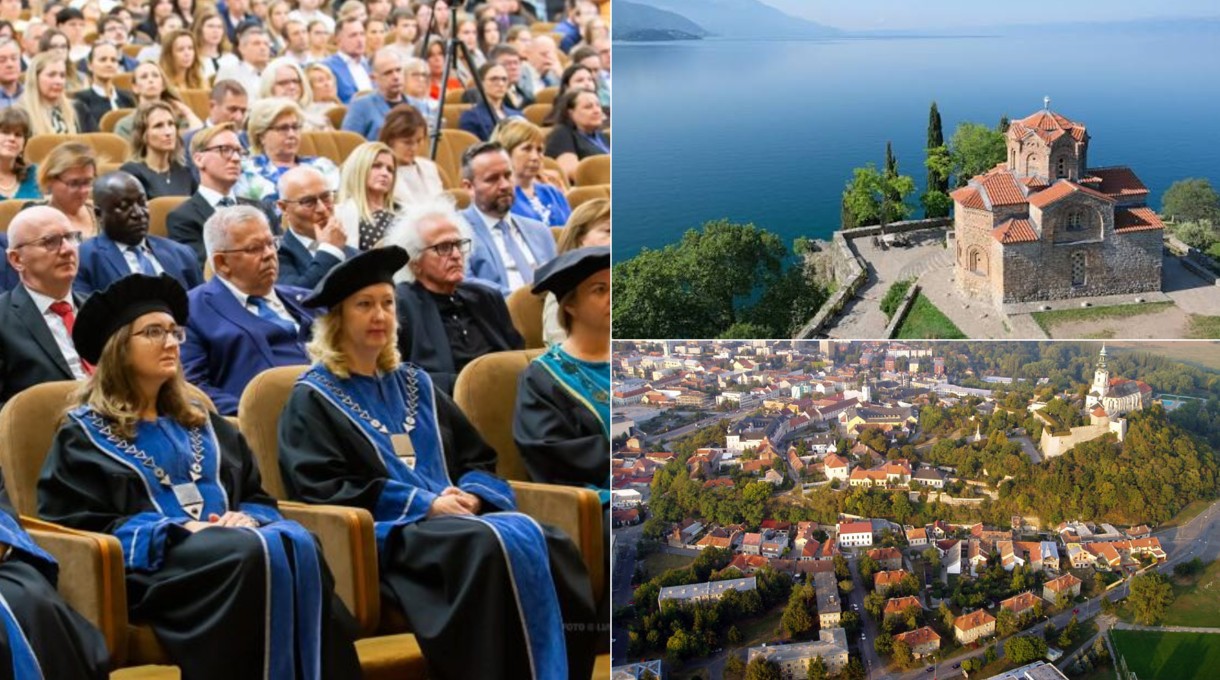
It is precisely through this lens that one should interpret the recent presence of the internationally renowned Macedonian writer and President of the International University “Europa Prima,” Jordan Plevneš, at the academic ceremony of the Constantine the Philosopher University in Nitra, where the newly elected Rector, František Petrovič, was officially inaugurated.
At first glance, an academic solemnity.
In essence, something far greater.
For Nitra is not merely a city.
Nitra is one of those sacred domains where the European history of Slavic literacy, spirituality, and education has etched a profound and indelible mark. When, in such a space, a Macedonian author, a Slovak academic community, and the European cultural world converge, the event assumes a far grander dimension.
From protocol, it transforms into cultural diplomacy.
NITRA AND OHRID — TWO POINTS, ONE CIVILIZATIONAL VERTICAL
There exist places that history binds far more powerfully than political maps ever could.
Nitra and Ohrid are such places.
Between them lies not merely geographical distance.
Between them stands a monumental spiritual and literary vertical line.
From the Great Moravian Mission of Saints Cyril and Methodius, through their revered disciples, Saints Clement and Naum, down to the Ohrid Literary School, an unbroken historical continuity was forged—an echo that has resonated through the centuries.
What began as an enlightening mission endured as a sacred cultural tradition.
What was inscribed as the Word became memory, and what matured into memory became civilization itself.
Hence, the bond between Nitra and Ohrid must not be viewed merely as a historical record.
It is a civilizational vertical.
Nitra bears the legacy of the Moravian Mission.
Ohrid carries the continuation of that monumental educational impetus.
And today, within contemporary Europe, that narrative endures through universities, books, translations, the theatre, and cultural dialogue.
WHEN CULTURE BECOMES DIPLOMACY
In the realm of high politics, diplomatic relations are most often measured through treaties, summits, and official communiqués.
Yet, there exists another diplomacy.
Quieter.
More enduring.
And, at times, infinitely more potent.
Cultural diplomacy.
It demands no applause.
It requires no declarations.
It seeks no political slogans.
It opens doors through the medium of the book, the stage, the university, translation, and the eloquence of the human word.
In this sense, the presence of Plevneš in Nitra carries a symbolic weight that transcends his personal biography.
As a novelist, playwright, and academic figure, he stands in a domain where Macedonian culture can engage in dialogue with Europe, untainted by the expediency of daily politics.
And herein lies the true power of culture.
When politics shifts, culture remembers.
When borders are redrawn, books remain.
When transient narratives collide, civilizational heritage continues to speak in its own unmistakable language.
A SINGLE TOUCH, CENTURIES OF MEMORY
Yet, amid the entirety of the event, one moment stood out with extraordinary symbolic resonance:
The profound honor bestowed upon Jordan Plevneš to touch the holy relics of Saint Cyril — Constantine the Philosopher, at the Cathedral of Nitra.
At first glance, a solemn gesture.
Yet, the underlying symbolism runs vastly deeper.
A contemporary Macedonian hand draws near to the memory of the man who, alongside Saint Methodius, altered the cultural horizon of the entire Slavic world.
A living writer touches the legacy of one of Europe’s most monumental enlightenments.
And in that singular instant, the past no longer feels distant.
It comes alive.
This is no mere regression into antiquity.
It is an affirmation of continuity.
It is the enduring principle that culture does not cease when a historical epoch draws to a close.
It is transmitted.
From master to disciple.
From book to book.
From language to language.
From generation to generation.
That is precisely why the symbolism of Cyril and Methodius belongs not to one nation alone.
It belongs to the shared civilizational history of Europe.
”CYRIL AND METHODIUS — WHO ARE YOU?” — A QUESTION FOR CONTEMPORARY EUROPE
And here we arrive at what is perhaps the most compelling chapter of this story.
The invitation extended by the distinguished European theologian and Bishop of Nitra, Viliam Judák, to Jordan Plevneš to feature as a guest at the “Days of Cyrillo-Methodian Memory” festival with his play, “Cyril and Methodius — Who are you?”, is far more than an invitation to a literary or theatrical gathering.
The query embedded in the title itself is profoundly provocative.
Who are you?
Yet, perhaps even more crucial is the corollary:
Who are we today in relation to their legacy?
Who is the contemporary European in relation to the ideal of enlightenment?
What remains of a Europe that once saw literacy as the ultimate instrument for human liberation?
What remains of the conviction that languages are not barriers, but bridges?
And does contemporary Europe still possess the moral strength to recognize the Slavic contribution to its own cultural heritage?
Precisely for this reason, the drama need not be interpreted merely as a historical reconstruction.
It functions equally as an urgent contemporary European question.
Not merely: Who were Cyril and Methodius?
But rather:
What have we done with their inheritance?
WHEN THE MACEDONIAN WORD RETURNS TO THE SANCTUARY OF ITS HISTORY
Of particular significance is the fact that Plevneš’s drama is slated for publication in the Slovak language, translated by Prof. Dr. Zvonko Tanevski, under the auspices of “Matica Slovenská.”
Here, something truly sublime unfolds.
A Macedonian author writes of Cyril and Methodius.
The work is translated into Slovak.
And it returns to the very cultural heartland linked to the Moravian Mission.
It forms a virtually symbolic circle.
Yet not a circle that closes, but one that expands and continues.
For in translation, the original voice is never lost.
On the contrary.
It is granted new life.
The Macedonian word becomes the Slovak word, while simultaneously carrying forth its innate Macedonian memory.
Thus, culture refuses to be confined within national borders.
It transcends them.
MACEDONIA IS NOT MERELY GEOGRAPHY
This is the precise moment wherein we must comprehend our own cultural standing.
Macedonia must not exist before Europe solely as a political topic.
It must not feature only when discussions turn to diplomatic squabbles, European integration, economics, or geopolitics.
Macedonia possesses another, far more powerful voice.
The voice of culture.
The voice of the book.
The voice of the stage.
The voice of the university.
The voice of Ohrid.
The voice of Clement and Naum.
The voice of Cyril and Methodius as an integral part of the broader European civilizational narrative.
And when that voice echoes in Nitra, Macedonia presents itself not merely through its geography.
It speaks through its memory.
Through its culture.
Through its authors.
Through all that it has bestowed—and continues to bestow—upon the world.
TRUE POWER IS NOT MEASURED BY TERRITORIAL EXTENT
Great powers possess vast territories.
Formidable armies.
Immense economies.
Complex political structures.
Yet history employs a vastly different unit of measurement.
Endurance.
There exist small nations with monumental historical influence.
There exist small languages endowed with immense literary majesty.
There exist cities that appear modest on a map, yet stand as titans in civilizational history.
Ohrid is one such city.
Nitra is another.
And that is precisely why their encounter today bears profound meaning.
Not because we ought to reduce the past to myth, but because without a past, we cannot meaningfully shape the future.
WHEN MACEDONIA SPEAKS WITH EUROPE
Plevneš in Nitra is not merely a photograph from an academic ceremony.
It is the image of a far greater possibility.
The possibility of Macedonia engaging with Europe through that in which it is most supreme:
Through culture.
Through its creators.
Through its universities.
Through translation.
Through drama.
Through a history that does not divide, but rather reminds us of that which once bound us together.
Hence, the narrative from Nitra must not conclude with a formal protocol photograph.
Its true story is only just beginning.
From Nitra to Ohrid.
From Cyril and Methodius to Clement and Naum.
From the ancient Word to the modern book.
From the Moravian Mission to the European stage.
And from history onward into the future.
Such is the path of the Word.
The Word that cannot be imprisoned within boundaries.
The Word that never ages.
The Word that outlasts politics.
The Word that remains standing when all daily disputes fall silent.
And perhaps that is precisely why, today, we must rediscover the true sanctity of culture.
For a nation may be modest in territory, yet monumental in its civilizational memory.
A people may be small in number, yet great in the legacy they have left to history.
And a writer can accomplish what no political declaration ever could:
To carry the true voice of his homeland across borders, and allow that voice to be heard, resonant and dignified, in another tongue.
Thus, when Nitra and Ohrid meet in a singular cultural moment, it is not merely two cities meeting.
Centuries meet.
Memory meets the present.
The Word meets man.
And perhaps most importantly of all,
Macedonia and Europe meet through the language that has never ceased to speak.
A THOUGHT OF WISDOM
”Culture is the memory of humanity.”
— Jan Assmann
When a culture safeguards its memory, it does not merely reside in the past.
It earns the right to a future.
Slobodan TOMIĆ, MA
Analyst and Publicist
Author of the Political TV Magazine “Glasot na Narodot”
