

An Original Political Analysis by M.Sc. Slobodan Tomic

Slobodan Tomic
“If a man does not know to what port he is steering, no wind is favourable.”
— Seneca
WHEN THE STREETS BEGIN ASKING QUESTIONS THE GOVERNMENT DOES NOT WANT TO HEAR
In politics, there comes a moment when the confidence of a long-entrenched government collides with the growing discontent of its citizens.
It is the moment when official statements can no longer silence the question spreading throughout society: whom does the government truly serve, and who ultimately pays the price for its decisions?
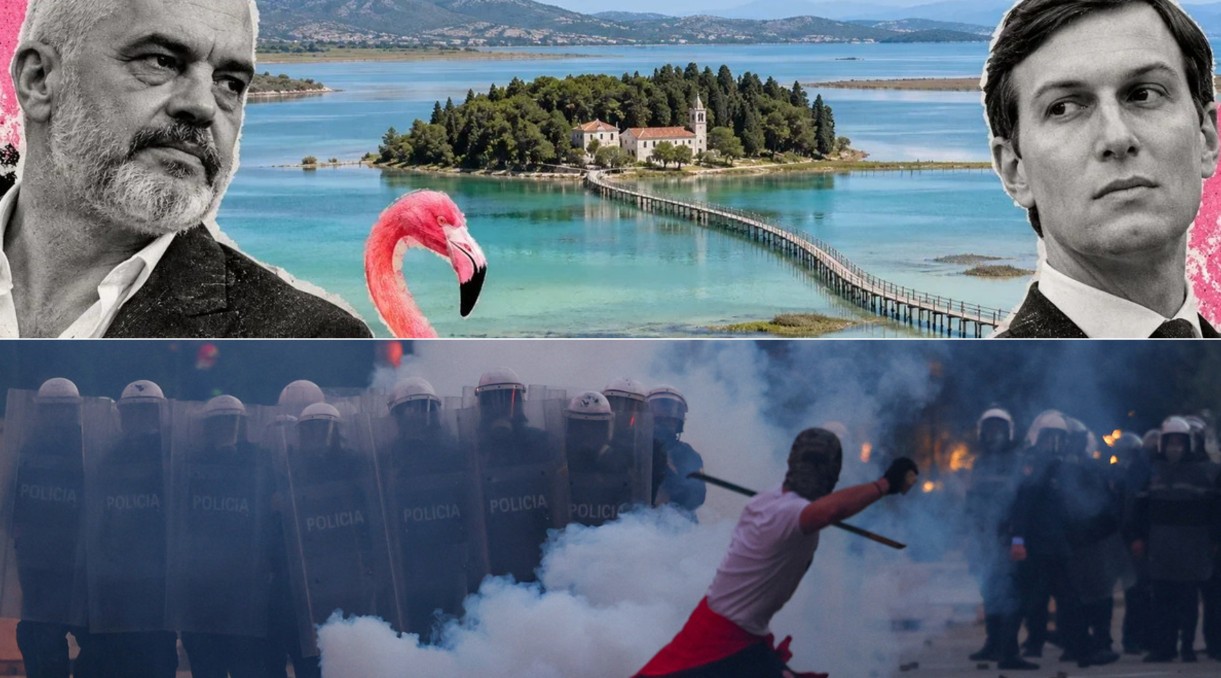
Albanian Prime Minister Edi Rama is facing precisely this kind of challenge. Having been in power since 2013, he now finds himself confronted by protests that have once again brought to the forefront fundamental questions about political accountability, the fight against corruption, the economic prospects of young people, and public confidence in state institutions.
Young people do not take to the streets over a single political statement or one controversial decision alone. When protests gather momentum, they often reflect years of accumulated frustration: a lack of opportunity, doubts about the integrity of institutions, the perception that the rules do not apply equally to everyone, and the growing conviction that a better future may be easier to find abroad than in one’s own country.
For that reason, the protests in Albania should not be reduced to an ordinary confrontation between the government and the opposition. They are also a test of institutional maturity, democratic culture, and the political establishment’s willingness to listen to the people it claims to represent.
Rama has refused to resign and has argued that the protests could jeopardise Albania’s European path. This raises a fundamental question: should the prospect of European integration serve as a defence of any government, regardless of its record, or should it impose a higher standard of governance, accountability, and respect for citizens’ rights?
Europe belongs to no prime minister. European integration is neither an individual’s political achievement nor a weapon with which citizens should be intimidated into believing that every expression of discontent threatens their country’s future.
The European path is built on functioning institutions, a judiciary that makes no distinction between the powerful and ordinary citizens, a free media, and politicians prepared to answer for their actions.
If a government genuinely believes in European values, it should not regard peaceful protest as an enemy. It should recognise it as a democratic right and a warning that public trust is a finite political resource.
RAMA AND THE QUESTION OF ACCOUNTABILITY
Edi Rama is no newcomer to Albanian politics.
For years, he has shaped his country’s political landscape, represented its interests before international partners, and championed his vision of a European Albania.
Yet the longer a political establishment remains in power, the greater its responsibility for the condition of the state.
No government can invoke past achievements, international meetings, and promises of a brighter future indefinitely while ignoring questions about corruption, living standards, and the prospects facing younger generations.
Politics draws an important distinction between formal power and genuine legitimacy. Formal power derives from constitutional office and electoral outcomes. Legitimacy, however, must be sustained through public trust, accountability, and a willingness to listen to citizens.
When that trust begins to erode, no diplomatic photograph, meeting with influential figures, or carefully crafted political message can fully replace an honest conversation with the public.
This is where Rama faces his real test.
The question is not whether he can remain in office for another day, month, or year. It is whether his government can demonstrate that public institutions are stronger than private interests and that public resources are not the preserve of privileged political circles.
Specific allegations of corruption require evidence, independent investigations, and due legal process.
Political commentary must not replace the work of the judiciary, nor should suspicion be presented as proven guilt.
But neither should the public be expected to stop asking questions simply because those questions are uncomfortable for the government.
Accountability is not an act of hostility towards the state. It is one of the foundations of democratic government.
YOUNG PEOPLE ARE NOT POLITICAL DECORATION
One of the most significant messages emerging from the protests is the frustration of young people.
A young person who cannot find employment commensurate with their knowledge and abilities, who no longer believes that hard work will lead to a dignified life, or who suspects that political connections matter more than merit will eventually begin to question their future.
They may leave the country.
They may remain and keep silent.
Or they may take to the streets and publicly demand accountability.
None of these choices should be treated with contempt.
A country that loses its young people loses far more than its workforce. It loses knowledge, creative energy, future families, and generations that should sustain its institutions and economy.
When students and young citizens demand answers about education, employment, the cost of living, and corruption, they are not attacking their country. They are asking their country to demonstrate that it has a place for them.
Politicians often celebrate young people as the future when they need their votes, enthusiasm, and support.
Their true attitude towards the younger generation, however, becomes apparent when the applause stops and difficult questions begin.
Democracy is not merely the right to vote in elections. It also includes the right to peaceful assembly, the freedom to criticise those in power, and the right to demand accountability.
Every instance of violence against citizens must be investigated, just as violence against police officers must be addressed in accordance with the law.
Violent incidents must not become a pretext for suppressing the right to peaceful assembly. Equally, peaceful demonstrators must not be branded as violent simply because their demands inconvenience those in government.
A government confident in its democratic legitimacy should be able to distinguish between genuine public disorder and the lawful exercise of civil rights.
That distinction is essential to any state aspiring to European standards.
KUSHNER, LUXURY DEVELOPMENTS, AND THE QUESTION OF THE PUBLIC INTEREST
Another source of discontent in Albania has emerged around a planned luxury tourism development associated with Jared Kushner, son-in-law of US President Donald Trump, and the development of coastal land.
The project has become part of a broader public debate about land management, decisions affecting environmentally sensitive areas, and whether citizens’ interests are adequately protected when major investment agreements are negotiated.
The involvement of a foreign investor is not, in itself, evidence of wrongdoing. Nor can anyone reasonably be declared guilty merely because of political or family connections.
Nevertheless, the scale of an investment, the sensitivity of its location, and the importance of public land demand the highest standards of transparency.
Who determined the terms of the project?
Were the procedures transparent?
How was the environmental impact assessed?
What economic benefits will accrue to local communities?
Was the public given a meaningful opportunity to influence the decision?
These are legitimate questions that deserve clear answers.
When a project involves a coastline, natural resources, or land of particular public significance, the government has an obligation to demonstrate that the public interest has not been subordinated to commercial ambition.
Foreign investment can create jobs, bring in capital, and stimulate economic development. But it must not become a means of circumventing public scrutiny.
The true European standard is not simply the ability to attract major investors. It is the ability to ensure that every investment complies with the law, is governed by transparent agreements, and safeguards the public interest.
That is why the government must respond to legitimate concerns with documents, verifiable facts, and transparent procedures—not merely with political messaging.
Economic development cannot be measured exclusively by the size of an investment. It must also be measured by the fairness of the process, the protection of natural resources, and the benefits delivered to society.
GEORGE SOROS, ZAЕV, AND THE QUESTION OF EXTERNAL INFLUENCE
Any serious examination of Balkan politics inevitably raises questions about the role of external centres of influence, international foundations, donor networks, diplomatic circles, and influential political figures.
The name of George Soros has appeared for years in political debates across the region, particularly in discussions concerning the funding of civil society organisations, media projects, and initiatives related to democracy, human rights, and institutional reform.
In Macedonia, these debates have frequently intersected with discussions about Zoran Zaev’s political rise, the change of government in 2017, and the wider international circumstances surrounding those developments.
A serious analysis, however, must distinguish clearly between political influence, publicly documented support, and allegations of secret control.
The existence of international connections or external support does not, by itself, prove that a politician has received instructions from a foreign centre of power.
Such a claim requires specific and credible evidence.
That does not mean external influence should be beyond scrutiny. On the contrary, democratic societies have every right to know who finances political and civic activities, what interests those actors represent, and whether any commitments could compromise the independence of domestic institutions.
Rather than casually labelling political opponents as “puppets”, we should demand documentary evidence, financial transparency, verifiable connections, and a careful examination of the decisions in question.
The central issue is straightforward: do domestic political leaders make decisions in the interests of their own citizens, or are they prepared to shape state policy around the priorities of influential external partners?
This question is not confined to one political party, one foundation, or one foreign actor. It applies to every government receiving international support, whether that support comes from Washington, Brussels, Moscow, Beijing, or regional centres of political influence.
Sovereignty cannot be measured by the number of diplomatic meetings a government attends. It must be measured by the ability of its institutions to make decisions in accordance with the law and the interests of their own citizens.
International cooperation is not inherently a threat to sovereignty. The danger arises when cooperation becomes dependency, when transparency gives way to opacity, or when external approval is valued more highly than the democratic mandate at home.
The distinction matters.
A country can maintain strong international partnerships while defending its independence. Indeed, a confident and institutionally mature state should be capable of doing precisely that.
EDI RAMA AND ALI AHMETI: REGIONAL TIES AND THE LIMITS OF POLITICAL INFLUENCE
Within this broader picture, the relationship between Edi Rama and Ali Ahmeti cannot be ignored, nor can the political messages that have emanated from Tirana over the years concerning developments in Macedonia.
Albanian political leaders have every right to follow regional affairs, cooperate with political partners, and discuss matters of common interest.
But there is a clear distinction between legitimate regional cooperation and attempts to steer the domestic political processes of a neighbouring country from abroad.
In 2017, the so-called Tirana Platform became a major point of contention in Macedonian political debate. Its significance, content, and political consequences continue to be interpreted differently.
For some, it represented a framework for the political demands of Albanian parties. For others, it established a troubling precedent because of the role that a political centre outside Macedonia appeared to play in aligning domestic political positions.
It would be inaccurate to portray every political agreement between parties as a foreign diktat.
It would be equally unreasonable, however, to dismiss every concern about attempts by neighbouring states to influence internal political developments.
The proper response is to examine specific statements, agreements, and actions rather than draw conclusions based solely on political associations.
Albania and Macedonia have a shared interest in cooperation on economic development, infrastructure, security, and European integration.
Yet good-neighbourly relations must rest on mutual respect—not on the assumption that one government has the right to determine the political direction of another state.
Albanians in Macedonia are equal citizens of their own country. Their rights, language, culture, political participation, and dignity must be protected under Macedonia’s Constitution and laws.
Their legitimate rights must never be used as a pretext for external political interference. Equally, those rights must never be questioned because of disagreements with political leaders who claim to represent them.
Criticism of a political party’s decisions must be based on its actions, not on the ethnicity of its members or voters.
That is the difference between responsible national politics and a politics that deliberately deepens divisions.
A mature regional relationship requires political leaders to respect both the rights of communities and the sovereignty of neighbouring states. These principles are complementary, not contradictory.
WHEN REGIONAL POLITICS BECOMES A QUESTION OF DOMESTIC RESPONSIBILITY
External influence always has a domestic dimension.
No foreign government can successfully shape the political processes of another state without domestic partners, institutional weaknesses, or interests that make such influence possible.
If Macedonia wishes to remain independent in its decision-making, it must therefore build strong institutions, maintain a coherent national strategy, and ensure that its political leadership defends national interests without turning them into the private property of any party.
Declaratory patriotism is not enough if it is unsupported by institutional discipline.
There can be no genuine sovereignty if every government changes its position according to the pressure of the moment.
Nor can a country maintain a long-term national strategy if its most important interests are repeatedly used as instruments for gaining or retaining political power.
Responsibility, therefore, rests not only with external actors but also with domestic political elites.
Every government must demonstrate that its decisions are guided by the public interest.
Every opposition must show that it can offer better policies, not merely sharper rhetoric.
Every politician who invokes the national interest must be prepared to demonstrate the results of their work.
And citizens must retain the right to ask who benefits, who loses, and who is left to pay the bill.
The strength of a democracy is not determined by how loudly its leaders speak about sovereignty. It is determined by how effectively its institutions protect the public interest.
A government that genuinely trusts its own democratic mandate has no reason to fear transparency. A political establishment that believes in the strength of its arguments should welcome scrutiny rather than seek to silence it.
Ultimately, the most effective defence against inappropriate external influence is not political theatre. It is a state whose institutions are transparent, accountable, and capable of serving citizens regardless of who occupies the seats of power.
CAN EDI RAMA SURVIVE BY INVOKING EUROPE ALONE?
No serious analysis can declare Edi Rama’s political demise in advance.
The protests are an important indication of public discontent, but their ultimate impact will depend on several factors: their scale and staying power, the conduct of the opposition, the response of state institutions, economic conditions, and the government’s ability to address citizens’ demands.
Rama may remain in office.
The pressure may continue and weaken his political position.
The protests may lead to concrete institutional changes—or they may fail to produce an immediate political outcome.
What is certain is that every government that remains in power for an extended period must eventually confront the consequences of its own decisions.
European integration cannot serve as permanent political protection against criticism. On the contrary, the more frequently a government invokes European values, the greater its obligation to uphold them at home.
The European perspective cannot be used to excuse a lack of transparency.
Demands for accountability cannot automatically be portrayed as attacks on the state.
Nor can every criticism be dismissed as an attempt at destabilisation.
The state is greater than its government, and citizens are more than an audience expected to listen to politicians.
That is why the proper response to protests cannot consist merely of political manoeuvring. It must involve verifiable results, independent investigations wherever credible grounds exist, transparent agreements, and institutions that do not depend on the will of one individual or one political party.
A government’s credibility is ultimately determined not by the explanations it offers for its shortcomings, but by its willingness to correct them.
The European Union should not be treated as a shield against domestic scrutiny. Its principles are meant to raise the standards by which governments are judged.
If a political leader invokes Europe while treating criticism as disloyalty, an uncomfortable contradiction emerges: European integration is presented as a national priority, yet one of the essential foundations of European democracy—the right to question those in power—is placed under suspicion.
That contradiction cannot be resolved through rhetoric alone.
It requires institutional integrity, political accountability, and respect for citizens’ democratic rights.
THE BALKANS MUST NOT BECOME A PLAYGROUND FOR OTHER PEOPLE’S INTERESTS
For too long, the Balkans have lived with the consequences of great powers and regional centres of influence pursuing their interests through local political elites.
The answer to this history, however, is neither isolation nor hostility towards every external partner.
The answer is to build institutions capable of cooperating with everyone while remaining dependent on no one.
Macedonia, Albania, and the other countries of the region need stability, investment, economic cooperation, and a credible European perspective.
But they need something even more fundamental: political leaders who understand that international support is not personal property and that every political mandate represents a temporary grant of public trust.
External partners can support reforms, invest in development, facilitate dialogue, and create opportunities for cooperation.
They cannot replace the responsibility of domestic institutions.
No foreign foundation can build a functioning judiciary if the domestic political establishment lacks the will to make it work.
No European report can substitute for a genuine fight against corruption.
No diplomatic meeting can compensate for the absence of trust between citizens and their government.
Ultimately, every state must answer the same question: do its institutions serve the public interest, or do they serve the interests of the political circles that control them?
The future of the Balkans depends, in part, on whether its political leaders can move beyond the old habit of treating international support as a substitute for domestic legitimacy.
A stable region requires more than agreements signed in diplomatic chambers. It requires societies in which citizens believe that the law applies equally, that political power can be challenged, and that their future does not depend on personal connections to those at the top.
The most durable international partnerships are built between states that respect one another’s independence—not between political elites that expect external patrons to protect them from domestic accountability.
EDI, GO! — THE POLITICAL MESSAGE AND THE LIMITS OF POWER
The headline “Edi, Go!” is a political message, not a predetermined outcome.
It expresses a demand for accountability and the frustration of those who believe that Rama’s government has failed to respond adequately to questions concerning corruption, economic prospects, and public confidence in institutions.
But the democratic outcome will not be determined by a column’s headline or by the wishes of political opponents.
It will be determined by citizens through democratic mechanisms, institutional procedures, and elections.
The real question is whether the political establishment is prepared to accept that power is not a permanent entitlement, but a responsibility that must continually be justified before the public.
Here we arrive at the heart of the wider Balkan political story.
Every political project has a shelf life.
Not because some hidden clock determines when it must end, but because public trust is not inexhaustible.
When results fail to materialise, when institutions fall short of expectations, and when the public interest collides with suspicions of political privilege, even the strongest government must confront the consequences.
International support can help a politician gain influence, strengthen a political position, or present a particular vision to the world.
But it cannot replace the support of citizens indefinitely.
The same principle applies to every political leader in the region, from Tirana to Skopje.
No political party is the state.
No prime minister owns the will of the people.
And no amount of external support can absolve a domestic government of its obligation to answer to its own citizens.
Anyone who believes that a government can survive indefinitely through international friendships, political arrangements, and a carefully cultivated image abroad will sooner or later have to confront a question asked at home:
What have you actually done for the people who entrusted you with power?
That is where political stature is measured.
Not by the number of meetings with world leaders.
Not by photographs taken at international conferences.
Not by assurances that the country will lose its future without one particular politician.
Political stature is measured by the institutions that endure, the justice that applies to everyone, the young people who choose to stay, the economy that offers a dignified life, and the citizens who begin to trust their state again.
Once that trust is lost, no political project can restore it through words alone.
The question, therefore, is not simply whether Edi Rama will leave office or remain in power.
The question is whether Albania can build institutions stronger than any prime minister; whether Macedonia can reinforce its capacity to make independent decisions; and whether the Balkans can finally stop treating political leaders as indispensable intermediaries between their own citizens and external centres of power.
Politicians may receive support from abroad, but their legitimacy must be sustained at home.
And when the moment comes to account for their actions, no diplomatic photograph, no foreign endorsement, and no political arrangement can answer on their behalf.
Edi Rama now faces that political test.
And the Balkans once again confronts an old question that remains unanswered:
Who truly determines the destiny of our states—the citizens themselves, or the political networks seeking to shape their will?
M.Sc. Slobodan Tomic
Political Analyst and Publicist
Author and Host of The Voice of the People Political Television Programme
