


Slobodan Tomić
“The greatest victory of a statesman lies not in defeating an adversary, but in preventing a war in which victory itself may become meaningless.”
An original reflection on the responsibilities of statesmanship
HEGEMONY IS NOT LEADERSHIP
In a world where military power is once again becoming a principal instrument of statecraft, and threats increasingly displace diplomatic dialogue, the question of great-power responsibility has become inseparable from the future of humanity itself.
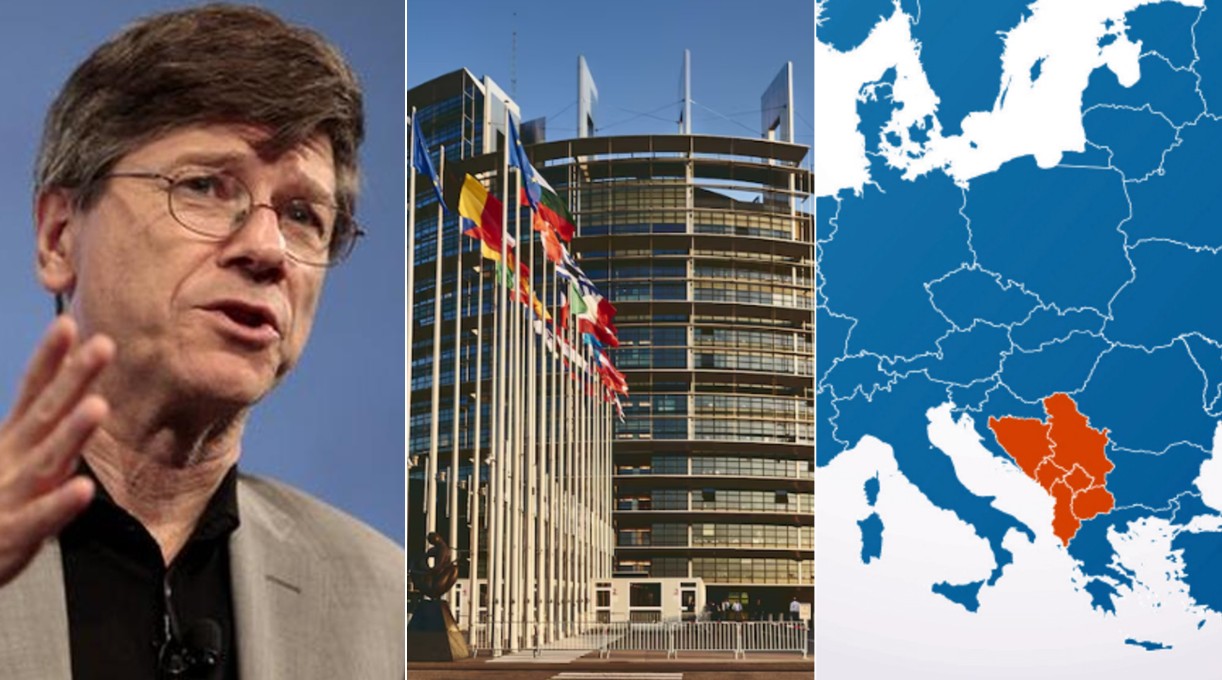
The warnings articulated by American economist and geopolitical analyst Jeffrey Sachs invite a serious examination of American foreign policy, Europe’s strategic dependence, and the danger that international relations may descend into an endless contest for domination.
At the heart of this critique lies a question that extends far beyond the distribution of military power: is that power being exercised to preserve stability, or is it deepening the divisions that render the international order increasingly fragile?
True leadership cannot be measured by the number of military bases a nation commands, the scale of its arsenal, or its capacity to impose its will upon an adversary. Its real measure is the ability to avert catastrophe, preserve peace, and create the conditions in which political solutions remain possible.
When every concession is branded a defeat, every adversary is treated as an enemy beyond negotiation, and every crisis becomes an opportunity to demonstrate strength, diplomacy loses its essential purpose. The world then enters a perilous cycle in which mistrust fuels rearmament, rearmament breeds fear, and fear opens the door to further conflict.
The nuclear age makes this trajectory particularly alarming. No state can confidently predict or control every consequence of a major war. Under such circumstances, political irresponsibility ceases to be the concern of any single nation. It becomes a threat to all.
EUROPE MUST LEARN TO THINK FOR ITSELF
Europe faces one of the defining strategic questions of our time: will it emerge as an autonomous political actor, or will it remain predominantly dependent on the assessments and decisions of its most powerful allies?
The transatlantic partnership remains important to the security of the European continent. Yet an alliance should never require the abandonment of independent political judgment. On the contrary, a genuine partnership rests upon trust, shared interests, and the capacity for candid dialogue—even when disagreements arise.
Europe must defend Ukraine’s security, uphold international law, and pursue credible avenues towards a diplomatic settlement. These objectives need not be mutually exclusive.
Russia’s aggression cannot be justified by geopolitical arguments. Yet a durable peace will also require a serious assessment of security risks, mechanisms for preventing escalation, and the possibilities for meaningful negotiations.
This is neither a call for capitulation to Moscow nor an argument for abandoning Ukraine. It is a call for Europe to resist the dangerous assumption that war must become the only conceivable political reality.
Peace cannot be secured through empty declarations. Nor can it be achieved by allowing a conflict to continue indefinitely without a coherent diplomatic strategy. What is required is political courage, strategic realism, and leadership capable of distinguishing the defence of fundamental principles from the danger of uncontrolled escalation.
Europe must not become a continent that merely reacts to decisions made elsewhere. It must become a force capable of proposing solutions, sustaining diplomatic channels, safeguarding its own security, and accepting its responsibilities to future generations.
RUSSIA, CHINA, AND THE DANGER OF A WORLD WITHOUT DIPLOMACY
Neither Russia, China, nor the United States can be excluded from the equation of global security. Yet none should be entitled to dictate the rules governing the rest of the world solely by virtue of its power.
China’s rise does not make war with the United States inevitable. Differences in political systems, economic interests, and strategic ambitions do not eliminate the necessity of dialogue. Competition among major powers can be dangerous; it becomes more dangerous still when political leaders begin to regard conflict as unavoidable.
Relations with Russia, likewise, cannot be reduced to a choice between unconditional acceptance of Moscow’s policies and the complete abandonment of diplomatic engagement. International law must apply to all states, but diplomatic communication must remain possible even when mistrust runs deep.
Iran, the wider Middle East, and the Mediterranean region further demonstrate how rapidly local conflicts can become entangled with the strategic interests of global powers.
In such an environment, military operations must be assessed on the basis of evidence, international law, and their consequences for civilian populations—not through the propaganda of any political centre.
The world cannot afford to reduce international relations to a crude contest between victors and vanquished. Nuclear weapons render that logic especially perilous. In a confrontation between major powers, even a state that declares itself victorious may ultimately lose everything it sought to defend.
SMALL STATES: WHO PROTECTS THOSE WHO HAVE NO SEAT AT THE TABLE?
Whenever major powers negotiate spheres of influence, security arrangements, and strategic corridors, small states are entitled to ask a fundamental question: what place will be reserved for them in the emerging international order?
For smaller nations, international law is not an abstract legal formula. It is one of the most important safeguards of their sovereignty, territorial integrity, and right to make independent political choices without becoming wholly dependent on the will of more powerful states.
Small countries cannot compete with great powers in military capacity, economic weight, or demographic scale. They can, however, build resilient institutions, pursue competent diplomacy, strengthen regional cooperation, and invoke international rules with consistency, credibility, and sound argument.
Their greatest mistake would be to assume that security can be guaranteed by blindly following every decision of a powerful ally. It would be equally misguided to reject the alliances and partnerships that contribute to their stability.
Small states need a foreign policy grounded in principle rather than isolation; alliances without political subservience; pragmatism without surrendering national dignity.
This is where the true test for the Balkan states becomes apparent. The region’s history demonstrates the high price societies pay when geopolitical rivalries are imported into domestic politics, when external disputes deepen internal divisions, and when political elites exploit foreign influences to consolidate their own power.
The Balkans must not once again become a chessboard on which others move the pieces while the peoples of the region bear the consequences.
MACEDONIA: ALLIANCES WITH DIGNITY, A EUROPEAN FUTURE BUILT ON PRINCIPLE
For Macedonia, these questions carry particular weight.
As a member of NATO and a country committed to European Union membership, Macedonia has clear security and political interests. Yet its European aspirations must be accompanied by dignity, consistency of principle, and the ability to defend its legitimate national interests.
NATO membership does not require Macedonia to relinquish its independent assessment of international affairs. Nor should European integration become an indefinite process of waiting, devoid of clear rules, measurable criteria, and equal treatment.
Macedonia should honour its commitments, strengthen its partnerships, and remain a constructive force in the region. At the same time, it must insist upon mutual respect, European standards, and the principle that questions of identity and history must not become perpetual obstacles to its future.
This is not a policy directed against Europe. On the contrary, it is a commitment to a Europe faithful to its own declared values.
Macedonia has no interest in treating relations with the great powers as a forced choice that requires it to abandon its own strategic compass. Its interests lie in cooperating with democratic partners, strengthening national security, developing its economy, and building a state in which institutions are stronger than partisan interests.
A small state becomes vulnerable when it lacks a coherent strategy, when its institutions are weak, and when national questions are exploited for short-term political gain. It can, however, earn respect through sound arguments, diplomatic consistency, and serious, sustained engagement.
Macedonia cannot dictate the direction of the international order. It can, however, refuse to remain a silent spectator to its own destiny.
That is the essence of responsible statecraft: to participate in alliances without surrendering independent thought; to seek compromise without accepting humiliation; and to pursue a European future without forgetting the people in whose name that future is being built.
THE FINAL TEST: WHO WILL SAVE THE WORLD FROM A VICTORY WITHOUT A FUTURE?
Jeffrey Sachs’s warnings should be understood as an invitation to serious debate about the responsibilities of great powers, the limits of military force, and the indispensable role of diplomacy. His assessments may be challenged, scrutinised, and tested against the evidence. Yet the questions they raise are too consequential to be dismissed merely because they unsettle established political narratives.
Humanity does not need a world in which one power dictates its will to everyone else. Nor does it need a world in which every state treats its own power as superior to international law.
What it needs is an international order in which security is not the exclusive privilege of the strongest, in which small nations are not bartered away for the strategic interests of others, and in which diplomacy is not mistaken for weakness.
For when great powers turn victory into an obsession and the humiliation of their adversaries into a political objective, the ultimate outcome may be a world without winners.
All that may remain are the ruins of a civilisation that possessed sufficient weapons to destroy itself, yet insufficient wisdom to save itself.
The world does not belong to those who can force their adversaries to their knees. It belongs to those who possess the wisdom to prevent humanity itself from being brought to its knees.
M.Sc. Slobodan Tomić
Political Analyst and Publicist
Author and Host of The Voice of the People
Author’s Note: This is an original geopolitical analysis inspired by the publicly expressed views of Jeffrey Sachs. The opening and closing reflections are original formulations by Slobodan Tomić and are not presented as verbatim quotations from Sachs.
