

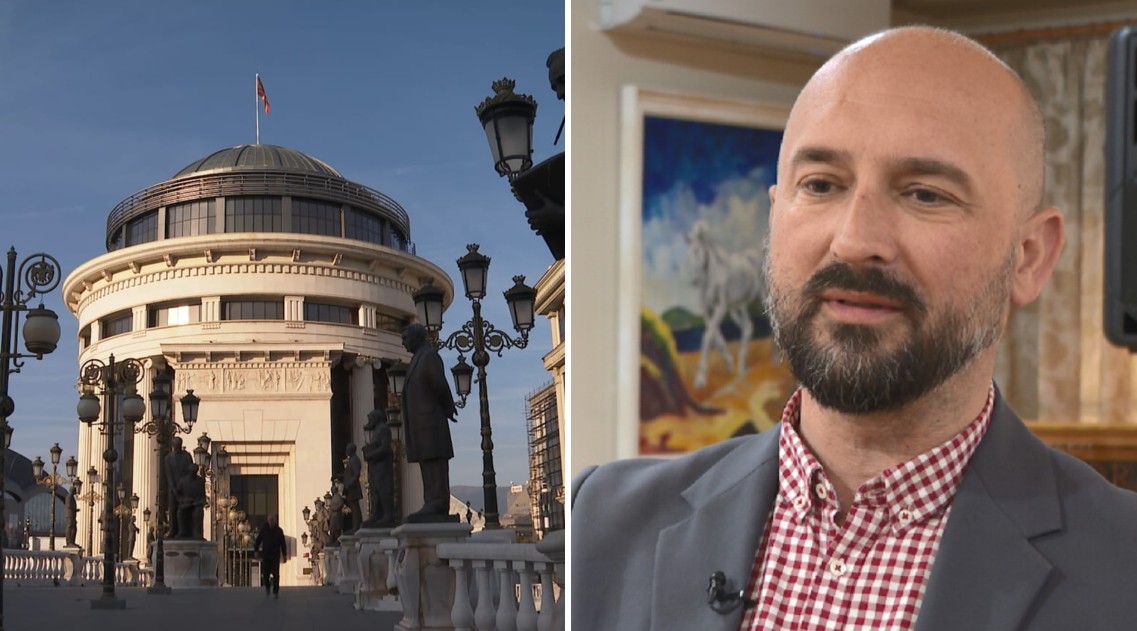
Will the appointment of Nenad Saveski free justice, or will prosecutorial silence continue?
By Slobodan Tomic
Editor’s Note
In every state, there are moments when a particular institutional decision becomes more than a mere procedure.
It becomes a test of the system’s maturity, the strength of its institutions, and the state’s readiness to confront its own weaknesses.
In Macedonia today, such a moment is the appointment of a new State Public Prosecutor.
This is not just a question of a single position.
It is a question of whether justice will finally become a pillar of the state, or remain its greatest weakness.
“A state where justice is captive is a state where freedom is only an illusion.”
Cicero
When Justice Becomes a Matter of State Survival
The history of nations teaches a simple yet harsh lesson: states do not fail solely because of external enemies.
More often, they collapse due to internal corrosion.
When institutions stop functioning, when justice becomes selective, when laws are applied differently to the powerful and to ordinary citizens, the state slowly loses its essence.
It is no longer a system of rules.
It becomes a system of influence.
Without justice, a state is merely geography, not a political community.
Macedonia, more than three decades after independence, still struggles with this historic dilemma.
A State That Has Waited Too Long for Justice
Over the past thirty years, Macedonian institutions have undergone numerous reforms.
New laws were passed.
Judicial strategies were drafted.
European standards were promised.
Yet reality often told a different story.
Cases dragged on for years.
Investigations vanished in institutional labyrinths.
Major political scandals never reached true judicial resolution.
Over time, this created something far more dangerous than legal weakness.
It created distrust—and when citizens lose faith in justice, they begin to lose faith in the state itself.
An Appointment That Could Determine Institutional Future
In the coming period, the Macedonian Parliament will need to make a decision that could have profound implications for the institutional system.
The government’s proposal is the appointment of Nenad Saveski as State Public Prosecutor.
This decision requires 61 parliamentary votes.
But the numbers in parliament are not the most important part of this story.
The key question behind them is:
Will Macedonia finally have a prosecutor who will free justice, or will the system continue to guard silence?
The Prosecutor’s Office as a Symbol of Systemic Crisis
In recent years, the Prosecutor’s Office has often been at the center of public criticism.
Citizens witnessed cases that raised serious doubts about the system’s functionality:
Investigations that never reached court;
Scandals that remained unpunished;
Economic crimes with enormous financial consequences;
Public enterprise directors who became millionaires;
Budget funds that disappeared without institutional response.
Moreover, political decisions that changed the course of the state were often accompanied by serious allegations of corruption and abuse of power.
Yet many of these issues never reached judicial resolution.
When institutions remain silent, suspicions become truth in the eyes of the public.
Historical Shadows That Still Haunt the State
Macedonian history contains cases that remain part of the public memory today:
The assassination of the first President of independent Macedonia;
Controversial privatizations during the transition period;
Political scandals that shook the state over the past two decades.
Each of these cases raises one question:
Will justice ever be fully realized?
The answer does not depend solely on history.
It depends on the institutions that govern the state today.
And then there is the “sale,” pardon, the change of the constitutional name of the state, which became a topic at Georgi Ivanov’s press conference…
The Three Tests for the Future Prosecutor
If Nenad Saveski is appointed, his mandate will be defined by three critical tests:
Test of Independence
Will the Prosecutor’s Office be able to operate without political pressure?
Test of Courage
Will investigations be opened against the most powerful structures in the state?
Test of Trust
Will citizens once again believe that justice is possible?
These three questions will determine not only his career but the future of the institutional system.
Macedonia at a Historic Crossroad
In the history of every state, there are moments when a choice must be made between two paths.
One path leads to a true rule-of-law state.
The other leads to continued institutional impunity.
Today, Macedonia stands at that very crossroad.
The choice of the new State Public Prosecutor will show which path is chosen.
The Court of History
In the end, institutions make decisions.
But history is the ultimate judge.
The Macedonian people do not demand the impossible.
They demand only one thing: justice.
Justice that is equal for all.
Justice that fears no power.
Justice that restores trust in the state.
The Final Question for the State — Manifesto
Today, Macedonia faces a question that transcends daily politics:
MACEDONIA BEFORE THE COURT OF JUSTICE.
Will a state finally be born where the law is stronger than power?
Will a Prosecutor’s Office emerge that does not fear the truth?
Will the circle of institutional silence finally be closed?
History will answer.
But that answer will not be written by any commentator.
It will be written by the institutions.
And remembered by the people.
