

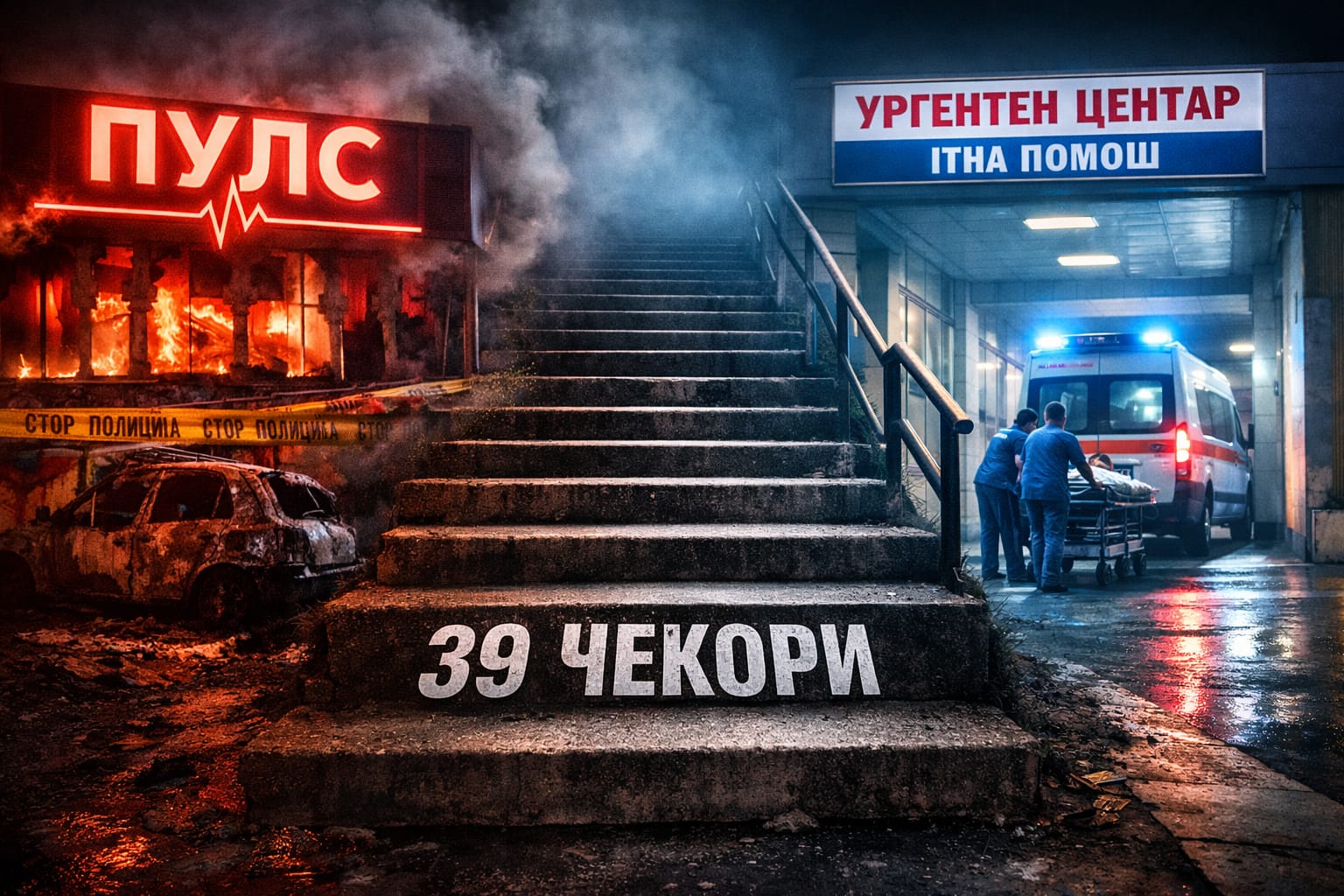
The anniversary of “Pulse”, 39 steps to the Emergency Center and the question Macedonia can no longer avoid
Written by: Slobodan TOMIĆ

“The greatest evil is not done by those who do evil, but by those who see it and remain silent.”
Albert Einstein
ONE YEAR AFTER “PULSE”, A TRAGEDY THAT SHOOK MACEDONIA
One year after the fire in the Pulse nightclub in Kočani, Macedonia is once again facing the question that every great tragedy raises with brutal honesty:Did we truly learn anything?On March 16, 2025, 63 young people lost their lives.More than 200 were injured.An entire generation was struck by a pain that cannot be measured by statistics.At the international conference in Skopje, the state leadership spoke about the lessons of the tragedy.Prime Minister Hristijan Mickoski publicly read the names of all the victims, reminding everyone that they are not numbers, but human destinies.And this is precisely where the real story begins.Because tragedies never end on the day they happen.They continue in every family that has lost a child.In every empty chair at the dinner table.In every morning when a parent wakes up with the memory of the most painful loss.
WHEN THE STATE LEARNS FROM TRAGEDY
After the fire, the European Civil Protection Mechanism was activated. The injured were transported to hospitals across Europe.Medical teams arrived in Macedonia.Health Minister Azir Aliu announced systemic reforms.The government is investing in new emergency vehicles, new protocols for mass-casualty incidents, and improved crisis management.President Gordana Siljanovska-Davkova emphasized the moral dimension of the tragedy.Foreign Minister Timčo Mucunski spoke about the strength of international solidarity.All of this is important.But behind every institutional sentence stands one simple truth:systems exist because of human life.
BUT THERE IS ANOTHER TRAGEDY
A tragedy that did not happen in a nightclub.But in a hospital room.At the Mother Teresa Clinical Center.On the fatal night between January 26 and 27, 2025, at the Hematology Clinic, patient Gjorgji Tomić was in critical condition.From the Hematology ward to the entrance of the Emergency Center there are only:39 steps.That is the distance between hope and tragedy.
39 STEPS THAT MAY HAVE MEANT LIFE
Exactly that many steps separated a young man, Gjorgji Tomić, from timely medical intervention that might have saved his life.On that night — January 26 to 27, 2025 — the situation was dramatic.According to the testimony of an eyewitness, a professor-doctor who together with the father carried him down the stairs, the patient was in critical condition:oxygen saturation 65not intubatedwithout appropriate medical response for hours.The condition worsened.And then something happened that raises the most difficult question for any healthcare system.A brain hemorrhage occurred.And the outcome was tragic.Death.
THE QUESTION NO ONE WANTS TO ASK
Was this a medical error?This question is not an attack on doctors.It is a question about the system.Because medicine is a profession of immense responsibility.But it is also a profession that must have mechanisms of self-control and accountability.When the system does not ask these questions, then the public must ask them.
WHEN THE SYSTEM DEFENDS THE SYSTEM
Instead of a serious public debate, instead of an independent review, statements appeared in the public sphere claiming that doctors are exposed to verbal criticism.But here a fundamental question arises:Is criticism an attack, or a demand for truth?Among the people there has long been a bitter saying:“The same judge accuses you and judges you.”When institutions investigate themselves, public trust inevitably collapses.
THE HARSH TRUTH OF MEDICINE
A well-known physician once uttered a sentence that sounds terrifying, but real:“Our medical mistakes are buried only by the gravediggers and the black earth.”But a modern society must never allow that to be the final truth.Because if mistakes are buried, they will be repeated.
WHY IS AN INTERNATIONAL REVIEW NECESSARY?
When the scandal surrounding the treatment of patients at the Oncology Clinic emerged in Macedonia, the state requested an international review.That was the right decision.Which raises a simple question:why not do the same for the case of Gjorgji Tomić?Not for politics.Not for sensationalism.But for the truth.
TWO TRAGEDIES, ONE LESSON
The tragedy in Kočani and the tragedy of Gjorgji Tomić are different.But in essence they raise the same question:does the system function when it is needed the most?In Kočani, safety standards failed.In the hospital, the question arises whether the medical response failed.But in both cases the result is the same:lives that can never be returned.
THE PAIN OF ONE FAMILY, A QUESTION FOR AN ENTIRE SOCIETY
Behind the tragedy of Gjorgji Tomić stands a family.Two minor children who were left without their father.Children entering the most sensitive period of their lives.That is why the question is not only medical.It is societal.It is a question about:trust in institutionsthe accountability of the systemthe future of patients in Macedonia.
IT LIES ON MY HEART, IT WEIGHS ON MY SOUL
To seek the truth is not weakness.To cry over injustice is not shame.Shame is to remain silent when the system makes mistakes.Shame is to close one’s eyes before tragedy.Because if the truth is not spoken today, tomorrow another father will tell the same story.
TRAGEDIES MUST TEACH US SOMETHING
One year after “Pulse”, Macedonia speaks about reforms.But real reforms are not in conferences.They are in the courage to admit mistakes.In the readiness to establish the truth.And in the determination that tragedies must never happen again.Because a state is not measured by the number of its institutions.But by how much one human life is worth.And by whether it is ready to speak the truth — even when that truth is the hardest.
