

By Slobodan TOMIC

Slobodan TOMIC
“Courage is not the absence of fear, but the decision that something is more important than fear.”
Nelson Mandela
THIS IS NOT A CHOICE – THIS IS A JUDGMENT
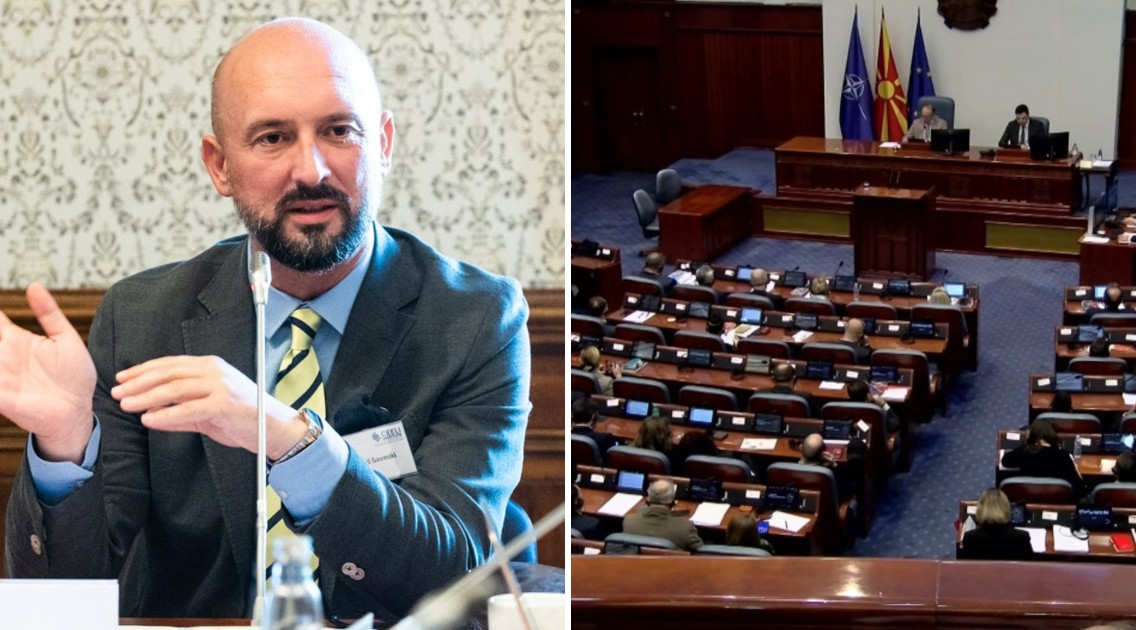
At the 94th session of the Assembly of the Republic of Macedonia, with 66 votes in favor, Nenad Saveski was appointed the new State Public Prosecutor.But this is not an ordinary personnel decision.This is a judgment on a system that has been devouring the state from within for three and a half decades.This is a test to see whether Macedonia will finally confront the legacy of political impunity created during the years when SDSM shaped the state according to party loyalty rather than justice.
66 VOTES OF SUPPORT – BUT NOT A BLANK MANDATE
The Assembly confirmed the government’s proposal with 66 votes in favor, 8 abstentions, and 2 against. While the ruling majority backs the appointment, the message from the parliamentary benches is clear: support is not unconditional. Members of the majority publicly stated they expect an immediate turnaround in what they call the “captured prosecution” left by the previous SDSM-DUI administration. Formally, SDSM has no objections to Saveski’s resume, but politically, they signal concern that he might become a “party prosecutor.”The parliamentary group remained divided – some did not vote, and eight abstained. Members of the European Front also abstained. Two MPs from Taravari’s faction in the Alliance for Albanians – Halil Snopche and Rijad Shaqiri – voted against. Levica did not participate in the debate. These numbers are not just statistics. They are a political map of trust and suspicion. Saveski has promised digitalization, radical accountability, and the end of long-dormant cases.”You cannot fight wealthy criminal networks with a poor institution,” he said. This is the fundamental diagnosis. For years, the prosecution has been institutionally weakened – financially, in staffing, and structurally. Not by accident, but as a method of control. But the real test will not be in promises. It will be in the question: Who will be hit first? High-profile corruption cases, tender abuses, scandals involving public funds – that is where we will see whether this is a real turnaround or just continuity.
FROM BRANKO TO TODAY – THE ROOT OF IRRESPONSIBILITY
Let’s be honest. The system of selective justice was not born yesterday. It was installed in the early years of pluralism, when former regime structures simply changed color, not mindset. During Branko Crvenkovski’s era, the foundations were laid for a model: party above institutions, loyalty above law, deals above justice. The prosecution was not a check on power. It was its quiet ally. Thus began the long era of the “untouchables.”
THE ATTEMPT THAT REMAINED HALF-TRUTH
In 1995, an assassination attempt targeted then-President Kiro Gligorov. Decades later, there is no complete institutional truth. No masterminds revealed. No historical legal catharsis. It was the first major test. And the first signal that the system would protect, not uncover. From that moment arose the perception that power is negotiated, not prosecuted.
THE TRANSITION – THE BIGGEST UNSOLVED CASE
Suspicious privatizations.Vanished factories.Workers on the street.Newly minted millionaires with party ties. Who was held accountable? The prosecution remained silent. Its silence was louder than any verdict. This was when SDSM cemented the model: “Do not open the past – manage the present.”
2001 – JUSTICE SACRIFICED FOR POLITICAL PEACE
The 2001 conflict shook the state. But instead of a fundamental legal resolution, we received political compromises. Peace was necessary. But justice was pushed into the shadows. Every compromise on justice breeds new impunity.
SDSM AND THE ILLUSION OF “NEW JUSTICE”
When SDSM later returned to power, it promised a “new beginning.”The Special Public Prosecutor’s Office was formed – a historic opportunity. But instead of institutional catharsis, scandals, compromises, and a collapse of trust followed. The people were left again with the feeling that justice is a political tool, not a moral duty.
THE “FILING CABINET SYSTEM” – SDSM’S LEGACY
The “filing cabinet” is not an administrative oversight. It is a strategy.Delay.Obsolescence.Forgetting.Impunity is not created with amnesty. It is created in silence. It was precisely that silence that was destroying the state.
WHY THIS IS NOT THE TIME FOR POLITICAL SPINS
Today, as the prosecution must be reformed, it cannot again become a tool in the hands of parties that for decades used the institution for their own interests. This is not a moment for a new mask on the old system. This is a moment for a break.
SAVESKI – BREAK OR CONTINUITY?
Nenad Saveski has a historic task. Not to be comfortable. Not to be acceptable to all. But to be dangerous to corruption.The first 100 days will not be measured in speeches. They will be measured by: opening high-profile corruption cases, reviewing suspicious dormant files, equal treatment regardless of party affiliation. If he strikes where it hurts most, he will restore trust. If he stays silent, he will become part of the history of missed opportunities.
THE GREATEST DANGER: QUIET ACCEPTANCE
If this chance fails, there will be no revolution. No rebellion. There will be something worse – a people who have stopped believing in justice, and a state where citizens no longer trust justice slowly ceases to be a state.
THE FINAL STRIKE
This is not a test of one person. This is a test of whether the model created by SDSM – political protection, selectivity, and institutional weakness – will be confronted. If Saveski succeeds, Macedonia will begin to stand upright. If he fails, we confirm that for 35 years we have lived under the illusion of a state. History will not remember speeches. It will remember courage. And it will ask a simple question: Was this the moment Macedonia finally broke with the past? Or the moment it chose silence once again?
