

“When a nation fails to unite in its most difficult moments, it risks having its history written by others.”
Goce Delčev
By Slobodan Tomić

Macedonia is not facing just a political crisis. It is facing a crisis of collective awareness. A country that historically survived through unity now confronts its most dangerous weakness, internal division at a critical moment. This is no longer a routine political dispute, but a clash between two fundamentally different concepts: the state as a value, and the state as a tool.
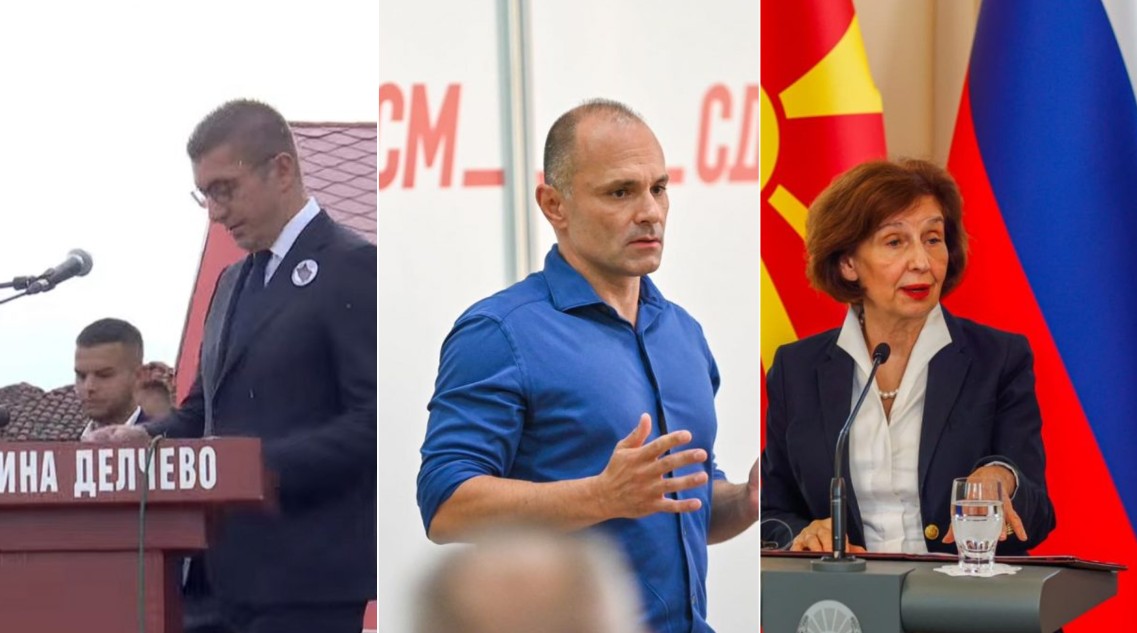
When Hristijan Mickoski called for national unity from Razlovci, a place deeply rooted in the country’s revolutionary tradition, the message was not partisan. It was strategic. It was a call to build a minimum national consensus on key issues that define the country’s future. Yet the response was rejection. Instead of dialogue, confrontation followed. Venko Filipče dismissed not only the proposal, but the very need for consensus. In times of external pressure and identity challenges, refusing even to engage in dialogue is not a political stance, it is a systemic risk.
At the same time, developments abroad reveal a deeper dimension of the crisis. Gordana Siljanovska-Davkova raised fundamental questions in Ljubljana about the nature of the EU accession process: is it a rules-based path, or an open-ended framework of political conditionality?
Her position was not anti-European. It was grounded in constitutional reasoning — reforms are necessary, but not under coercive “constitutional engineering.”
The reaction she faced was telling: instead of substantive debate, political attacks prevailed.
The claim that constitutional amendments represent the “only path” forward lacks credibility without clear guarantees and enforceable mechanisms. Macedonia has already experienced the consequences of asymmetric concessions: each compromise has led to new demands. Citizens are not rejecting Europe, they are rejecting uncertainty and humiliation.
Today, the country stands before two distinct trajectories. One leads to a stable, economically resilient state with strong institutions and a clear, dignified position within Europe.
The other leads to prolonged dependency, fragile institutions, and chronic political distrust.
The first requires unity. The second thrives on division.
This is why calls for national cohesion are being resisted. A united Macedonia is harder to influence, harder to pressure, and harder to control. Division, on the other hand, creates space for short-term political gains and long-term structural weakness.
States rarely collapse suddenly. They erode gradually, when compromise becomes a substitute for strategy, when political interest overrides public interest, and when silence replaces accountability.
This is precisely why the present moment is not just another political episode, but a strategic turning point.
This is no longer a simple contest between government and opposition. It is a choice between a Macedonia that seeks to consolidate itself as a functional European state, and a Macedonia that remains structurally dependent and politically fragmented.
The call for unity is not about political alignment. It is about defining and defending core principles: sovereignty, identity, and the rule of law. Everything else is secondary.
History will not remember who was louder. It will remember who acted with responsibility when it mattered most. The question is no longer whether political actors agree, but whether they are capable of uniting when the state itself requires it.
The choice is clear: unity, or continued fragmentation.
