

(Niccolò Machiavelli)
Written by: Slobodan TOMIĆ

Slobodan TOMIĆ
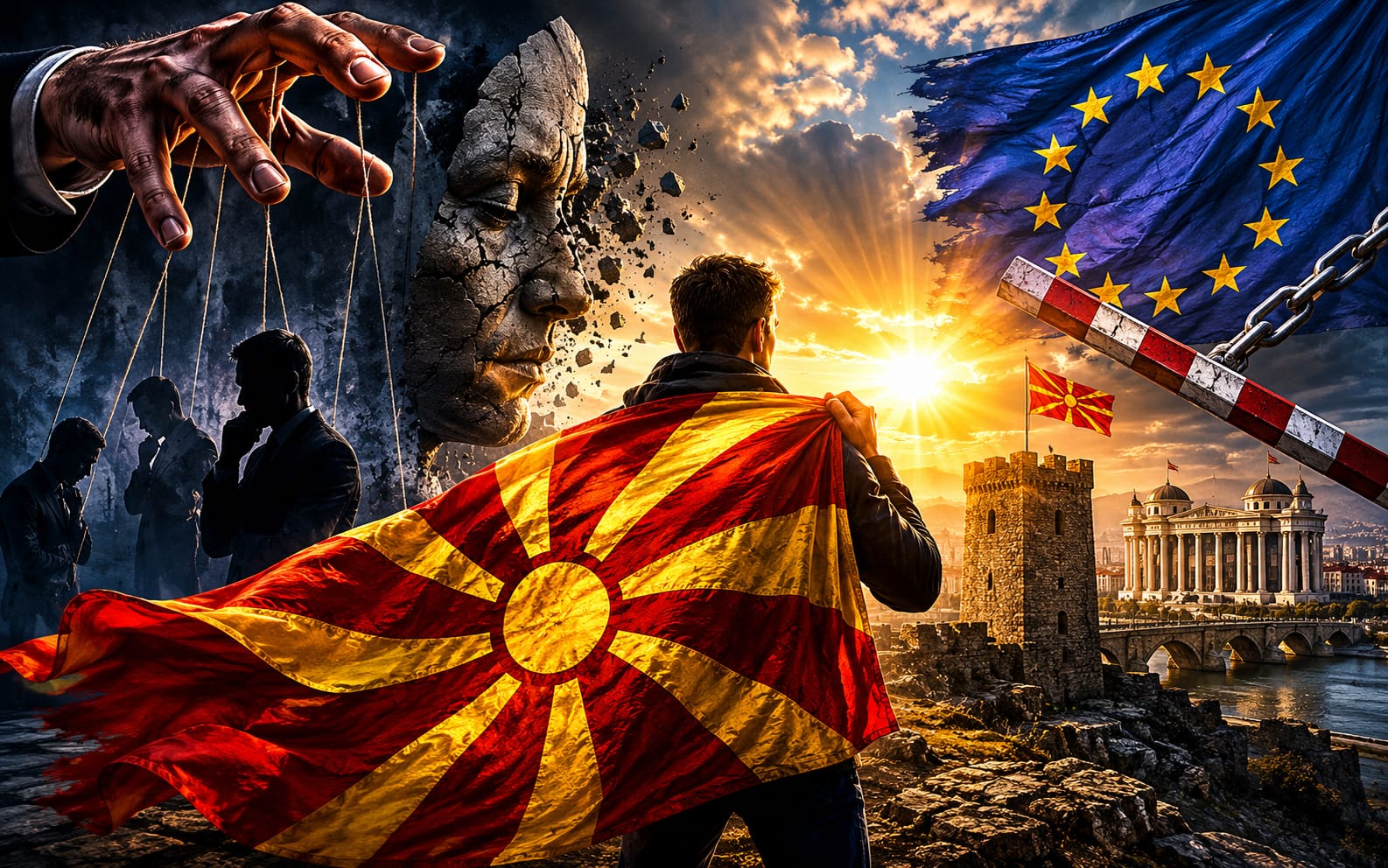
Macedonia today is not facing merely a diplomatic challenge.It stands in the middle of a historic clash between two concepts: whether it will become a state that will dignifiedly secure its place in Europe, or a territory kept in an endless waiting room until it renounces its own name, identity, language, and historical consciousness. That is precisely why the statements made by German journalist Michael Martens are not an ordinary media provocation, but a strong signal that more and more people in Europe are beginning to recognize the truth Macedonia has lived with for years: that part of Bulgarian policy does not seek compromise, but the gradual redefinition of the Macedonian nation.When Martens speaks of a “policy of destroying Macedonia from within,” he is not referring to classical military or territorial aggression.He is speaking about something far more sophisticated, a process in which a state is pushed to question itself, deny itself, and ultimately renounce its own foundations.That is the most dangerous form of pressure: when what is demanded is not merely political concessions, but a transformation of consciousness itself.This brings us to the essential question: why, at such a historic moment, does Macedonia still lack genuine national unity?Why, when Prime Minister Hristijan Mickoski extends a hand for a common national strategy, does part of the opposition continue repeating the clientelist refrain that “constitutional amendments must happen at any cost”? Politics is not merely mathematics of votes. Politics is the ability to recognize the gravity of a historical moment, and today that moment demands statesmanship, not party calculation.This is where the greatest dilemma surrounding the conduct of Venko Filipče and SDSM emerges.When a political party insists on inserting Bulgarians into the Constitution without first securing clear guarantees for the Macedonian language, identity, and an end to historical conditionality, then a completely legitimate question arises: is this truly a vision for Europe, or fear of losing support from external centers of power? That is why part of the public increasingly perceives such an approach as clientelist, a form of politics in which satisfying foreign expectations becomes more important than building an internal national consensus.Macedonia is not blocking Europe. Macedonia is being blocked by a Europe that has for years sent contradictory messages.Today, even within the European Union itself, resistance to double standards is growing.The statements by Péter Magyar and Robert Fico are a clear sign that some European leaders already understand that the Balkans cannot be kept indefinitely in a waiting room while new geopolitical priorities emerge in parallel.When they say that the countries of the Western Balkans must not be bypassed, they are in fact admitting that the European Union risks losing its own credibility.The initiative of Friedrich Merz for a new enlargement dynamic reveals something very important: Europe knows that the current model is unsustainable. Yet at the same time, resistance to that initiative demonstrates that the Union itself is entering a period of internal fragmentation.In such a situation, Macedonia must act with extreme caution.If it rushes forward without guarantees, it risks permanent national consequences.If it withdraws entirely, it risks geopolitical isolation.That is why Mickoski’s strategy at this moment is built around something long absent from Macedonian politics: an attempt to balance the European perspective with the preservation of dignity.This is precisely why his messages about a “dignified path toward the EU” resonate with a large portion of the public.For the first time in a long while, Macedonia is not approaching Europe with its head bowed, but with the position that European integration must not become synonymous with national self-denial.That does not mean anti-European politics.Quite the opposite.It means demanding that Europe respect its own principles.At the same time, the new American strategy for the Balkans carries enormous significance.Washington is clearly signaling that the era of “nation-building” is over and that an era of partnerships has begun.This is a dramatic shift. The United States no longer wishes to act as a tutor over the Balkans, but as a partner to stable and functional states, and this directly places Macedonia before a historic test: whether it can transform itself into a serious, predictable, and strategic partner.Within this new geopolitical architecture, Macedonia gains an extremely important role.It is no coincidence that the United States speaks about energy corridors, infrastructure, organized crime, and regional stability. Macedonia is a crossroads.But a crossroads can become either a bridge or a battlefield. That is precisely why Washington insists on local responsibility. Americans will no longer spend political capital rescuing elites incapable of building a functional state on their own.This is also where one can see why Mickoski is attempting to strengthen Macedonia as a credible partner both for the EU and for the United States. His policy moves in several directions simultaneously: stabilizing institutions, ensuring economic predictability, maintaining a clear pro-NATO orientation, and restoring the sense that the state possesses red lines.In international politics, nobody respects a country that has no position of its own.Yet the greatest danger facing Macedonia does not come only from abroad.It comes from internal division. From elites that for years transformed the national question into a tool for daily political survival.From parties incapable of rising above narrow partisan interests. From the habit of immediately labeling anyone who speaks about dignity as a “radical,” when the truth is exactly the opposite: it is radical to demand that an entire nation endlessly prove that it exists.Today Macedonia stands between three powerful currents: European uncertainty, American geopolitical repositioning, and Bulgarian pressure for historical redefinition.In such times, only states with clear national consciousness and political maturity survive.Everything else is a recipe for long-term instability.That is why the question is no longer simply whether Macedonia will enter the European Union. The real question is what kind of Macedonia will enter it — upright or broken, dignified or stripped of identity, as a partner or as a warning of what happens when a state begins to renounce itself.
