

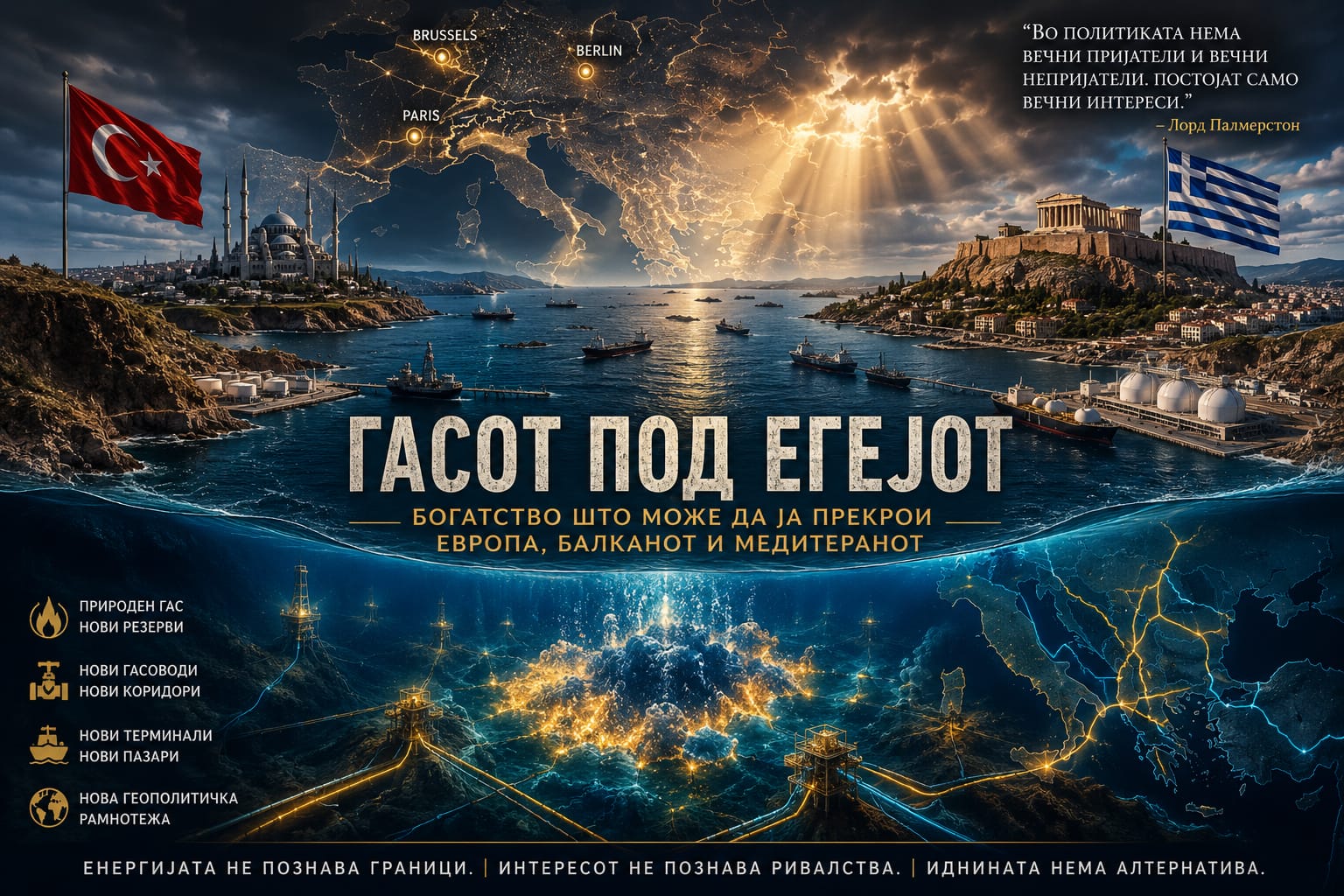
“NATIONS HAVE NO PERMANENT FRIENDS OR PERMANENT ENEMIES. THEY HAVE ONLY PERMANENT INTERESTS.
Lord Palmerston
By: Slobodan TOMIC

There are moments in history when the world believes it is witnessing the most important events unfold before its eyes, while the real transformations are quietly taking shape far from the headlines.
That was true of empires.
That was true of wars.
That was true of the great economic revolutions that altered the course of civilizations.
And it may be true once again today.
While political crises, elections, conflicts, and daily headlines dominate public attention, a far more profound story may be emerging beneath the waters of the Aegean Sea.
For generations, the Aegean represented rivalry, tension, and strategic competition between Turkey and Greece.
It was a sea associated with disputes, military confrontations, competing maritime claims, and conflicting visions of regional influence.
Yet history teaches us that geography can suddenly acquire a completely different meaning when energy enters the equation.
Today, the Aegean is no longer merely a body of water separating two neighboring nations.
It is becoming one of the most strategically significant energy theaters of the twenty-first century.
Beneath its waters and throughout the broader Eastern Mediterranean lie resources that have attracted the attention of governments, energy corporations, investors, military planners, and geopolitical strategists across the globe.
Natural gas has become far more than a commodity.
It has become power.
Influence.
Security.
Leverage.
The modern world runs on energy, and nations that control energy routes increasingly shape political outcomes far beyond their borders.
This reality became even more evident as Europe intensified its search for diversified energy supplies and new strategic corridors capable of reducing vulnerabilities and strengthening long-term energy security.
In this new environment, the Eastern Mediterranean has emerged as one of the most important geopolitical crossroads on Earth.
Every new exploration project.
Every seismic survey.
Every diplomatic meeting.
Every energy partnership.
Every maritime discussion.
Carries implications that extend far beyond the region itself.
The stakes are enormous.
Not because of symbolism.
Not because of historical narratives.
But because energy has become the currency of geopolitical influence.
The question is no longer whether the Aegean matters.
The question is how much it may matter in the decades ahead.
If significant energy resources are successfully developed and integrated into broader regional infrastructure, the Eastern Mediterranean could evolve into a critical component of Europe’s future energy architecture.
Such a development would transform investment flows.
It would reshape transportation networks.
It would create new economic centers.
It would redefine strategic partnerships.
It would alter the balance of influence throughout the Mediterranean basin.
In such a scenario, Turkey occupies a uniquely important position.
Its geography places it at the intersection of Europe, Asia, the Middle East, and the Caucasus.
It is a natural bridge between producers and consumers, between energy resources and global markets.
At the same time, Greece possesses strategic advantages as a gateway into the European energy system.
Its ports, infrastructure, and location offer significant opportunities for connecting regional energy supplies to European demand.
When these realities are viewed together, a remarkable geopolitical equation begins to emerge.
Not an equation built on friendship.
Not an equation built on ideology.
But an equation built on interests.
History repeatedly demonstrates that interests often achieve what emotions cannot.
Former rivals become partners.
Historic adversaries become stakeholders in common projects.
Long-standing disputes are reassessed when economic opportunities reach sufficient scale.
This is not idealism.
It is realism.
And realism has always been the true language of geopolitics.
That is why serious strategic thinkers increasingly focus on a simple but profound question:
Could the economic logic of energy eventually become stronger than the historical logic of rivalry?
Could natural gas become a catalyst for a new era of cooperation where conflict once dominated?
Could shared prosperity prove more valuable than perpetual confrontation?
These questions are no longer theoretical.
They are central to discussions taking place in diplomatic circles, energy boardrooms, policy institutions, and strategic planning centers around the world.
Because the consequences extend far beyond Turkey and Greece.
They affect Europe.
They affect global energy markets.
They affect investment strategies.
They affect the broader balance of power across the Mediterranean and beyond.
The struggle over the future of the Aegean is therefore no longer simply a dispute about islands, maritime boundaries, or competing historical narratives.
It has become part of a much larger contest over the future energy map of Europe.
And that is precisely why this story deserves far greater attention than it currently receives.
For beneath the waters of the Aegean lies more than natural gas.
There lies the possibility of a new strategic reality.
A reality capable of influencing economic growth, regional stability, diplomatic relations, and geopolitical alignments for decades to come.
The world has witnessed similar turning points before.
Moments when geography became destiny.
Moments when resources reshaped politics.
Moments when economic interests transformed relationships once thought impossible to change.
Perhaps the Eastern Mediterranean is approaching such a moment now.
Perhaps the story unfolding beneath the waves is not merely about energy.
Perhaps it is about the future architecture of power itself.
FINAL STRIKE
History remembers the moments when geography becomes destiny and resources become instruments of transformation.
The Aegean may be approaching such a moment.
Not because it contains only natural gas.
But because it may contain one of the keys to Europe’s future energy security, the Mediterranean’s future geopolitical balance, and a new era in which strategic interests become stronger than centuries of rivalry.
And when interests become stronger than history, the future begins to rewrite the past.
Slobodan Tomic
Political Analyst and Columnist
