

“Justice is the highest virtue, because it encompasses all other virtues.”
— Aristotle (384–322 BC)
By Slobodan Tomic

Slobodan Tomic
In European politics, the most important messages do not always emerge from official declarations, summit conclusions or signed treaties. Sometimes they appear in documents with no formal legal force, yet with considerable political influence. Such documents are the so-called non-papers—informal policy papers that often reveal the direction in which Europe’s political decision-makers are thinking.
Today, the European Union faces a fundamental question: what kind of Europe does it want to build? A Europe with different tiers of membership and varying levels of integration, or a Europe that remains faithful to the principle that every country meeting the accession criteria deserves full membership?
At the heart of this debate are two competing non-papers, presenting two distinct visions for the future of the European project. Once again, the Western Balkans—and Macedonia in particular—find themselves at the center of that discussion.
The First Non-Paper: Gradual Integration
The first concept advocates gradual integration into the European Union.
It envisages deeper economic integration, broader access to EU programmes, participation in selected European policies and the opportunity to benefit from parts of the European framework even before formal accession.
At first glance, the model appears pragmatic. It could connect candidate countries more rapidly with European institutions while allowing them to adapt progressively to EU standards.
Yet it also raises a fundamental question.
Would this become a genuine bridge towards full membership, or could it evolve into a permanent intermediate status between candidacy and accession?
This is where the central dilemma lies.
For decades, the EU’s enlargement policy has rested on a simple principle: reforms have a clear destination. If that destination becomes blurred or is replaced by long-term associate membership, then the very philosophy of European enlargement inevitably comes into question.
The Second Non-Paper: Europe of Equal Rules
The second non-paper, backed by seven EU member states—Italy, Austria, Croatia, the Czech Republic, Greece, Slovakia and Slovenia—offers a different vision.
Its message is clear: the ultimate objective for the Western Balkans must remain full membership of the European Union.
No privileged intermediate zone.
No second-class membership.
No permanent categories of integration.
Instead, a Europe where every country is judged according to the same rules, the same standards and the same accession criteria.
Its authors warn that creating permanent intermediate categories would undermine confidence in the enlargement process. If candidate countries begin to believe that the goalposts are constantly shifting, both the incentive for reforms and the EU’s influence throughout its neighbourhood will inevitably weaken.
Two Visions, One European Question
This is no longer merely a diplomatic discussion.
It is a question of the European Union’s credibility.
The European idea has never rested solely on economics, institutions or the single market. It has always been built on trust—the belief that the same rules apply equally to everyone.
Once that trust is weakened, the strength of the European project itself begins to erode.
Macedonia: A Test of Europe’s Credibility
For Macedonia, this debate is anything but theoretical.
For more than two decades, the country has pursued its European path, implementing reforms, making difficult political choices and expecting that every fulfilled obligation would bring it one step closer to full EU membership.
Yet many citizens increasingly feel that the destination has moved further away instead of coming closer.
That is precisely why today’s debate over the two non-papers matters so much for Macedonia.
It raises one essential question:
Does the European perspective still lead to membership—or merely to an endless waiting room?
Friedrich Merz’s Message
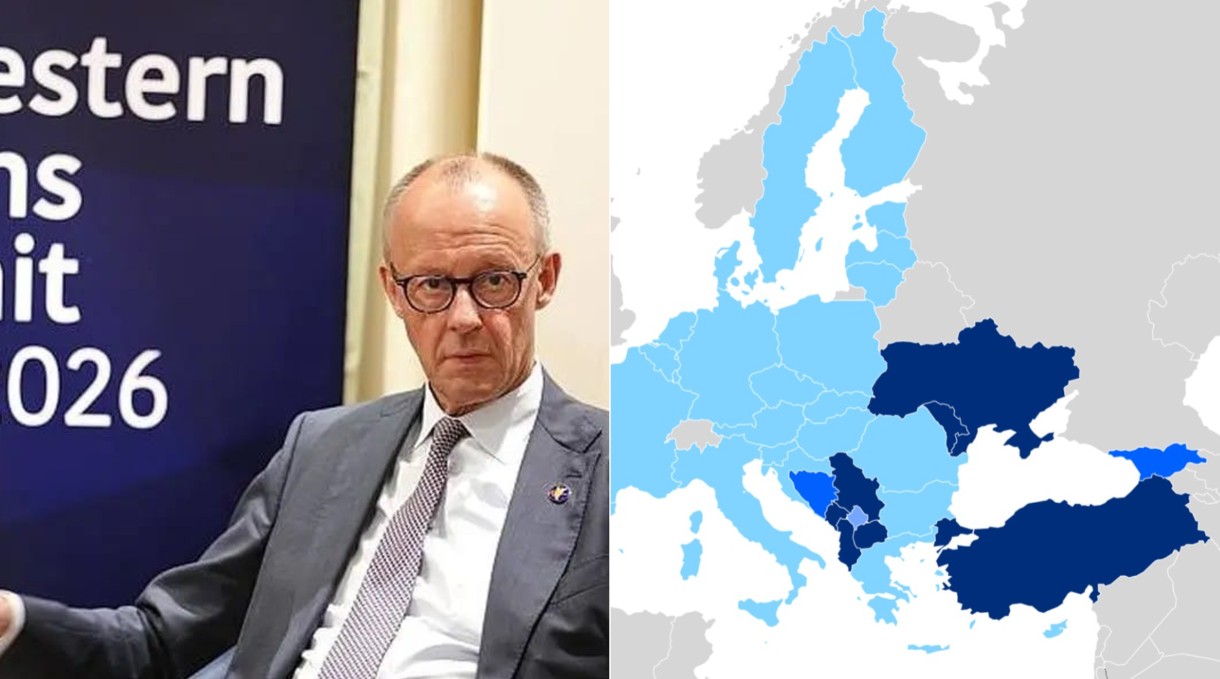
Meanwhile, German Chancellor Friedrich Merz has once again revived the idea of introducing associate membership for Ukraine and the Western Balkan countries, including Macedonia.
He pointed out that the European Union has not admitted a single new member for thirteen years, despite long-standing promises made to several European nations.
His warning was unequivocal:
“If we lose our credibility, we will lose those countries as well. Geopolitically, that would be the worst thing that could happen to Europe.”
His remarks add further weight to the dilemma raised by the two non-papers.
If associate membership is clearly defined as a transitional step towards full accession, it could become a useful instrument for accelerating integration.
If, however, it becomes a substitute for full membership, Europe risks creating a permanent category of countries trapped between candidate status and accession.
This is precisely why the second non-paper carries particular significance: it insists that full membership must remain the final objective, rejecting the creation of permanent second-tier categories within Europe.
Macedonia’s Silent Capital
Macedonia should not view Europe merely as a political destination.
It should see Europe as a partnership built on knowledge, trust and shared values.
In the twenty-first century, a nation’s greatest strength is no longer measured by territory, population or natural resources.
Its greatest strength is its people.
Macedonia possesses generations of citizens who have distinguished themselves across Europe and beyond.
Professors and researchers.
Doctors and engineers.
Entrepreneurs and business leaders.
Young people studying at European universities.
A diaspora that has contributed for decades to European economies, institutions and societies.
This is Macedonia’s silent capital.
A resource rarely mentioned in diplomatic papers, yet perhaps the strongest bridge connecting Macedonia with Europe.
Europe at a Crossroads
Ultimately, these two non-papers represent far more than diplomatic documents.
They reflect two competing visions for Europe’s future.
One proposes gradual levels of integration.
The other defends equal rules, equal standards and a clear accession perspective for every country fulfilling the required criteria.
In that context, Chancellor Friedrich Merz’s latest remarks are politically significant. They demonstrate that the future of enlargement is no longer merely an academic or diplomatic debate. It has become one of the defining geopolitical questions facing the European Union.
If the EU truly wishes to preserve its credibility, every new integration model must be explicitly designed as a pathway to full membership—not as its replacement.
Otherwise, the risk of creating a multi-tier Europe could further weaken confidence among candidate countries.
The choice Europe faces today will shape not only the future of the Western Balkans.
It will also shape the future of the European Union itself.
Because Europe is not built solely through treaties, institutions and policies.
Europe is built on trust.
And trust exists only when the same rules apply equally to everyone.
Macedonia should not remain a country endlessly waiting for decisions made elsewhere.
It should continue demonstrating its value through reforms, knowledge, institutional maturity and, above all, through its people.
Because the strongest bridge between Macedonia and Europe will not be built by politicians alone.
It will be built by those who create trust.
Those who generate knowledge.
Those who prove, through their work, that Macedonia is not merely a candidate for Europe—but a country that can and deserves to become an equal member of the European family.
