

“There is nothing more dangerous for a state than being governed by people whose only ideology is personal interest and whose only diplomatic skill is unconditional capitulation.”
(Niccolò Machiavelli)
By Slobodan TOMIĆ

Slobodan TOMIĆ
The Macedonian political scene has once again become the stage for a paradoxical and almost tragicomic spectacle.
The very people who, for nearly a decade, promoted capitulation as “statesmanship,” who turned national sovereignty into loose change for purchasing international sympathy, and who left the country in institutional devastation, now shamelessly presume to lecture others on diplomacy.
The opposition parties SDSM and DUI, together with their well-known network of party loyalists, clientelist structures and exhausted political figures, from Zoran Zaev and Dimitar Kovačevski, through Ali Ahmeti and Venko Filipče, to Andrej Žernovski and Ljubomir Frčkoski,have launched a coordinated political offensive.
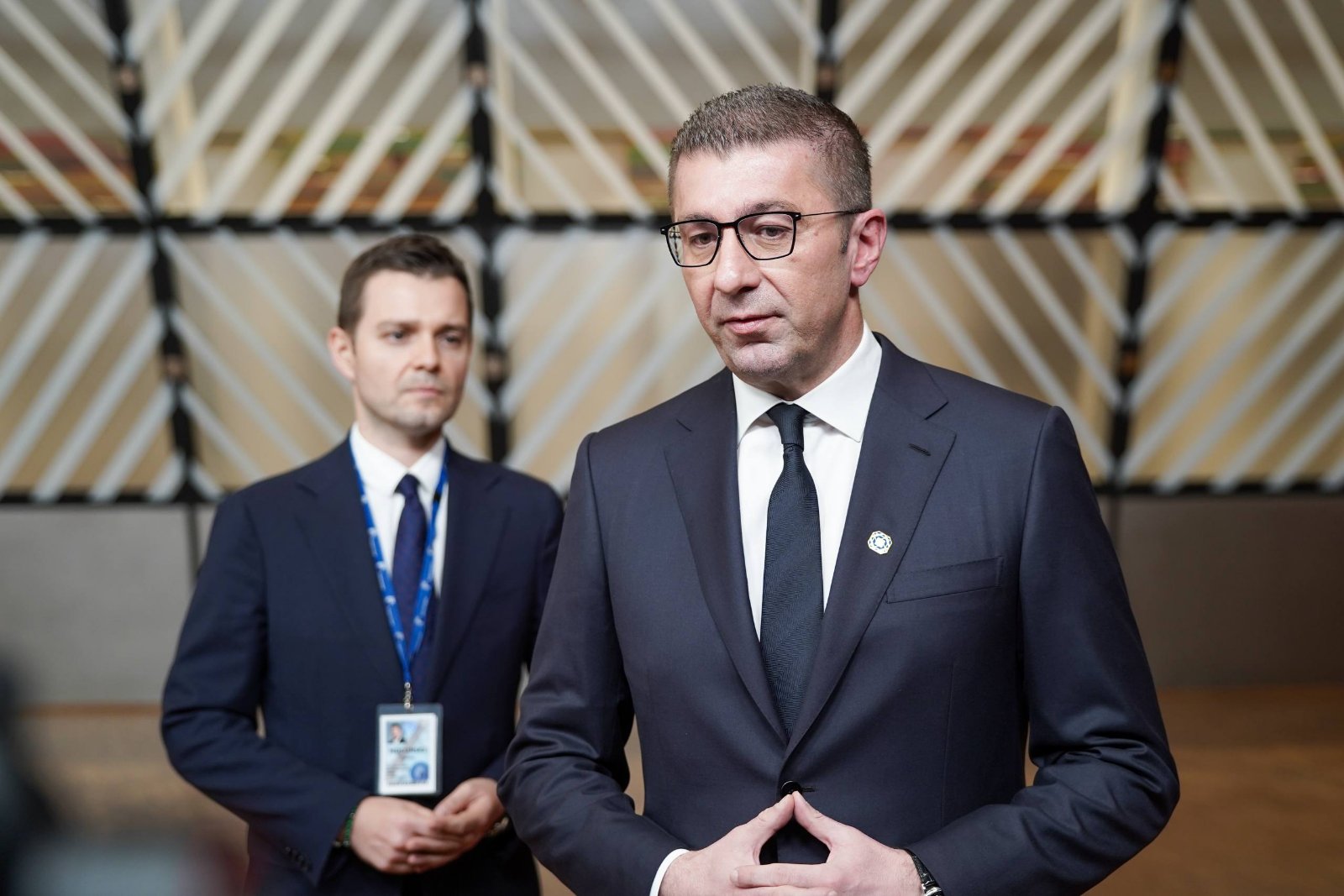
Their primary targets are Prime Minister Hristijan Mickoski and the Minister of Foreign Affairs and Foreign Trade, Timčo Mucunski.
Why such anxiety?
Because the new Government has established a standard completely unfamiliar to them: diplomacy based on principles, strategic vision and unwavering red lines.
To understand the essence of this political confrontation, however, one must carefully examine the facts, the motives and the credibility of those who are now the loudest critics.
Negotiations Behind Closed Doors: Diplomacy versus the Sale of National Identity
The opposition’s reaction to Minister Mucunski’s interview with MIA, in which he confirmed that discreet talks are being conducted to unblock Macedonia’s European path, was entirely predictable in its hysteria. These circles accused the Government of holding “secret negotiations,” deliberately ignoring the fundamental principles of international law and diplomatic practice.
In the serious world of international relations, discreet diplomacy is one of the essential instruments for resolving complex geopolitical disputes. It allows ideas to be tested, bridges to be built and sustainable compromises to be explored away from public pressure and daily political populism.
The difference between what SDSM and DUI practiced and what Mickoski and Mucunski are pursuing is fundamental, conceptual and diametrically opposed.
The SDSM–DUI Model (2016–2024): Their “negotiations” were not diplomacy but the systematic execution of external demands. They accepted virtually every condition placed before them.
They changed the country’s constitutional name, signed the Treaty of Good Neighbourliness that later became the source of successive blockades, and accepted the so-called French Proposal, incorporating historical and identity-related issues directly into the European Union’s negotiating framework. They had no red lines. Their doctrine was simple: surrender everything today in order to remain in power for one more day.
The Mickoski–Mucunski Model: The new Government negotiates from a position of national integrity. It has made it clear that dialogue will continue, but that membership in the European Union cannot come at the price of erasing the Macedonian people. Questions of identity, history, language and culture are excluded from any form of bargaining. At the same time, these discussions also focus on protecting Macedonia’s economic, trade and business interests, demonstrating that diplomacy has finally been placed in the service of citizens and the national economy rather than political survival.
The Diplomatic Corps: Decades on the Public Payroll Without Results
To understand why certain political figures reacted so nervously to Prime Minister Mickoski’s call to clean up the “swamp,” one must examine both their record and their legacy.
During the past eight years, Macedonia’s diplomatic network was transformed into a comfortable refuge for compromised party officials, political clients and individuals whose only qualification was unquestioning loyalty to the party leadership. Sending figures such as Ljubomir Frčkoski to New York or involving personalities like Andrej Žernovski in diplomatic appointments did not strengthen the country’s international position. These were classic clientelist transactions—rewards for political loyalty and opportunities for a comfortable life financed by Macedonian taxpayers.
What is their actual record?
What did these people achieve while walking the corridors of Brussels, Washington, New York and Sofia?
Did they secure even a single major foreign direct investment?
Did they obtain even one meaningful safeguard for the Macedonian national identity?
Did they open new opportunities for Macedonian businesses abroad?
The answer is devastating: none.
Their balance sheet consists of little more than empty rhetoric, while enormous expenses were paid by the Macedonian people.
Today, the same Andrej Žernovski—a man who has spent more than two decades directly or indirectly supported by the state budget, appears at press conferences criticizing Mickoski’s Ilinden address in Pelince.
He claims to be offended by the term “political sediment.”
Yet when a political establishment spends more than €32 billion in public funds during its years in power while failing to build a single major infrastructure project, modernize hospitals, strengthen higher education or leave behind a stronger country,instead producing only debt and institutional decline,the expression “political sediment” is no insult.
It is a precise and uncompromising diagnosis.
Geopolitical Blindness: The Opposition’s Remarkable Devaluation of Washington
Perhaps the clearest demonstration of SDSM’s political decline lies in its attitude toward today’s geopolitical realities and toward Macedonia’s principal strategic partner,the United States.
Richard Grenell’s recent private visit to Skopje,a senior member of President Donald Trump’s closest circle and Special Presidential Envoy for Special Missions,and his meetings with Prime Minister Mickoski and Minister Mucunski sent a powerful diplomatic signal.
Grenell publicly praised Skopje and indicated that Macedonia’s new leadership has established direct channels of communication with influential centres of power in Washington.
How did the opposition react?
When senior American political figures and close associates of key decision-makers met with Macedonia’s Foreign Minister, SDSM leader Venko Filipče and his political strategists dismissed them as “outsiders.”
This was not merely political misjudgment.
It represented an extraordinary display of diplomatic amateurism.
Political Blindness: SDSM demonstrated that it fails to understand the changing international environment. It remains trapped in outdated political assumptions while the Government led by Mickoski develops direct, long-term and respected relations with the new American administration.
Frustration and Resentment: Having themselves often functioned merely as implementers of external expectations, they now find it difficult to accept that a VMRO-DPMNE Government is increasingly treated as a respected and equal partner in international affairs.
Conclusion:
The Era of Bowing Has Ended
Macedonia stands at a moment of profound historical and diplomatic transformation.
The period during which Macedonia’s national interests were negotiated away in the corridors of Sofia and Brussels has come to an end.
SDSM, DUI, Zaev, Kovačevski, Ahmeti, Filipče and Žernovski have every reason to feel uneasy. Their concern does not stem from anxiety about the country’s future but from the realization that their political model has been fundamentally rejected.
Citizens no longer accept their narrative regarding the European path.
The new diplomatic course led by Hristijan Mickoski and Timčo Mucunski has demonstrated that Macedonia can negotiate wisely, discreetly and with dignity.
The country finally has leadership that understands its red lines, defends its identity, language and culture while simultaneously building stronger economic and diplomatic partnerships from Washington to Brussels.
The political remnants of the past may continue holding press conferences, but history has already delivered its verdict:
Macedonia’s future will be built with its head held high,not with its spine bent.
