

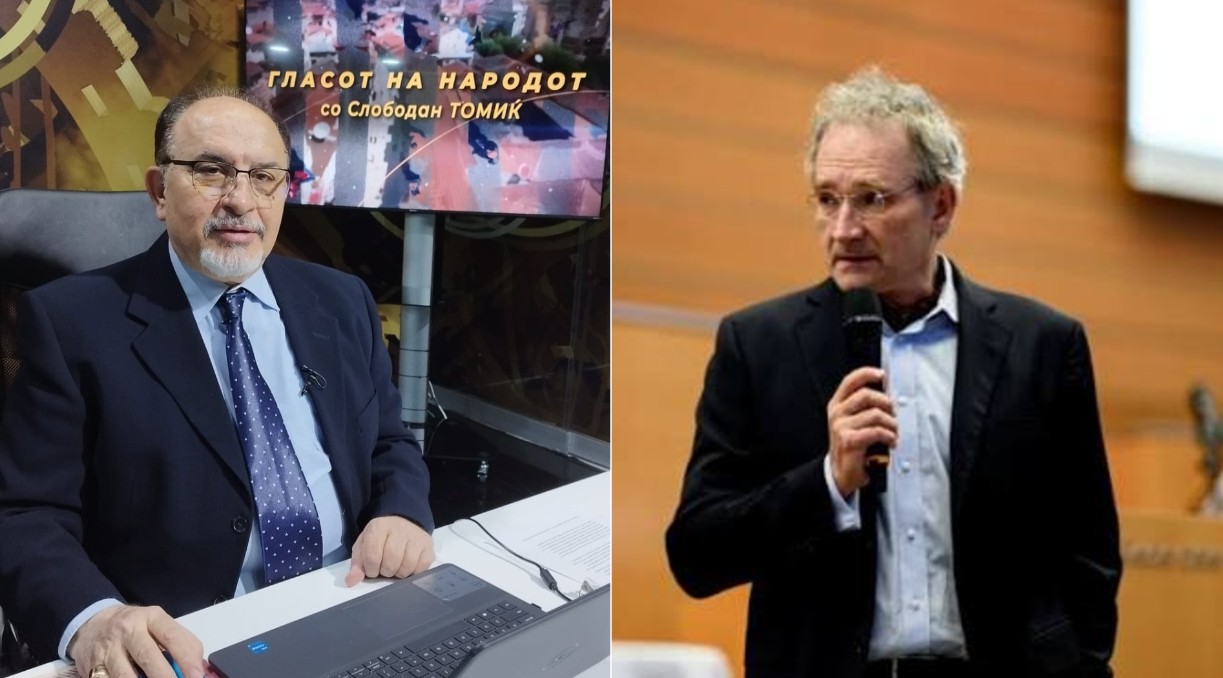
LANDMARK CONVERSATION FROM OHRID ON HUMANISM, EUROPE, MACEDONIA, EUROPEAN VALUES, DOUBLE STANDARDS, NATIONAL IDENTITY, LANGUAGE, CULTURE, EUROPEAN INTEGRATION, WAR, ARTIFICIAL INTELLIGENCE AND THE FUTURE OF HUMANITY
Interviewed and written by: SLOBODAN TOMIC
In a world once again marked by wars, political divisions, crises of values, migration, technological transformation and profound questions about Europe’s future, a conversation about humanism acquires particular significance.From Ohrid, the city of Saint Clement and Saint Naum, to contemporary Europe, its institutions and its dilemmas, this interview addresses some of the most fundamental questions of our time: human dignity, freedom, truth, national identity, language, culture, European integration, the responsibility of intellectuals and the future of humanity.Our interlocutor is the recipient of the World Award of Humanism 2026, whose professional work encompasses conflict analysis, strategies for conflict resolution and transformation, as well as major cultural projects aimed at reconciliation and mutual understanding between peoples and nations.His words from Ohrid carry particular significance for Macedonia.When he speaks about the European Union’s treatment of candidate countries, different standards between member states and candidate countries, national identity, language, culture and historical heritage, he raises questions that, from the Macedonian perspective, are not abstract European theories, but a profound political and civilizational experience.In this mega exclusive interview, Benedikter speaks directly and without diplomatic ornament.
“THIS AWARD IS A HIGH APPRECIATION OF MY WORK”
Slobodan Tomic:
Mr. Benedikter, first of all, congratulations on receiving the World Award of Humanism 2026. What does this prestigious recognition mean to you personally and professionally?
Benedikter:
Mr. Tomic, thank you for the congratulations. Personally, it is a great honor and pleasure for me that such a prestigious circle of intellectuals, scientists, and writers as the Ohrid Academy of Humanism has bestowed this award upon me.As far as my professional life is concerned, I view this award as a high appreciation of my work, particularly in the fields of conflict analysis and that specific cultural work aimed at overcoming tensions and antipathies between peoples and nations.Regarding conflict analysis, a major focus was placed on developing strategies for conflict resolution and transformation.The regions in which and about which I worked were the Balkans, the South Caucasus, and the Black Sea region, with a particular focus on Ukraine and Transnistria.Equally interesting, but with a significantly greater impact, was the aforementioned cultural work.I was given the opportunity to curate exhibitions dealing with Austrian and Central European contemporary history, usually in the context of bilateral or multilateral cooperation projects aimed at promoting reconciliation and mutual understanding between former enemy nations.I have been lead curator, curator, and manager of major cross-border exhibitions in which Austrian and Czech regions developed a shared perspective on the recent past, poisoned by destructive conflicts and showdowns in the 1940s — the Nazi occupation of Bohemia from 1938 to 1945 and the expulsion of millions of German-speaking citizens in 1945/46.These exhibitions of 2009 and 2013 were visited by a total of more than 600,000 people and represent milestones in the mental and intellectual reunification of these parts of Central Europe.
“HUMANISM IS NEITHER IDEOLOGY NOR RELIGION — IT IS AN ATTITUDE TOWARD LIFE”
Slobodan Tomic:
According to the Ohrid Academy of Humanism, you have been recognized for your contribution to contemporary humanism. What does it mean to you to be a humanist in a world marked by wars, divisions and global crisis?
Benedikter:
To me, being a humanist means living intellectually within a coordinate system defined by a series of specific skills, qualities, and virtues, to use an old-fashioned term here.From my perspective, the most important ones are: education, knowledge of past events, awareness of thought models from bygone eras, curiosity, reason, realism, empathy, and skepticism toward the absolute, as well as toward dogmas of any kind and direction.Humanism is neither ideology nor religion; rather, it is an attitude toward life.It determines the way of thinking, of viewing the world, and, of course, the way of acting.More humanism among elites worldwide, but also among the general population, is naturally desirable because humanism also dictates a corresponding approach to conflicts between social groups, peoples, and nations, as well as the types of solutions I favor.
“OHRID IS THE YOUNGEST, 21ST-CENTURY EMANATION OF SPIRITUAL OHRID”
Slobodan Tomic:
Ohrid is a city with a profound spiritual and cultural heritage, connected with Saints Clement and Naum and with European civilization. What is the significance of receiving such a global award in a place with such historical meaning?
Benedikter:
The spiritual and cultural heritage of Ohrid is indeed unique.The Literary School founded by St. Clement and St. Naum laid the foundations for Balkan-Slavic cultural identity.It was here, 1,100 years ago, that the history of the Balkans was steered onto a path that has maintained its direction ever since.St. Clement and St. Naum provided the Balkan Slavs with their Christian identity, while simultaneously giving Christianity in the Balkans its Slavic essence.What they and their disciples created endured and was so resilient that although the Ottomans were able to destroy Balkan-Slavic statehood, they could not erase the specific cultural DNA of the subjugated peoples.While Islam was able to gain a foothold to a certain extent, it never led to a comprehensive religious and cultural overwriting.Similarly, communism, as a short-term agent of destruction, failed to strike or shatter the core of the Christian-Balkan-Slavic essence.For me personally, places where events of such historical significance occurred always exude a specific aura.In my perception, this is all the more true for Ohrid, as this city remains a place where people think in grand dimensions to this very day.The Ohrid Academy of Humanism is the best proof of this — or, as I recently phrased it in my acceptance speech:“The Academy of Humanism … stands in the line of tradition” of St. Clement and St. Naum and “is the youngest, 21st-century emanation of spiritual Ohrid.”Receiving a humanism award in such a city is far more moving than if it had taken place in any ordinary settlement.
“WHEN ONE VALUE IS TURNED INTO AN ABSOLUTE, BALANCE IS LOST”
Slobodan Tomic:
Which values do you believe are most threatened today? Human dignity, freedom, truth, solidarity or respect for diversity?
Benedikter:
Depending on where we look in the world, individual values or even several of them at once are under threat.Afghanistan, Iran, and North Korea stand out as deterring examples of an extreme kind. Here, the multiple threat to values is a sad part of everyday life.When we direct our attention to Europe, these grievances are naturally not pronounced in such an extreme manner. Nevertheless, undesirable developments exist, although here, too, the threats vary depending on the nation.We are all aware that different standards prevail regarding freedom, human dignity, truth, and respect for diversity in countries like Sweden compared to Serbia, for example.Instead of losing myself in examples and assessments, I would like to address a fundamental, undesirable development.In many European societies, this has crept into the debate surrounding the much-discussed values.Depending on the agenda and socio-political stance, individual values are interpreted one-sidedly and absolute importance is assigned to them.In the next step, societal acceptance for these hypertrophied values is demanded or even enforced.Under catchphrases such as diversity and human dignity, highly questionable theories, such as gender being a purely social construct are being imposed on the whole of society in countries like Germany, for instance.The overemphasis on the alleged rights of small and smallest minorities carries the risk of restricting freedom of speech and expression for all those who refuse to follow the theories of various activists from the left-woke spectrum.Furthermore, the continuous fragmentation of societies into ever-smaller groups undermines solidarity within these communities.In addition, the various identity-politics issues distract from the truly central questions, such as distributive justice, generational justice etc.
“EUROPEAN VALUES CAN BECOME A SCREEN HIDING THE REAL REASONS AGAINST FURTHER ENLARGEMENT”
Slobodan Tomic:
The European Union often speaks about European values. How do you define these values, and do you believe they are always applied equally to all nations and citizens?
Benedikter:
According to Article 2 of the Treaty on European Union, the European values are as follows:Human dignity.Freedom.Democracy.Equality.The rule of law.Human rights.All of these values must be respected and upheld. And that is absolutely good and right.Regarding the fact that individual values are made absolute and overemphasized at the expense of others in specific societies, see above.Now, concerning their equal application to all nations, the following must be noted:States that are not yet members of the Union tend to be judged more critically by the Union regarding their respect for these values when it comes to accession prospects than those states that are already members.This may not be fair, but it stems from a comprehensible logic.The discussion surrounding the respect for and preservation of values serves as an excellent screen to conceal the actual reasons why certain EU members do not wish for further states to join.This statement, of course, carries particular weight when viewed from the Macedonian perspective.Fundamentally, however, I would like to note the following regarding EU values:Not least because of the focus on these values and the preoccupation with socio-political and identity-politics questions associated with them, the definition of meaningful goals and strategies to achieve them has been neglected over the past two decades.The EU and its member states lack an industrial policy that could have prevented Europe from falling behind the US and China.The EU and most of its member states also lack a defense policy that would have prevented Europe from being militarily weak and thus dependent on the US.Furthermore, the EU and its member states lack a migration policy capable of effectively shielding the Union’s borders and removing illegally entered economic migrants from EU territory.And what should also be noted regarding the topic of values:In the definition of European values, essential subjects have been completely disregarded.Nowhere is there a reference to the cultural and spiritual heritage of Europe or the shared cultural and intellectual roots of its peoples.The very essence that connects these nations in terms of a long and shared development has been left unaddressed.What a declaration of spiritual and intellectual bankruptcy.
“NATIONAL IDENTITY IS NOT AN OBSTACLE TO EUROPE”
Slobodan Tomic:
Can European integration and respect for universal humanist principles coexist with the protection of a nation’s identity, language, culture and historical heritage?
Benedikter:
Within the political spectrum shaped by internationalist ideas, as well as within the European institutions, there are powerful forces that view national identity as an obstacle to European integration.In the worldview of these schools of thought, nations, and particularly nation-states, are meant to dissolve into a European superstate.I consider this concept to be wrong, oblivious to history, and, moreover, highly likely to achieve the exact opposite.The truly fascinating aspect of Europe is the diversity of its cultures and nations.This diversity is, in truth, Europe’s strength, which can even provide momentum to political and economic integration.After all, the appreciation of and respect for cultural diversity serve as positive impulses and a solid prerequisite for deep and trustful cooperation.For Macedonia, this question has particular weight, because national identity, language, culture and historical heritage are not merely political categories.They are part of the living memory of a people.European integration should therefore not be understood as a condition for abandoning one’s own identity, but as an opportunity for Europe’s different identities to cooperate without being erased.
“INTELLECTUALS HAVE A MORAL RESPONSIBILITY TO SPEAK AGAINST INJUSTICE”
Slobodan Tomic:
As an intellectual and recipient of the World Award of Humanism, do you believe academics and public figures have a moral responsibility to speak openly against injustice?
Benedikter:
Yes, absolutely.This moral responsibility exists.
“ARTIFICIAL INTELLIGENCE COULD MAKE HUMANITY LESS INTELLIGENT”
In his address in Ohrid, Benedikter also raises one of the most important questions of our time, the relationship between humanity and technology.Humanity today possesses capabilities unlike those of any previous generation.We know how to split the atom, alter genetic blueprints and create technologies of enormous power.But this is precisely where the danger also lies.Benedikter warns of uncontrollable algorithms capable of making autonomous decisions concerning life and death, perhaps even nuclear strikes.But he also sees an everyday danger.Artificial intelligence can now generate school essays, newspaper articles, blogs, political speeches and academic papers within seconds.According to him, AI has the potential to become the first innovation that does not make humanity as a whole smarter, as was the case with the printing press or even the internet; but duller.
This is not merely a technological warning.It is a warning about the future of the human mind.
“WAR, EUROPE AND HUMANITY’S DESTRUCTIVE POTENTIAL”
In his speech, Benedikter also addresses Ukraine, war, global powers, freedom and human dignity.He points to Afghanistan, China, Iran, North Korea and Russia, warning that freedom and human dignity face serious threats in different parts of the world.He speaks about the concentration of wealth, global capital, the erosion of European economic and innovative power, and the political weaknesses of Europe.His criticism of contemporary Europe is direct: according to him, the European Union has moved from being a beacon of hope to becoming a minor player on the global chessboard.He also warns about divisions within European societies and unresolved questions surrounding migration.“THERE IS NO REASON TO BE DISCOURAGED”
Slobodan Tomic:
Finally, if you could send one message to young people in Europe and around the world, what is the most important lesson you would like them to remember?
Benedikter:
Europe, the world, their state may be cause for concern, ranging from climate change and the never completely banned danger of nuclear war to the threats and undesirable developments I have already mentioned.Yet, let us not be discouraged by them, for as a species, humans possess an even greater potential alongside their destructive capabilities.And this is the creative impulse given to us — the creative and constructive essence that, until now, has always maintained the upper hand.May every single person who is able to do so contribute to ensuring that this remains the case in the future.
OHRID AS PROOF THAT THE LIGHT PREVAILS
In his speech upon receiving the World Award of Humanism 2026, Benedikter develops perhaps the most powerful message of his entire address.He invokes Goethe and the figure of Mephistopheles as a symbol of the destructive forces within humanity and history.From Faust, he quotes:“Ein Teil von jener Kraft, die stets das Böse will und stets das Gute schafft.”“Part of that power, not understood,Which always wills the Bad,And always works the Good.”And here he finds hope.Ohrid, in his reading of history, is evidence.When Saint Clement, Saint Naum and their disciples created their literary and spiritual school, the age was not peaceful.While learned monks translated, wrote and created with devotion, wars devastated entire regions.And yet, great things were born.Again and again, history demonstrates that creation and destruction can exist simultaneously.But according to Benedikter, in the end the scales tip in favour of the creative impulse.
“THE LIGHT, THE CREATIVE POWER OF HUMANITY, PREVAILS”
Benedikter returns once again to Ohrid in his speech.He sees today’s Ohrid as evidence that light can outlive the destructive forces of history.The city of Saint Clement and Saint Naum has survived centuries of wars, political transformations, empires and ideologies.And today it exists within an independent Macedonian state.His message from Ohrid therefore carries a simple but profound meaning:Threats exist. Mephistopheles is lying in wait. But at this moment, the light prevails.
LEOPOLD FORSTNER, WHEN BEAUTY IS CREATED IN THE MIDST OF WAR
In his speech, Benedikter also tells an almost forgotten story from Austrian and Balkan history.In 1917, during the First World War, the Austrian Art Nouveau artist Leopold Forstner arrived in the Balkans.While Europe was engulfed in a devastating war, he travelled, sketched, photographed and collected materials documenting the culture of the Balkan peoples.His motifs included portraits, folk types, traditional costumes, cultural techniques, churches and mosques, cityscapes and landscapes.Just under 100 large-format drawings and around 50 photographs have survived.In addition, Forstner acquired around 2,000 objects for Austrian museums, ranging from textiles to weapons, documenting the high level of technical, artisanal and artistic skills within the region’s folk culture.
For Benedikter, this forgotten episode is a wonderful parable:Even in a time of the worst destructiveness, there is simultaneously room for the creative and the beautiful.But good does not triumph automatically.Good can triumph only because creative forces do everything in their power to push back destruction.
“THE OHRID ACADEMY OF HUMANISM IS AN IMPERATIVE OF OUR TIME”
At the conclusion of his address, Benedikter expresses his deepest respect and gratitude to all those who created and sustain the Ohrid Academy of Humanism.He accepts the award with joy and humility.But his message goes far beyond a personal distinction.It is a message to humanity.To intellectuals.To culture.To Europe.To Macedonia.And to the future.Ohrid, in Benedikter’s reading of history, is not merely a city of the past.Ohrid is proof that a civilizational light can survive centuries of darkness.From Saint Clement and Saint Naum, through literature, education and spirituality, to the contemporary Ohrid Academy of Humanism, the same thread continues:that humanity should create rather than destroy; enlighten rather than darken; connect rather than divide.And this is why, from Ohrid, Benedikter sends a message that sounds like a call:Do not allow darkness to convince you that the light has disappeared.Because the history of Ohrid testifies to the opposite.
THE LIGHT REMAINS.
Interviewed and written by:SLOBODAN TOMIC
