

By Slobodan TOMIC

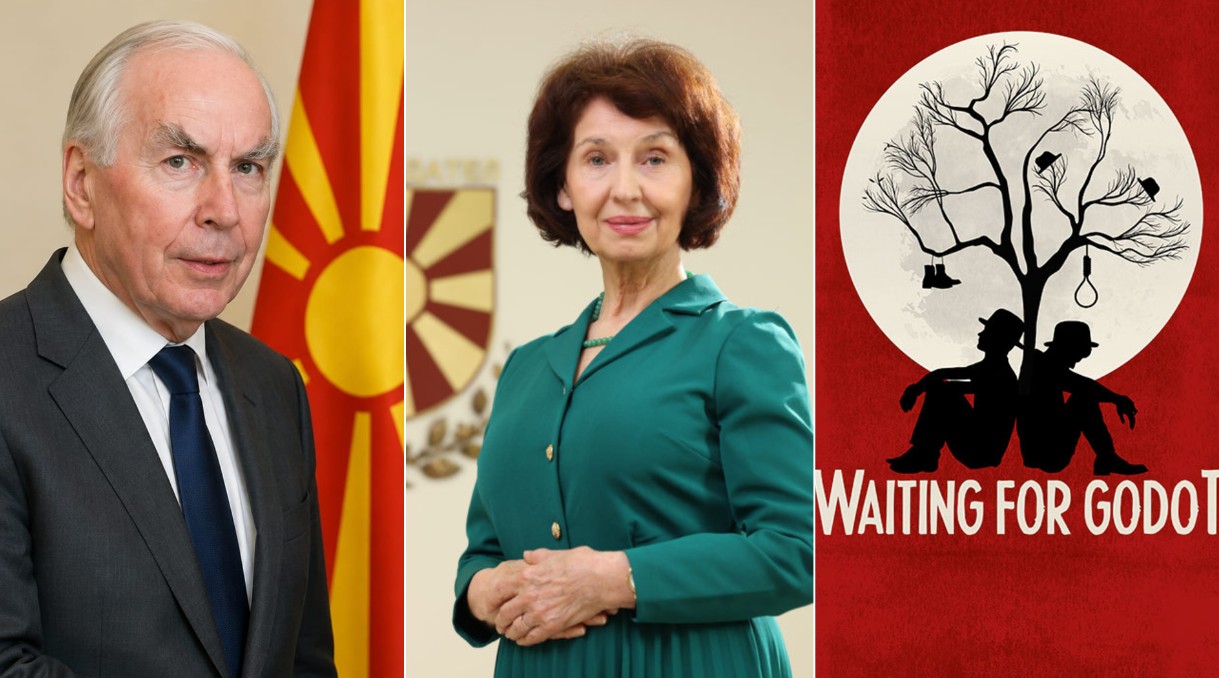
IF SOME FORMER AND CURRENT POLITICIANS HAD REASONED LIKE ROBIN O’NEILL, THEY WOULD HAVE STOPPED WAITING FOR GODOT LONG AGO
“If some former and current politicians reasoned like Robin, they would not be waiting for Godot.”
This sentence by President Gordana Siljanovska-Davkova, written after the exclusive interview with British diplomat Robin O’Neill, perhaps captures most precisely the essence of his historic testimony.
Because this interview is not merely a conversation with a diplomat from another time.
It is a conversation with a man who was inside history.
A man who was sent to Macedonia in 1992, at a moment when the country was only beginning to defend its independence, its name and its place in the international order.
And more than three decades later, his words sound as though they are addressed directly to the present.
GODOT IS NOT COMING
In Samuel Beckett’s Waiting for Godot, two men wait for someone who is supposed to arrive.
But he never comes.
Only a message arrives saying that he will come tomorrow.
And so they wait again.
That is why “Godot” became a symbol of endless waiting — of hoping that someone else will arrive and solve what we have failed to solve ourselves.
And when President Siljanovska-Davkova wrote:
“When some former and current politicians reasoned like Robin, they would not be waiting for Godot,”
she perhaps, even unintentionally, opened the central question raised by the entire interview.
Did Macedonian politics wait for Godot for too long?
We waited for Brussels.
We waited for Washington.
We waited for Athens.
We waited for Sofia.
We waited for the next mediator.
The next summit.
The next agreement.
The next historic opportunity.
And in the meantime, history was moving on.
THE MAN WHO WAS IN THE MIDDLE OF THE DISPUTE
Robin O’Neill does not speak from a textbook.
He speaks from his own diplomatic experience.
In July 1992, when the United Kingdom held the Presidency of the European Community, he was Secretary of the Conference of Member States dealing with the common policy towards the Republic of Macedonia.
He was subsequently appointed by the British Foreign Secretary as the Presidency’s representative for Macedonia.
He arrived in Skopje in September 1992.
And then, as he himself recalls, he understood that the issue was not simply a dispute over one name.
It was a question of history, identity and national sentiment.
KIRO GLIGOROV — “THE PRINCIPAL LEADER OF THE NEW REPUBLIC”
When he speaks about Kiro Gligorov, O’Neill does not use empty diplomatic formulas.
He says:
“I have a very high opinion of President Gligorov.”
And he adds that Gligorov was:
“the principal leader of the new Republic of Macedonia,”
who constantly worked to avoid conflict with neighbouring countries, foreign powers and the different ethnic communities within the state.
O’Neill also remembers something that cannot be found in official diplomatic documents.
At the end of his mission, Gligorov invited his wife to Macedonia.
The following morning, in Skopje, the President joined them for breakfast.
“It was a gesture of great kindness and something for which I will always be grateful.”
There is something more than diplomatic recollection in these words.
There is human testimony.
“REPUBLIC OF MACEDONIA, SKOPJE”
Then we come to one of the most important points in the entire interview.
The formula:
“Republic of Macedonia, Skopje.”
O’Neill confirms that the idea came from the Macedonian side as an attempt to find a compromise with Greece while retaining the word Macedonia.
And then comes the sentence that deserves to be read again:
“I thought that was, in essence, the best solution.”
This is not a statement by a politician of today.
It is not the statement of a partisan analyst.
It comes from a British diplomat who was directly involved in the process.
And when I asked him whether Europe could have shown greater political courage, his answer was simply:
“Yes.”
One word.
But behind that word stands an entire history of missed opportunities.
“I WAS NOT REALLY A MEDIATOR”
Perhaps the most difficult testimony in the interview comes when O’Neill speaks about his own mandate.
“The biggest difficulty was that I actually was not really a mediator.”
Why?
Because, as he himself explains:
“I had no authority to persuade either side to change its position.”
And then comes the sentence that pulls back the curtain:
“My instructions were to get the Republic of Macedonia to change its name.”
This is not a minor historical observation.
It is testimony about the balance of power under which the negotiations were conducted.
O’Neill does not hide the reality.
He acknowledges that Greece believed his task was to come to Skopje and tell Macedonia:
You must change your name.
And here we return once again to the question:
Where was the genuine negotiation?
GREEK POLITICS AND THE MISSED OPPORTUNITY
O’Neill does not oversimplify Greek politics.
He says that political will was lacking.
And he explains:
“It was essentially a question of the domestic political situation in Greece and disagreements between the political parties.”
But he goes further.
He says that there were people in Greece who would have liked the Republic of Macedonia:
“to disappear and be absorbed into Serbia.”
That is one of the hardest sentences in the entire interview.
But precisely because it is difficult, it must be said.
Not in order to create new hatred.
But in order to understand the political atmosphere in which the independent Macedonian state was born.
FYROM — “IT WAS NOT A GOOD NAME”
O’Neill also has a clear position on the temporary reference FYROM.
“I don’t think FYROM was a good name.”
Why?
Because, in his view, it created the impression that the Republic of Macedonia was somehow less independent than it actually was.
And then:
“It is a nation in its own right and should be accepted as a fully independent nation in its own right.”
This is perhaps one of the strongest statements in the interview regarding statehood.
PRESPA — THE COMPROMISE AND ITS PRICE
O’Neill does not shy away from the Prespa Agreement either.
He acknowledges that the agreement enabled Macedonia to enter NATO.
And he says:
“In international relations, sometimes compromises have to be made.”
At the same time, he acknowledges why the agreement is unacceptable to part of Macedonian society.
That distinction is important.
Understanding a compromise does not mean denying the pain of those who believe that the price was too high.
That is precisely why his testimony is not black and white.
It is diplomatic.
And human.
BULGARIA — THE SAME HISTORY REPEATING ITSELF?
Here the interview from the past enters directly into the present.
O’Neill says:
“I regret that in some ways the position that Greece had 35 years ago is being repeated.”
And he calls on the European Commission to examine seriously and scientifically whether the dispute with Bulgaria is real.
When asked whether there is a need for constitutional changes, his answer is:
“I don’t believe there is.”
And regarding the continuation of European negotiations:
“Yes. I believe the negotiations should continue.”
He goes even further.
In his view, the European Commission and the Member States should put pressure on Bulgaria in the interests of stability and economic progress in the Southern Balkans.
“WE NOW LIVE IN THE 21ST CENTURY”
One of the shortest but strongest messages comes when I asked him whether history is once again being used as an instrument of political pressure.
His answer:
“Yes.”
And then:
“We now live in the 21st century.”
This may be one of the central messages of the entire interview.
Not because history should be forgotten.
But because history should be understood — not endlessly used as a weapon.
EUROPE AND THE DANGER OF LOSING CREDIBILITY
O’Neill does not spare the European Union either.
When asked whether the EU risks losing its credibility in the Western Balkans, his answer is:
“Yes, I think it does.”
And he explains that the Union should work toward achieving its objective rather than following the political interests of individual Member States.
His advice to Macedonia is simple:
“Be patient.”
But for O’Neill, patience does not mean passivity.
On the contrary.
He calls on Macedonia to continually remind Member States and the European Commission how important it is for the country to be admitted to the European Union.
In other words:
Patience — yes.
Waiting with folded arms — no.
And once again, we return to Godot.
MACEDONIA AFTER 35 YEARS
O’Neill does not see Macedonia as a failed story.
On the contrary.
He says that Macedonia has consolidated its independence, organised its economy and established good internal relations among its different communities.
But he also speaks about corruption and problems in political life.
Despite this, his final assessment is encouraging:
“Despite the difficulties, I believe that the Republic of Macedonia has made real progress over the past 35 years and has a future and an opportunity.”
It has a future.
It has an opportunity.
Those words come from a man who saw Macedonia during its most difficult beginnings.
AND IN THE END, MACEDONIA AS A HUMAN STORY
Perhaps the most beautiful part of the interview is not the political one.
It is the human one.
O’Neill says that he is proud to have been given the opportunity to try to resolve the dispute.
He says he is grateful for the warm welcome he received from the Government and people of Macedonia.
And he describes Macedonia as:
“A wonderful and fascinating country.”
That is the Macedonia that remained in his memory.
Not merely as a diplomatic subject.
But as a country.
As people.
As memories.
DON’T WAIT FOR GODOT
And now, after the entire interview, President Siljanovska-Davkova’s sentence carries even greater weight:
“When some former and current politicians reasoned like Robin, they would not be waiting for Godot.”
Because O’Neill showed us what it means to talk even when the sides are far apart.
To seek a solution even when the solution appears impossible.
To accept that compromise exists.
But also to understand that every compromise has a price.
To have political courage.
To be patient.
But not to be passive.
And perhaps this is precisely the lesson for Macedonian politicians — both those of yesterday and those of today:
Do not allow history to govern politics instead of you.
Do not wait for someone else to come.
Do not wait for the next mediator.
Do not wait for the next summit.
Do not wait for “better times.”
Do not wait for Godot.
Because Godot, as we know from Beckett, may never come.
And a state cannot stand still while waiting.
Macedonia has the right to compromise.
It has the right to a European future.
It has the right to its own positions.
It has the right to defend its interests.
But it also has an obligation to think like a state.
To talk.
To negotiate.
To decide.
To take responsibility.
Robin O’Neill did not give us a ready-made answer for the future.
He gave us something perhaps more valuable:
testimony that history always leaves room for those who have the courage to recognise it.
And that is why his interview should not remain merely a television programme.
It is a document of an era.
A testimony from a man who was there when Macedonia was taking its first steps.
And perhaps the most important question that remains after this interview is not:
“When will Godot come?”
But:
“When will we finally stop waiting for him?”
Because states that wait for their future to be created by others lose that future.
States that have the courage to create it themselves write history.
Do not wait for Godot.
Reason. Think. Negotiate. Decide.
And act as a state.
As Robin O’Neill reasons.
