

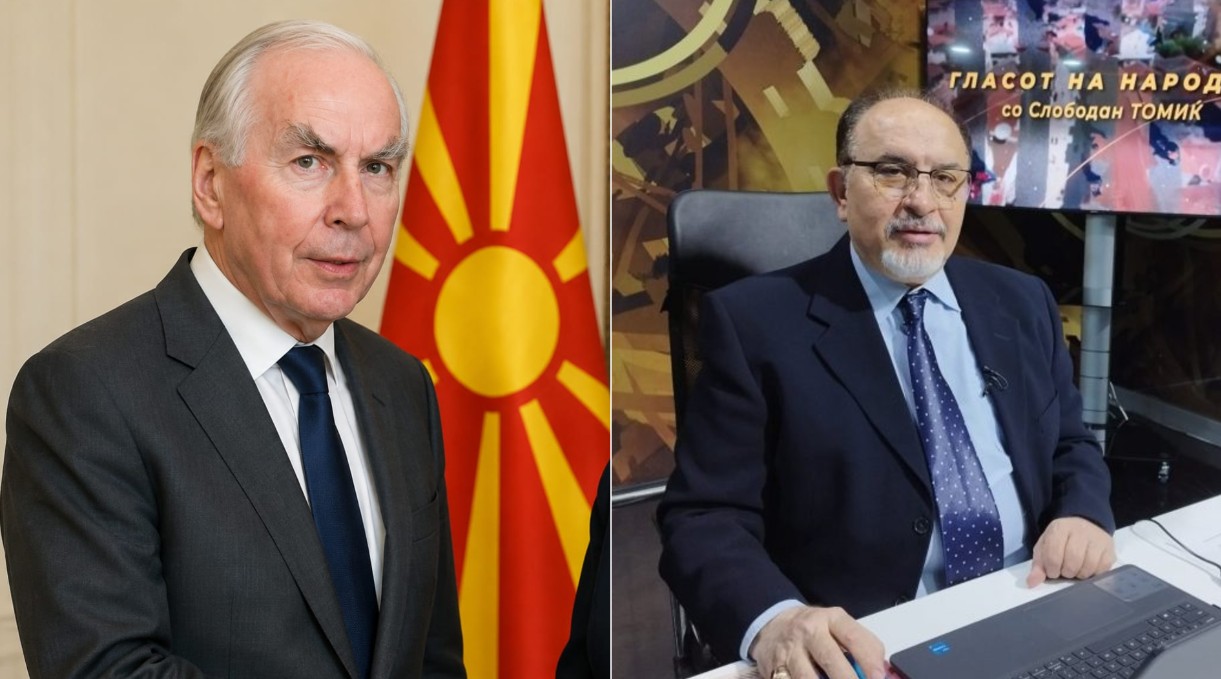
A historic testimony for “Voice of the People with Slobodan Tomic” on Vistel Television
Author and interviewer: SLOBODAN TOMIC
On the occasion of 35 years of Macedonian independence, British diplomat Robin O’Neil, who was directly involved in the diplomatic efforts surrounding the Macedonian-Greek dispute during the first years of Macedonia’s independence, gave an exclusive interview to “Voice of the People with Slobodan Tomic” on Vistel Television.
More than three decades later, O’Neil speaks openly about his diplomatic mission in Macedonia, his relationship with the first President Kiro Gligorov, the proposal “Republic of Macedonia, Skopje,” the Greek position, missed opportunities, the Prespa Agreement, Bulgaria, the European Union and Macedonia’s future.
QUESTION & ANSWER
- THE BEGINNING OF THE MISSION
SLOBODAN TOMIC:
Your Excellency, when did you first become involved in the dispute between Macedonia and Greece over the name?
ROBIN O’NEIL:
In July 1992, the United Kingdom held the presidency of the European Community. During that month, it organized a conference of all European Community members to discuss a common policy towards the Republic of Macedonia.
I was the organizing secretary of that conference. Afterwards, I was appointed by the British Foreign Secretary to become the Presidency Representative for Macedonia.
SLOBODAN TOMIC:
Did you already believe that this was not simply a dispute over the name, but also a question of history, identity and national feelings?
ROBIN O’NEIL:
No. I discovered that when I first went to Skopje at the beginning of September 1992. - KIRO GLIGOROV — THE LEADER OF THE NEW REPUBLIC
SLOBODAN TOMIC:
From your personal diplomatic experience, what kind of man was Kiro Gligorov?
ROBIN O’NEIL:
I have very high regard for President Gligorov. In my view, he was the principal leader of the new Republic of Macedonia and worked at all times to avoid conflict with the other republics, with outside countries and with the ethnic groups within the Republic.
SLOBODAN TOMIC:
How would you describe your relationship and friendship with him?
ROBIN O’NEIL:
President Gligorov treated me at all times with great courtesy.
At the end of my mission, he invited my wife to come to Macedonia for a holiday. We stayed in a comfortable guest house.
On our first morning in Skopje, as we were having breakfast, President Gligorov joined us for breakfast.
I thought that was a gesture of great kindness, and one for which I shall always be grateful to him.
SLOBODAN TOMIC:
How important was President Gligorov during the first years of Macedonia’s independence?
ROBIN O’NEIL:
During independence, he worked to maintain peace and to bring the Albanian-speaking community in Macedonia fully into the life of the country, as far as possible.
SLOBODAN TOMIC:
Did Gligorov have a clear vision of how to preserve Macedonian identity while avoiding a prolonged conflict with Greece?
ROBIN O’NEIL:
President Gligorov faced difficulties with all of Macedonia’s neighbours.
Greece, Albania, Serbia and Bulgaria all had disputes with Macedonia.
President Gligorov tried to find a middle way and opportunities with all of these countries.
SLOBODAN TOMIC:
What remains most vivid in your memory from your conversations with Mr. Gligorov?
ROBIN O’NEIL:
The long discussions about the need for the European negotiator and the wider world to accept that the new Republic contained the word Macedonia in its name.
For him, that was an essential principle. - “REPUBLIC OF MACEDONIA, SKOPJE”
SLOBODAN TOMIC:
You were closely associated with the proposal “Republic of Macedonia, Skopje.” How and when did that idea emerge?
ROBIN O’NEIL:
That idea came from the Macedonian side.
It was the proposal of Macedonia in an attempt to meet the objections of Greece that the name of the new Republic should not include the word Macedonia.
That was not acceptable to Macedonia, but they proposed the form “Republic of Macedonia, Skopje.”
SLOBODAN TOMIC:
What was the essential logic behind this formula?
ROBIN O’NEIL:
It was an attempt to retain the name Macedonia in a form that could be acceptable as a compromise formula.
SLOBODAN TOMIC:
Did you believe that this formula could provide a compromise without questioning Macedonian national identity?
ROBIN O’NEIL:
That was something for the people of Macedonia to decide. It was a compromise proposal.
SLOBODAN TOMIC:
How did the Macedonian leadership react?
ROBIN O’NEIL:
Both the Macedonian and Greek sides considered it.
I thought it was fundamentally the best solution.
SLOBODAN TOMIC:
And how did the Greek side react?
ROBIN O’NEIL:
The Greek side insisted that the name of the new Republic should not include the word Macedonia. - A MISSED HISTORICAL OPPORTUNITY
SLOBODAN TOMIC:
With the benefit of hindsight, do you believe that “Republic of Macedonia, Skopje” could have become a lasting solution?
ROBIN O’NEIL:
The conflict became a very unamicable issue in international relations. There were, however, possible solutions that could have been accepted in the Balkans.
SLOBODAN TOMIC:
Do you believe that Europe at that time could have shown greater political courage?
ROBIN O’NEIL:
Yes.
The principle had been accepted in the European Community that one country could say that an issue was so important that it could not make concessions, and that position was respected. - THE FIRST YEARS OF INDEPENDENCE
SLOBODAN TOMIC:
How do you assess Macedonia’s position during the first years after independence?
ROBIN O’NEIL:
Serbia made the establishment of the Republic of Macedonia as difficult as possible.
There were serious economic consequences. Macedonia was a landlocked country and found itself in a very difficult position.
SLOBODAN TOMIC:
Did the international community sufficiently understand the sensitivity of the Macedonian question?
ROBIN O’NEIL:
No.
SLOBODAN TOMIC:
How much did the dispute with Greece affect Macedonia’s Euro-Atlantic path?
ROBIN O’NEIL:
It made it more difficult for Macedonia to become part of the European Community and, most importantly, a member state of the European Union.
The opposition of Greece, and later that of others, made it impossible.
SLOBODAN TOMIC:
Do you believe Macedonia was placed in a position where it was constantly expected to make concessions?
ROBIN O’NEIL:
Yes, because of the attitude of Greece. - HISTORY AND THE BALKANS
SLOBODAN TOMIC:
Is the Balkans still paying the price for unresolved questions from the past?
ROBIN O’NEIL:
Yes. The passions and tensions of the past still have a considerable influence.
SLOBODAN TOMIC:
How much does history complicate diplomatic compromise?
ROBIN O’NEIL:
History influences policy. You need a government with the courage to confront the past.
SLOBODAN TOMIC:
Does European diplomacy sufficiently understand the historical context of Macedonia?
ROBIN O’NEIL:
Yes, I think we do, particularly after more than a hundred years. - THE MOST DIFFICULT MOMENTS WITH GREECE
SLOBODAN TOMIC:
What were the most difficult moments in your diplomatic experience with the Greek side?
ROBIN O’NEIL:
The difficulty with Greece was that they would never accept that this was a negotiation.
They thought that my task was to tell Macedonia that it must change its name.
I had one meeting with the Prime Minister of Greece at that time, Mr. Mitsotakis, at which he said, in effect, that if Macedonia surrendered and accepted a change of name, everything would be wonderful.
SLOBODAN TOMIC:
What were the principal Greek concerns?
ROBIN O’NEIL:
I believe that the principal Greek concerns were essentially a matter of Greek politics.
SLOBODAN TOMIC:
Did you ever feel that the Greek side was seeking not only a compromise over the name, but something more?
ROBIN O’NEIL:
I think that there were people in Greece who would have liked to see the Republic of Macedonia disappear and be absorbed into Serbia.
Then the question of the name Macedonia would itself disappear.
SLOBODAN TOMIC:
Were there moments when an agreement could have been reached but the political will was lacking?
ROBIN O’NEIL:
During my negotiations, the political will was lacking.
It was not there.
That was essentially a matter of the internal political situation in Greece and disagreements between the political parties.
SLOBODAN TOMIC:
What, in your view, was the greatest missed opportunity?
ROBIN O’NEIL:
I think the greatest difficulty was what I spoke about earlier: I was not really a mediator.
I had no powers to persuade either side to change its position.
My instructions were to get the Republic of Macedonia to change its name. - THE PRESPA AGREEMENT
SLOBODAN TOMIC:
From today’s perspective, how do you view the Prespa Agreement?
ROBIN O’NEIL:
It made possible the entry of Macedonia into NATO.
I can understand that it is not acceptable to some people in Macedonia, but in international relations, for success, you sometimes have to make compromises.
SLOBODAN TOMIC:
Do you believe that Prespa resolved the dispute or merely closed one chapter?
ROBIN O’NEIL:
For political reasons within Greece, I think the Prespa Agreement was the only solution at the time.
Whether it is possible to reopen the question now is a matter for later statesmen to consider. - FYROM
SLOBODAN TOMIC:
How do you assess the former reference FYROM?
ROBIN O’NEIL:
I do not think that the name FYROM was a good one.
It suggested that the Republic of Macedonia was somehow less of an independent country than it really was.
Although for a short time perhaps FYROM was acceptable, I do not think that the Republic of Macedonia would personally like to recall the term “Former Yugoslav Republic of Macedonia.”
It is a nation on its own merits and should be accepted as a fully independent nation on its own merits. - BULGARIA
SLOBODAN TOMIC:
Macedonia is now facing a serious dispute with Bulgaria. How do you view this issue?
ROBIN O’NEIL:
I regret that, in some ways, this resembles the position Greece took 35 years ago.
Within the European Union as it is today, the task of handling negotiations for the admission of a new country should be given first of all to the European Commission.
They should study scientifically and seriously whether this is a real problem.
SLOBODAN TOMIC:
Is there really any need for changes to the Constitution of Macedonia?
ROBIN O’NEIL:
I do not believe that there is.
In many countries, several languages are accepted for use, even in official business.
Today in Britain we have quite a large population who have come from India, and for some purposes we accept different languages.
With good sense, I believe this is not a fundamental problem.
SLOBODAN TOMIC:
You strongly criticized Bulgaria in my program in 2022. Are you still with that position?
ROBIN O’NEIL:
Yes.
I believe that negotiations should now be permitted to go forward.
It is a matter for the other member states of the European Union and the European Commission to put pressure, if you like, on Bulgaria to change its position for the sake of stability and economic progress in the Southern Balkans.
SLOBODAN TOMIC:
Are there similarities between the dispute with Bulgaria and the earlier dispute with Greece?
ROBIN O’NEIL:
I think so.
I am not very familiar with the politics of Bulgaria, but I think this is a matter of internal political dispute within Bulgaria which, with statesmanship, should be resolved.
SLOBODAN TOMIC:
Is history once again being used as an instrument of political pressure?
ROBIN O’NEIL:
Yes.
I think you can become too caught up, too preoccupied, with history.
I think we now have to live in the 21st century. - THE EUROPEAN UNION
SLOBODAN TOMIC:
How do you assess the European Union’s position regarding the Bulgarian-Macedonian dispute?
ROBIN O’NEIL:
The United Kingdom is no longer a member of the European Union and I am not familiar with the internal debates within the European Union.
But if the European Union wishes to take a wide view of the future of the Balkans, it must see that it is necessary to admit Macedonia as a member of the European Union.
SLOBODAN TOMIC:
Does the European Union risk losing credibility in the Western Balkans?
ROBIN O’NEIL:
Yes, I think it does.
The region is important to the European Union and it should be working to achieve that rather than following political partisanship or the interests of individual member states.
SLOBODAN TOMIC:
What would you advise Macedonia at this stage?
ROBIN O’NEIL:
To be patient, but at the same time to continue to stress to all member states of the European Union and to the European Commission the importance to them and to the Balkan region of admitting Macedonia to the European Union. - MACEDONIA AFTER 35 YEARS OF INDEPENDENCE
SLOBODAN TOMIC:
After 35 years of independence, how do you assess Macedonia today?
ROBIN O’NEIL:
I think Macedonia has made progress in many directions.
Economically, things have not been easy because Macedonia is a landlocked state with no easy outlets to other countries or the sea.
It is my impression that relations with the Albanian community are now much better than they were.
There are clearly problems, including corruption and the organization of political life, and there is further progress to be made.
SLOBODAN TOMIC:
What are the great achievements of the Macedonian state?
ROBIN O’NEIL:
The great achievements are that it has consolidated its independence, organized its economy and established good internal relations between different communities in the state.
Although it faces continuing difficulties, I believe that the Republic of Macedonia has made real progress over the past 35 years.
It has a future and an opportunity. - PERSONAL TESTIMONY — A GIFT FOR 35 YEARS OF INDEPENDENCE
SLOBODAN TOMIC:
Your Excellency, looking back at those years today, what are you most proud of?
ROBIN O’NEIL:
I am proud that I was permitted to act, to attempt to resolve a dispute over the name of Macedonia.
I am grateful to the government and the people of Macedonia for the warm welcome I received at all times.
I am happy that I made some progress on the issue, though at the time it was not possible to resolve it.
SLOBODAN TOMIC:
What memories do you have of Macedonia?
ROBIN O’NEIL:
I have very happy memories of the time I spent in Macedonia.
I found my diplomatic mission an interesting and rewarding one, even though in the end, and at the time, it was not successful.
I value the chance I was given both to carry out that mission and, in particular, to visit Macedonia, which I found a beautiful and fascinating country. - “REPUBLIC OF MACEDONIA, SKOPJE” — A FINAL REFLECTION
SLOBODAN TOMIC:
I personally believe that the formula “Republic of Macedonia, Skopje” was better than the present formula. What do you think?
ROBIN O’NEIL:
I think that a solution under which Macedonia retained its name for its own internal legislative purposes would have been a good solution.
But internationally it was not really possible.
I understand the objections to the present name, but at least it makes possible a future course under which Macedonia can join the European Union. - BULGARIA AND MACEDONIANS
SLOBODAN TOMIC:
Why, in your view, does Bulgaria have a problem recognizing Macedonians who live in Bulgaria and respecting their rights?
ROBIN O’NEIL:
I think that Bulgaria is quite wrong in its position.
A rather broader and more sensitive approach by Bulgaria is necessary. - THE FINAL MESSAGE
SLOBODAN TOMIC:
Your Excellency, finally, if you had to give one message today to the Macedonian people and to Europe, what would that message be?
ROBIN O’NEIL:
First, I have greatly valued our personal relationship over these past years.
And to your wider question, I would say that I still believe that closer integration of the countries of Europe is desirable, indeed necessary.
Macedonia should play its full part in that process.
Personally, I regret that the United Kingdom left the European Union.
I think it would have been much better if the United Kingdom had remained a member of the European Union.
SLOBODAN TOMIC:
Your Excellency, thank you very much for joining us, for this historic testimony and for giving this extraordinary interview to the Macedonian public.
ROBIN O’NEIL:
Thank you.
EXCLUSIVE AUTHOR INTERVIEW
ROBIN O’NEIL
British diplomat and former Presidency Representative for Macedonia
Interviewed by: SLOBODAN TOMIC
“VOICE OF THE PEOPLE WITH SLOBODAN TOMIC”
VISTEL TELEVISION
SPECIAL INTERVIEW MARKING 35 YEARS OF MACEDONIAN INDEPENDENCE
MACEDONIA — THE CHESSBOARD OF THE BALKANS
