

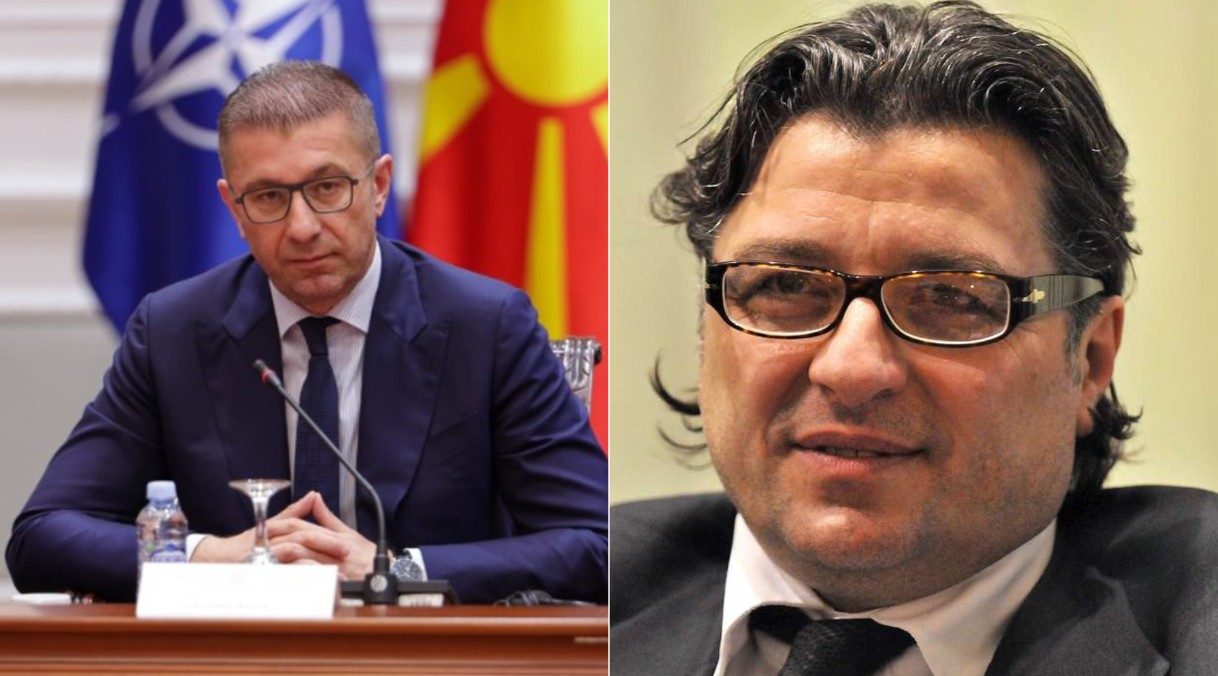
From “We Have One Name” to Today’s Lectures on Macedonia,
Three and a Half Decades of Words, Positions, and Political Turns
By Slobodan TOMIC

There is an old wisdom attributed to Socrates:
“The unexamined life is not worth living.”
I would continue it:
An unexamined political biography should not be the basis for judging others.
That is why today I am not writing about Ljubomir Frchkoski as a person.
I am not interested in his private life.
I am not interested in whom he likes or dislikes.
I am not interested in whether he politically likes or dislikes Hristijan Mickoski.
I am interested in the words.
I am interested in the positions.
I am interested in the facts.
And above all:
I am interested in Macedonia.
Because when a man with such extensive political and academic experience comes out today and labels VMRO-DPMNE a “betrayer of Macedonian national interests,” that is no longer ordinary political criticism.
That is a serious political accusation.
And serious accusations require serious evidence.
It is not enough to say:
“Betrayer!”
You have to show:
Where?
When?
With which document?
With which decision?
With which signature?
With which concession?
And this is where our story begins.
PROFESSOR, DO NOT JUDGE MACEDONIA BY A DOUBLE STANDARD
Frchkoski is now attacking the current government’s move concerning the idea of a joint resolution with Bulgaria.
But what exactly did Mickoski propose?
The proposal was for Macedonia and Bulgaria to jointly initiate a resolution in the European Parliament affirming the distinctiveness of the Macedonian identity and Macedonian language.
That is not a resolution asking Europe to tell us:
“You are Macedonians.”
No.
We already know that.
Our parents knew it.
Our grandparents knew it.
Generations before us knew it.
The Macedonian people did not appear the moment a European parliamentarian wrote a document.
The Macedonian language was not invented in Brussels.
Macedonian identity is not a European administrative category.
So what is the essence?
The essence is this:
to obtain political confirmation from precisely the state with which we have a dispute.
And here we come to Frchkoski.
“YOU ARE HUMILIATING YOURSELVES”? REALLY?
In the statement we are analyzing, Frchkoski turns the argument around like this:
If constitutional amendments are the condition, then why should we seek an additional resolution confirming the Macedonian people and state?
According to his logic, by doing so Macedonia is once again reopening the question of whether it is recognized at all.
And this is where he uses the argument of self-humiliation.
Well, this is where we have to stop.
Because there is a fundamental difference between:
asking someone to create you
and
asking someone to confirm that they will not challenge what already exists.
Those are not the same thing.
Mickoski is not asking Bulgaria to give him an identity.
He is asking Bulgaria to demonstrate that it can respect it.
He is not asking Bulgaria to create the Macedonian language.
He is asking it to stop politically problematizing its distinctiveness.
And if Bulgaria truly has no problem with that:
What is the problem with the resolution?
Accept it.
Vote for it.
Confirm it.
And that is it.
NOW — FRCHKOSKI OF 2005
And here comes the part that must be engraved into this story.
On May 19, 2005, in a text published in Vecher, Frchkoski was quoted as saying:
“The problem with the name is that we have nothing to give; it is ours. We have one name.”
And even more importantly:
“Nimetz does not understand that this is not a question of a name, but of identity.”
Wait.
Do not rush.
Let us read it once again.
“We have one name.”
And:
“It is not a question of a name, but of identity.”
So, at that time, Frchkoski understood the essence.
The dispute was not merely administrative.
It was not merely geographical.
It was not merely a diplomatic formula.
The dispute was about identity.
And today?
When Macedonia proposes international political confirmation of the Macedonian identity and language,
suddenly that becomes a problem?
SO WHAT CHANGED, PROFESSOR?
That is the question.
Not the insult.
Not the party.
Not Mickoski.
The question.
What changed?
Then:
“We have one name.”
Today:
“You are humiliating yourselves if you seek additional confirmation.”
Then:
“It is a question of identity.”
Today:
If a politician seeks an additional guarantee precisely for that identity,
that is wrong?
No, Professor.
Macedonia is not what changed here.
The argument changed.
And that is the essence of this column.
DO NOT ATTACK THE ONE ASKING FOR A GUARANTEE — ASK WHY THE GUARANTEE IS NEEDED
This is the whole point.
If nobody disputes the Macedonian language,
then confirm it.
If nobody disputes the Macedonian identity,
then confirm it.
If nobody disputes the Macedonian people,
then confirm it.
If everyone agrees that Macedonia is a state,
then confirm that without any ambiguity.
What is insulting about that?
What is humiliating about it?
On the contrary.
It can be a diplomatic test.
A test of the sincerity of the neighbor.
Because the real question is not:
“Why is Macedonia asking for a guarantee?”
It is:
“Why does Macedonia need a guarantee at all?”
That is the question from which we should not run away.
FRCHKOSKI USES THE HEAVIEST WORD
Let us return to his current political assessment.
Frchkoski labels VMRO-DPMNE a “betrayer of Macedonian national interests,” saying that it will be remembered that way.
Betrayer.
That is not a word to be thrown around like confetti.
Betrayal is one of the most serious political accusations.
Therefore, I demand:
PROOF!
Not analysis.
Not rhetoric.
Not political hatred.
Proof.
Which national interest?
Which decision?
Which article?
Which agreement?
Which concession?
Where?
BECAUSE CRITICISM IS LEGITIMATE — A LABEL IS NOT AN ARGUMENT
You can say:
“Mickoski is wrong.”
You can say:
“This strategy is wrong.”
You can say:
“The resolution will not produce results.”
You can say:
“Bulgaria will not accept it.”
All of that is political debate.
But when you say:
“Betrayer,”
then you have to prove it.
Otherwise, it is not an argument.
It is a label.
LET US TURN THE LOGIC AROUND
Frchkoski essentially says:
“If you ask others to recognize you, you humiliate yourself.”
Fine.
Let us accept that logic.
What, then, does the demand for guarantees mean in international politics?
Is every guarantee a humiliation?
Is every resolution a humiliation?
Is every declaration a humiliation?
Is every international confirmation a humiliation?
No.
International politics is full of guarantees, declarations, resolutions and political commitments.
They do not create reality.
They can confirm it, protect it, or politically strengthen it.
And that is precisely the essential distinction Frchkoski overlooks.
MACEDONIA DOES NOT NEED A TUTOR
Neither from Bulgaria.
Nor from Greece.
Nor from Brussels.
Nor from Washington.
Nor from Moscow.
Nor from Paris.
Nor from Berlin.
And, with due respect to professors:
nor from Ljubomir Frchkoski.
Macedonia has its own people.
Its own language.
Its own state.
Its own history.
And the right to fight for its own interests.
The fact that politician Mickoski is seeking a guarantee does not mean that he doubts Macedonia.
It may mean precisely the opposite:
that he does not want Macedonia to pay the price once again for someone else’s interpretation of Macedonia.
AND HERE IS THE BIGGEST PARADOX
In 2005, Frchkoski said:
“We have one name.”
And:
“It is not a question of a name, but of identity.”
Today, when Macedonia is once again trying diplomatically to secure confirmation of its identity and language,
Frchkoski says:
“You are humiliating yourselves.”
I am not saying that a person is not allowed to change his mind.
Of course he is.
But if you have changed your mind:
explain why.
That is democratic and intellectually honest.
FRCHKOSKI BEFORE THE MIRROR
That is why this column is not a call for censorship.
It is not a call for Frchkoski to remain silent.
On the contrary.
Let him speak.
Let him speak even more.
Because every sentence he utters is material for analysis.
And when he says:
“Betrayers,”
we will ask:
“Where is the betrayal?”
When he says:
“Self-humiliation,”
we will ask:
“Why is a guarantee humiliating?”
When he says:
“Everything is finished,”
we will ask:
“If it is finished, why does the political dispute still exist?”
And when he says that the issue should not be reopened,
we will ask:
“Who reopened the problem of Macedonian identity — the one asking for a guarantee, or the one challenging it?”
AND NO, THIS IS NOT A PARTY-POLITICAL COLUMN
I am not writing:
“Mickoski is infallible.”
No.
I am writing something else:
You cannot declare a person a traitor simply because you disagree with his politics.
And one more thing:
You cannot monopolize Macedonia.
Neither the right.
Nor the left.
Neither VMRO-DPMNE.
Nor SDSM.
Neither Frchkoski.
Nor Tomic.
Macedonia stands above all of us.
THEREFORE, PROFESSOR, ONE REQUEST
The next time you sit in front of a camera and call someone a “traitor,”
bring the evidence with you.
Put it on the table.
Document by document.
Decision by decision.
Agreement by agreement.
And then we will talk.
But if the argument is simply:
“I know because I am a professor,”
then that is not an argument.
That is authority.
And democracy does not work that way.
THE LAST WORD
In the end, I would close this column with the thought attributed to Marcus Tullius Cicero:
“History is the witness of time, the light of truth, and the life of memory.”
Therefore, Frchkoski,
do not be afraid of the mirror.
History will not ask whether you were loud enough.
It will not care how many times you used the word “traitor.”
It will not care how harshly you attacked Mickoski.
It will ask something much simpler:
What did you say then?
What are you saying today?
And where is the difference?
And Macedonia?
Macedonia will remain.
With its people.
With its language.
With its history.
With its name.
And with one eternal truth:
NO ONE HAS THE RIGHT TO BE GREATER THAN MACEDONIA.
Not Frchkoski.
Not Mickoski.
Not Tomic.
Nor anyone else.
Because politicians come and go.
MACEDONIA REMAINS.
