

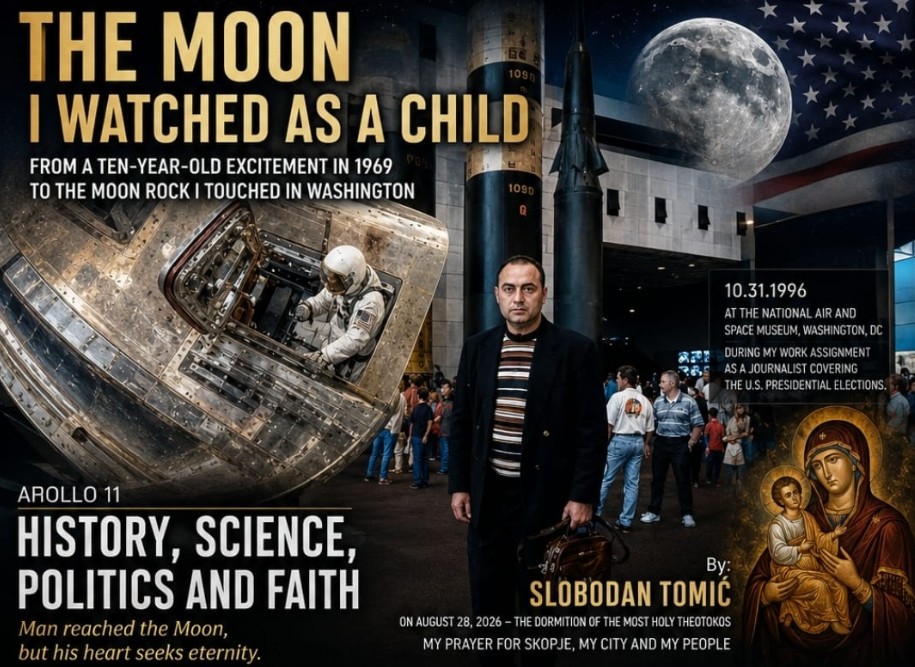
Written by: Slobodan TOMIĆ

There are images that a person never forgets.
Not because they are the most beautiful.
But because an entire life is trapped inside them.
For me, one of those images is the Moon.
I watched it as a ten-year-old child.
Today, at the age of 67, I can still close the book of time and see that same image.
1969.
I am ten years old.
I am a fourth-grade student.
With my father, my brothers and sisters, we stay awake watching the Apollo 11 mission.
Television in those days was something special. In the former Yugoslavia, millions of people were watching the same screen and waiting for the same historic moment.
The commentators were speaking, images from distant America were arriving in our homes, and we, the children, were staring at the television as if we were looking through a window leading to another world.
And it truly was another world.
Because man was about to set foot on the Moon.
On the place we had watched from Earth for thousands of years.
That night, I knew nothing about great politics.
I did not know what the Cold War meant.
I did not know what geopolitics meant.
I did not know that behind that mission stood an enormous competition between the United States of America and the Soviet Union.
I knew only one thing:
Man was going to the Moon.
And for a ten-year-old child, that was enough for a miracle to be born.
My father recognized that curiosity in me.
“Write to them,” he told me.
“To whom?”
“To the Americans. To the embassy. To the astronauts.”
And I wrote a letter.
As a fourth-grade student, with a child’s hand and a child’s vocabulary, I tried to address people who, at that moment, were something more than ordinary people to me.
They were people who were going to the Moon.
I do not remember every word of that letter today.
But I remember the emotion.
I wanted to tell them that I was following them.
I wanted to tell them that I was excited.
I wanted to know what was there.
I wanted to know what a person feels when, for the first time, he sets foot on another celestial body.
The letter remained somewhere in my life.
Just as the greatest dreams of childhood sometimes remain — closed away in some drawer of time.
Life went on.
The child grew up.
I became a journalist.
I began to travel.
I began speaking with politicians, diplomats, ambassadors, statesmen and people from different parts of the world.
And then life gave me an incredible coincidence.
WASHINGTON
Years later, I found myself in Washington, following the American presidential election between Bill Clinton and Bob Dole.
America was once again before me.
But this time, not through a television screen.
This time, I was there.
And, almost as if some invisible hand were taking me back to my childhood, I had the opportunity to visit the National Air and Space Museum.
There was Apollo 11.
Not as a picture.
Not as a television broadcast.
But as a historic object before my eyes.
The command module, “Columbia.”
The spacecraft in which Armstrong, Aldrin and Collins returned to Earth.
Official NASA records confirm that the Apollo 11 crew consisted of:
Neil Armstrong, commander,
Buzz Aldrin – lunar module pilot,
Michael Collins – command module pilot.
I stood before “Columbia.”
And in that moment, I was ten years old again.
I saw my father.
I saw my brothers and sisters.
I saw the television.
I saw the Moon.
And suddenly I realized that time sometimes makes incredible circles.
What I had watched as a child through the glass of a television screen was now standing before me.
And somewhere inside me, that old question appeared again:
“How did man get there?”
But there was something else.
I also came into contact with a piece of Moon rock, something that for me was not merely a piece of matter.
It was a touch with history.
With something that man had brought from another world.
Today, when I look back on that moment, I do not know whether I was touching the rock more, or whether the rock was touching my childhood.
THE MYSTERY THAT REMAINS
More than half a century later, the story of Apollo 11 continues to generate enormous interest.
And here I want to be particularly careful.
Because a journalist must never replace truth with sensation.
For years, a story has circulated claiming that the famous director Stanley Kubrick, author of “2001: A Space Odyssey,” confessed before his death that the Moon landing had been filmed in a movie studio.
There is a video.
There is also a man who looks like Kubrick.
But it is not Kubrick.
It is an actor.
Verified facts show that the story is a hoax, and Kubrick himself died in March 1999.
Therefore, as a journalist, I cannot put that story into a book as truth.
But I can ask another question.
What did Apollo 11 truly mean in the time in which it happened?
Because it was not merely a scientific achievement.
It was also an enormous political competition.
America and the Soviet Union were competing to see who would be first.
Who would have the stronger technology.
Who would have greater prestige.
Who would demonstrate that its system was stronger.
The Moon became a symbol of that battle.
And America arrived first.
On July 20, 1969, Armstrong and Aldrin stepped onto the surface, while Collins remained in orbit in the command module. The mission returned more than 20 kilograms of lunar material to Earth.
That is history.
And history does not need to be falsified in order to be interesting.
It is great enough without inventions.
TITO AND APOLLO 11
But within this global story, there is also a Yugoslav chapter.
And that part is particularly interesting to me.
The Apollo 11 crew came to Belgrade in October 1969.
Neil Armstrong, Buzz Aldrin and Michael Collins visited Yugoslavia as part of their world tour.
Yugoslavia was the only communist country on their itinerary.
Tito received them.
And that was not a coincidence.
During the Cold War, Yugoslavia had a specific position.
It was not part of the Soviet bloc.
Nor was it a Western state.
Tito was trying to lead Yugoslavia between the great powers.
And then came another incredible moment.
On April 24, 1970, U.S. President Richard Nixon presented Tito with an item bearing the Yugoslav flag that had been carried to the Moon, together with a fragment of the lunar surface brought back by the first mission to land on the Moon.
Today, that gift is displayed at the Museum of Yugoslavia in Belgrade.
That is a fact, and around it, different stories have been created for decades.
It is said that Yugoslavia had a secret space program, that Tito helped the Americans, that America took over Yugoslav technology, and that major financial agreements were connected with it.
Some of those stories are fascinating.
But fascinating does not mean proven.
And therefore, as a journalist, I will make a distinction.
What is a document — I will leave as a document.
What is testimony — I will leave as testimony.
What is a legend — I will call a legend.
Because truth is not defended with fiction.
WHAT IS THE WISDOM OF A STATESMAN?
Here I come to something that, for me, may be even more important than Apollo 11.
Wisdom.
I have criticized Tito.
And I still criticize him today for many injustices and policies of his time.
But history must be viewed from a distance.
Tito had his great mistakes.
But he also possessed political ability.
He managed to keep a complex state and its peoples together in one space and to build a position for Yugoslavia that, in its time, carried significant weight among the great powers.
That does not mean that we should idealize him.
It does not mean that we should forget the injustices.
But it does mean that we should understand what statesmanship means.
A politician must not come to power in order to heal his own complexes.
He must not come to power to satisfy his own frustrations.
He must not turn the state into his personal experiment.
Because behind every decision stand millions of human lives.
A politician can leave.
The state remains.
A politician can forget.
The people pay.
And that is why, for me, a statesman is not the person who speaks the loudest.
A statesman is the one who knows what will remain behind him when he is gone.
GOD, SCIENCE AND THE HUMAN NEED TO UNDERSTAND THE WORLD
And after politics, science and the Moon, I return once again to what, for me, is the greatest question.
Who created all of this?
I have my own answer.
I believe in God.
I believe in the Creator.
I believe in the Lord Jesus Christ.
That is my personal faith.
I do not want to impose it on anyone.
I do not want to judge a person who thinks differently.
Every person has the right to his or her own beliefs.
But I also have the right to my faith.
And that faith follows me even when I look toward the farthest boundaries of the Universe.
The more humanity discovers, the more it realizes how much it does not know.
Science seeks an answer to the question of how.
Faith also asks the question why.
Perhaps a human being spends an entire life between those two questions.
CERN AND THE “GOD PARTICLE”
We often hear about the so-called “God particle.”
That is the popular name given to the Higgs boson.
But here, once again, I must make an important correction, including for myself.
Scientifically, the Higgs boson is not proof that God exists.
In 2012, the ATLAS and CMS experiments at CERN discovered a particle consistent with the long-sought Higgs boson, and the discovery confirmed the existence of the Higgs field and the mechanism through which elementary particles acquire mass.
That is a great scientific discovery.
But science cannot, with a single experiment, prove or disprove my faith.
For me, on the contrary, the realization that the Universe is so complex only deepens the question of its Creator.
I do not ask science to prove God to me.
In science, I see humanity’s search for truth.
And in faith, I see a search for meaning.
CHARLES DARWIN AND THE STORY OF HIS DEATHBED
In my journalistic work, I have often mentioned Charles Darwin.
And here, once again, I want to be honest.
For years, a story has circulated claiming that Darwin renounced the theory of evolution before his death, repented, and turned to Christ.
The story is most often associated with Lady Hope.
But historical evidence does not confirm it.
On the contrary, Darwin’s children rejected the story. His son Francis publicly called it untrue, while his daughter Henrietta, who was present during her father’s final days, stated that the story was fabricated.
Therefore, I will not write that Darwin repented on his deathbed as though that were a historically proven fact.
It would not be honest.
But I will say something that I consider far more important:
Faith should not be defended with lies.
If we believe in God, then we should have enough courage to love the truth.
Even when that truth does not suit us.
Even when it destroys one of our favorite stories.
And even when it forces us to think again.
A CONVERSATION WITH MARK DICKINSON
During my journalistic career, I had the opportunity to speak with numerous diplomats and political figures.
Among them was the British diplomat Mark Dickinson, who served as British ambassador to Macedonia during a period that I remember for its great political and social turbulence.
I do not remember our conversations merely as diplomatic meetings.
I remember them as conversations between people.
As a journalist, I was always interested in something deeper than an official statement.
What does the person think?
What does he believe?
What does he know?
What does he not know?
And where does fact end and legend begin?
That question has followed me throughout my life.
And that is why today, when I look back on all those conversations, I do not want to attribute words to anyone that I cannot confirm.
I can testify to the meetings.
To the questions.
To the conversations.
But what I cannot prove — I will not turn into a fact.
That is my obligation as a journalist.
AND AFTER EVERYTHING — THE MOON REMAINS
Today I am 67 years old.
When Apollo 11 launched, I was ten.
When man stepped onto the Moon, I was a child.
When I visited Washington, I was already a journalist.
When I stood before Apollo 11, I became a child again.
And when I touched a piece of Moon rock, I felt something that cannot be explained with the vocabulary of journalism.
As if two people within me had become one.
Ten-year-old Slobodan.
And today’s Slobodan.
One looked toward the Moon from his home.
The other stood before the evidence of one of humanity’s greatest journeys.
Decades passed between them.
But the question remained the same.
Who are we?
Where do we come from?
Where are we going?
And, finally:
Why do we exist?
Perhaps humanity will reach Mars.
Perhaps it will go even farther.
Perhaps it will discover things we cannot even imagine today.
But I believe that the farther humanity travels into the Universe, the more it will return to itself.
It will return to its childhood.
To its father.
To its home.
To its faith.
To its question.
And perhaps that is precisely why the Moon will never be just the Moon for me.
It is a memory.
It is history.
It is science.
It is politics.
It is human courage.
It is also human vanity.
But above all, for me, it is a reminder that a human being can travel very far and yet never completely lose the need to look upward and ask:
“Who created all of this?”
I have my answer.
And I carry it with me.
From that year, 1969.
From my father.
From the letter of a ten-year-old child.
From the television screen.
From America.
From Washington.
From Apollo 11.
From the Moon rock.
From all the people I have met.
From all the questions I have asked.
And from all the answers we have yet to find.
ONE PIECE OF WISDOM FOR THE END
“Those who cannot remember the past are condemned to repeat it.”
— George Santayana, The Life of Reason, 1905
And perhaps that is precisely why I am writing down this memory.
Not only for myself.
Not only for my generation.
But for those who come after us.
So that they may know that one night, in the distant year of 1969, a ten-year-old boy sat with his father, his brothers and sisters in front of the television and watched a man walk on the Moon.
And that child did not know then that one day he would become a journalist.
He did not know that he would travel to America.
He did not know that he would stand before Apollo 11.
He did not know that he would touch a piece of Moon rock.
But he knew something that may be more important than anything else:
that one must ask questions.
And a person who stops asking questions also stops searching for the path to truth.
I am still asking.
And I am still looking upward.
Toward the Moon.
Toward the stars.
Toward eternity.
And toward God.
