

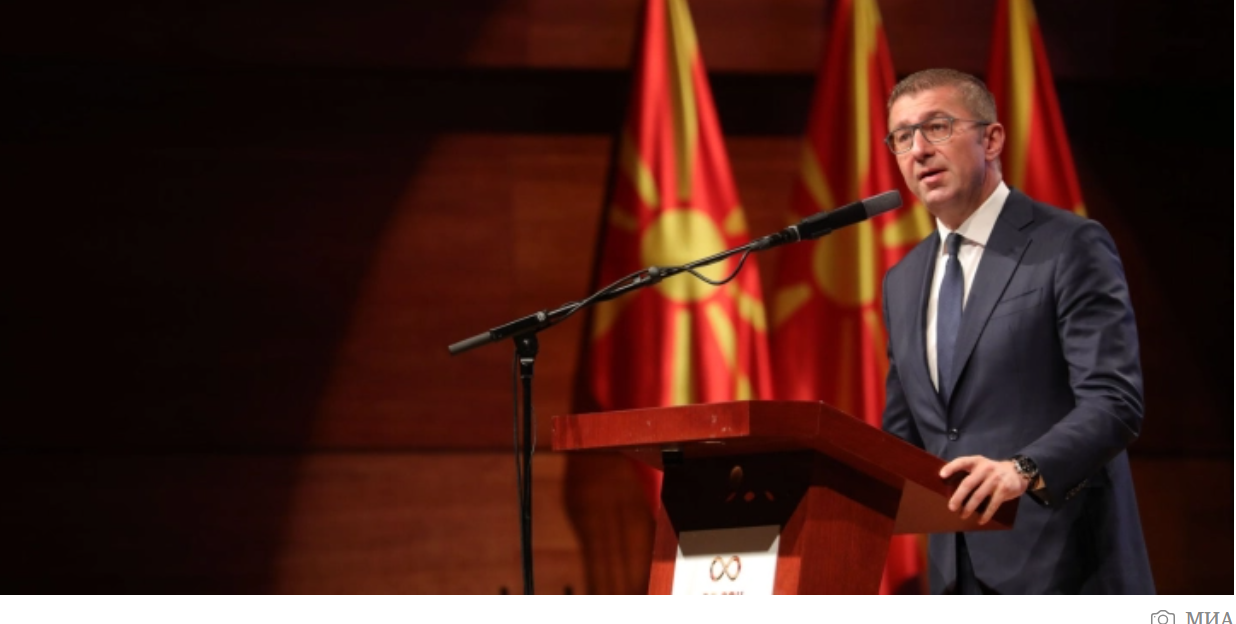
INTRODUCTION TO THE SERIES
WHEN POWER FACES THE MIRROR
Thirty-five years of independent Macedonia.
Thirty-five years of politics.
Thirty-five years of elections, governments, opposition parties, victories, defeats, promises, disappointments and hopes.
Over these three and a half decades, many faces have changed.
Governments have changed.
Parties have changed.
Political alliances have changed.
But one question has remained the same:
What did those who held power leave behind?
That is why we are opening this series:
PORTRAITS OF POWER
THE FACE BEHIND THE OFFICE
This is not a series about myths.
It is not a series about idols.
It is not a series about political score-settling.
And it is not a series in which we will declare someone a hero or a culprit in advance.
This is a series about the people behind the offices.
About leaders who, at a certain moment in history, were given the opportunity to make decisions affecting millions of human destinies.
About their decisions.
Their victories.
Their mistakes.
Their courage.
Their weaknesses.
About the people who elected them.
But also about the people they disappointed.
Because political office is temporary.
History is not.
WE DO NOT MEASURE THEM BY THEIR WORDS
We often remember politicians by their speeches.
History remembers them by their deeds.
A leader may deliver thousands of speeches.
But if no achievement remains behind him, the words disappear.
A leader may enjoy enormous popularity.
But if he leaves behind shattered trust, time will measure him.
A leader may be fiercely attacked.
But if he leaves something valuable behind, time will reveal it.
That is why, in this series, we will not ask only:
“What did he say?”
We will ask:
“What did he do?”
TIME IS THE STRICTEST JUDGE
Politics has its courts.
Elections have their numbers.
The media have their headlines.
Social networks have their verdicts.
But there is one judge who cannot be bought, frightened or turned into a partisan instrument.
Time.
Time reveals what was true.
What was a mistake.
What was courage.
What was political marketing.
And what was a historical delusion.
That is why every portrait in this series is an attempt to look at a person beyond daily politics.
Without partisan glasses.
Without fear.
Without hatred.
But also without blind affection.
POWER IS NOT A PRIVILEGE
When a person comes to power, he receives something the ordinary citizen does not have.
The power to decide.
The power to sign.
The power to appoint.
The power to change.
The power to influence the lives of others.
But with every power comes responsibility.
The greater the power, the greater the responsibility.
And that is precisely why we will ask the hardest questions.
Not to humiliate.
But to measure.
WHO REMAINS?
At the end of every mandate, one question remains:
What was left behind?
Were institutions left stronger?
Was life better?
Was there greater security?
Was there more justice?
Was there greater trust?
Was the state stronger?
Or were only divisions, debts, scandals and disappointments left behind?
That is the essence of this series.
Not to see leaders only through their offices.
But to see them through their legacy.
THE FACE BEHIND THE OFFICE
Because behind every prime minister stands a human being.
A person with character.
With ambitions.
With fears.
With weaknesses.
With people around him.
With friends.
With opponents.
With those who tell him the truth.
But also with those who tell him only what he wants to hear.
And that is where the real portrait begins.
Not in the office.
But in character.
SEVEN LEADERS. ONE HISTORY.
In this series, we will open the portraits of the people who have left the strongest mark on Macedonian politics in recent decades.
Hristijan Mickoski.
Venko Filipche.
Izet Mexhiti.
Maksim Dimitrievski.
Ali Ahmeti.
Dimitar Apasiev.
And the leaders who marked the previous stage of VMRO-DPMNE:
Ljubcho Georgievski.
Nikola Gruevski.
SDSM:
Branko Crvenkovski.
Vlado Buckovski.
Zoran Zaev.
Different people.
Different characters.
Different policies.
Different visions.
But one state.
Macedonia.
And one shared responsibility:
What did they do with the power entrusted to them?
FIRST PORTRAIT
HRISTIJAN MICKOSKI
THE MAN WHO CAME AFTER THE STORM
“A clear conscience is difficult to maintain and easy to lose.”
— Hristijan Mickoski

Written by: Slobodan Tomic
THIS IS NOT A PORTRAIT OF THE OFFICE. IT IS A PORTRAIT OF THE MAN.
In politics, it is easiest to write praise.
Even easier is to write condemnation.
The hardest thing is to write a portrait.
Because a portrait should neither beautify a person nor destroy him.
It should reveal him.
It should place before the public the person as he truly is, with his strengths, his weaknesses, his victories, his mistakes, his decisions and the burden carried by the office.
That is why this is not a gallery of praise.
But neither is it a political execution.
It is an attempt to measure those who wield power according to the hardest standards:
time, decisions, results and responsibility.
The first portrait is of the man who today carries the most responsible political office in the state.
Hristijan Mickoski.
THE PROFESSOR
Hristijan Mickoski did not enter politics as a classic professional party politician.
He comes from an academic and engineering background.
Professor.
Engineer.
A man accustomed to formulas, systems, calculations and solutions.
In December 2017, he was elected president of VMRO-DPMNE, and in 2021 he was re-elected as leader of the party.
After years in opposition, political attacks, electoral defeats and internal party pressures, his party won the parliamentary elections in 2024.
On June 23, 2024, the new Government was elected, headed by Hristijan Mickoski.
From that moment, the professor was no longer managing only a political party.
He was governing a state.
And that is an entirely different responsibility.
THE SCHOOL OF OPPOSITION
Mickoski spent a long period in opposition.
That is a school that leaves a mark.
Opposition teaches you how to criticize those in power.
Power teaches you how to carry responsibility.
The difference is enormous.
When you are in opposition, you can say:
“I would do things differently.”
When you are prime minister, the people ask:
“Why didn’t you do it?”
That is precisely where the real test for Mickoski begins.
Not at the podium.
Not at the rally.
Not in the party hall.
But in real life.
In the economy.
In justice.
In institutions.
In hospitals.
In schools.
In the everyday life of the person who has no political office, no party membership card and no influential person to open the door for him.
THE VICTORY
Winning an election is a major political achievement.
But winning an election is not the final victory.
It is the beginning of responsibility.
A citizen can give you trust.
But he has not given you the right to arrogance.
He can give you a mandate.
But he has not given you the right to forget yourself.
He can put you in power.
But he has not given you the right to forget that power is temporary while the state is permanent.
That is the greatest difference between a politician and a statesman.
A politician thinks until the next election.
A statesman thinks until the next generation.
“I AM NOT NAIVE”
In one of his public statements in 2026, Mickoski spoke about tolerance, respect for people and understanding human weaknesses.
But he also sent another message:
That tolerance does not mean naivety.
That is an important distinction.
Because a state cannot be governed either by hatred or by naivety.
A person should be given a chance.
But the system must have a boundary.
You can forgive a mistake.
But you must not forgive corruption.
You can understand weakness.
But you must not allow an individual’s weakness to become the weakness of an institution.
You can show humanity.
But you must also show responsibility.
THE CLEAR CONSCIENCE
“A clear conscience is difficult to maintain and easy to lose.”
This sentence is not merely a political message.
It is a political test.
Especially for the person at the top.
Because the higher a person rises, the more people look at him.
And the less room there is for mistakes.
The prime minister cannot expect citizens to remain silent observers.
They have the right to ask questions.
To criticize.
To doubt.
To demand accountability.
And to demand answers.
A clear conscience is not defended with words.
It is defended through deeds.
STRENGTH
There is one thing that cannot be denied to Mickoski:
perseverance.
He endured a long period in opposition.
He endured political attacks.
He endured internal party pressures.
He endured ridicule.
He endured attempts to politically exhaust him.
And he reached the Government.
That is political strength.
But every strength carries its own danger.
The office of a strong leader must never become the office of an infallible leader.
Firmness is a virtue.
Stubbornness is not.
Determination is strength.
Self-sufficiency is weakness.
The strongest leader is not the one who never changes his mind.
The strongest is the one who knows when to say:
“I was wrong.”
WHO IS AROUND THE PRIME MINISTER?
This is the question every leader must ask himself.
Not only:
“Who am I?”
But:
“Who are the people standing around me?”
The history of politics is full of leaders who did not fall because of their opponents.
They fell because of the people whispering in their ears.
Intermediaries.
Fixers.
People who sell access.
People who create the impression that nothing can be done without them.
People who filter the public before it reaches the leader.
Every prime minister must be careful here.
Because the public does not always see the difference between the leader and those around him.
To the people, they are the leader’s face.
Therefore:
the wrong person beside the prime minister can cause more damage than the loudest opponent standing before him.
THE CASE OF THE GOVERNMENT DRIVER
At the beginning of September 2026, the public was shaken by the case of an employee of the Government’s Service for General and Common Affairs, who was detained on suspicion of requesting a bribe connected with mediating employment.
The case must be left to the institutions.
Suspicion is not a verdict.
An accusation is not a final conviction, and the person has the right to due process and a defense.
But the political message is much broader.
If someone is genuinely attempting to sell public service for money, then this is not merely an individual moral failure.
It is an attack on the institution.
Therefore, the investigation must answer the most important question:
Is this an isolated case, or is there something broader behind it?
And even more importantly:
If someone was selling influence, who gave him reason to believe he could do it?
There is no room here for protection.
No room for a party membership card.
No room for friendship.
No room for “our man.”
If there is guilt — let there be accountability.
Regardless of who the person is.
NO ONE IS UNTOUCHABLE
The real fight against corruption is not measured by the number of arrests.
It is measured by whether the system is equal for everyone.
If a member of the ruling party commits an offense, he must be held accountable.
If an official commits an offense, he must be held accountable.
If an opposition politician commits an offense, he must be held accountable.
If a wealthy person commits an offense, he must be held accountable.
If a poor person commits an offense, he must be held accountable.
The law must not have a party.
The law must have equal weight.
Only then will the citizen believe that the state belongs to him.
THE DEBT
One of the most serious issues for any government is public debt.
In September 2026, the opposition came forward with claims of new borrowing of around €1.3 billion and public debt approaching €12 billion.
These are political claims made by SDSM, which must be distinguished from official statistical data and the methodology used to calculate public debt.
But the essence of the question remains.
The state does not live on political statements.
It lives on money, and every borrowed denar is an obligation of future generations.
At the same time, the Ministry of Finance warns that obligations of nearly €1.5 billion are coming due in 2027.
Therefore, the question is not only:
“Who borrowed?”
But:
“What was the money spent on?”
If we borrow for development, there must be development.
If we borrow for infrastructure, there must be infrastructure.
If we borrow for growth, there must be growth.
But if we borrow merely to maintain the political administration, patch holes and survive from today until tomorrow, then the bill will be paid by those who today have no right to vote.
Our children.
Our grandchildren.
YOU CANNOT LIVE FOREVER ON INHERITANCE
Every new government inherits something.
Money.
Debts.
Institutions.
Problems.
Agreements.
Decisions.
But inheritance cannot be an eternal excuse.
At some point, a government must stop talking about what it inherited and start talking about what it created.
Because citizens do not vote for the past.
They vote for the future.
THE PREDECESSORS
Before Mickoski, other VMRO-DPMNE leaders stood at the helm.
The leadership of Ljubcho Georgievski marked the party’s first major political stage and the creation of state structures during the first years of independence.
Later came Nikola Gruevski, with a long period in power, major infrastructure projects, a strong party organization, but also serious political controversies and conflicts that left deep marks on Macedonian society.
Every predecessor leaves something behind.
But no successor is obliged to repeat another person’s mistakes.
That is precisely Mickoski’s historical test.
Not to be anyone’s copy.
But to be himself.
MICKOSKI AND VMRO-DPMNE
Mickoski is the leader of VMRO-DPMNE.
But as prime minister, he has a different obligation.
To be the prime minister of all citizens.
Those who voted for him.
And those who did not.
Those who support him.
And those who criticize him every day.
That is the democratic weight of the office.
The party demands loyalty.
The state demands responsibility.
The party leader may think in party terms.
The prime minister must think as a statesman.
When he enters the Government, a man must not carry only a party color.
He must carry the color of the state.
WHAT DO WE ACKNOWLEDGE?
We acknowledge his perseverance.
We acknowledge his political endurance.
We acknowledge his ability to survive a long period in opposition.
We acknowledge his determination.
We acknowledge his firmness.
But precisely because of that, more must be demanded of him.
Not less.
Because the person entrusted with great power must also carry great responsibility.
WHAT DOES MICKOSKI OWE THE PEOPLE?
Not spectacle.
Not political theater.
Not endless accusations against the past.
But:
work.
honesty.
justice.
responsibility.
institutions.
order.
respect for the individual.
And above all, courage.
The courage to make the necessary cut.
When the problem is with an opponent.
And when the problem is with his own man.
Because true courage is not attacking your enemy.
True courage is saying “no” to your own man when you know he is wrong.
THERE IS NOTHING UNDIGNIFIED ABOUT CORRECTION
No leader is without mistakes.
No prime minister can know everything.
No cabinet can be perfect.
That is why correction is not weakness.
Correction is maturity.
If a policy produces no results, change it.
If a person does not justify the trust placed in him, replace him.
If a decision was wrong, acknowledge it.
If someone around you abuses his position, remove him.
The people do not demand perfect people.
They demand honest people.
THE MIRROR
Hristijan Mickoski is at the top today.
But the top is a lonely place.
From there, the voice of the ordinary person is heard the least.
At the top, good information arrives most often.
Bad information arrives least often.
That is why every leader must have people who tell him the truth.
Not only what he wants to hear.
But what he needs to hear.
This portrait was not written to defend Mickoski.
But neither was it written to bring him down.
It was written to place a mirror before him.
And in the mirror, every person must look at himself.
THE FINAL JUDGMENT
The day will come when Mickoski will no longer be prime minister.
The day will come when VMRO-DPMNE will be in opposition.
The day will come when political slogans will be forgotten.
The day will come when election numbers will be nothing more than statistics.
But the roads will remain.
The schools will remain.
The hospitals will remain.
The institutions will remain.
The debts will remain.
The laws will remain.
The way the state treated its people will remain.
And the most important thing will remain:
Was Macedonia better when you left than when you arrived?
That is the only biography that truly matters in the end.
FROM THE STORM TO HISTORY
Hristijan Mickoski came after a turbulent period.
After years of divisions.
After difficult political conflicts.
After disappointments.
After deep distrust in institutions.
After years in which many people stopped believing that politics could be a form of service.
That is why his task is greater than winning for one party.
He has the opportunity to show that government can be different.
But opportunity itself is not success.
Time will measure success, and time does not vote for anyone.
Time is afraid of no one.
And time forgives nothing.
IN THE END…
In the end, the prime minister does not remain.
The party does not remain.
The office does not remain.
The cabinet does not remain.
The official cars do not remain.
The protocols do not remain.
The state remains.
The people remain.
The deeds remain.
And the memory remains.
Therefore, Hristijan Mickoski, when one day the door of the Government closes behind you, it will not matter how many times you were attacked.
It will not matter how many speeches you delivered.
It will not matter how many political opponents you defeated.
One thing will matter.
What did you do for Macedonia?
Did you make it stronger?
Did you make it fairer?
Did you make it more honorable?
Did people begin to believe in institutions again?
Did young people gain a reason to stay?
Did those who left gain a reason to return?
Did the state become safer for its citizens?
And, most importantly:
Did you preserve the trust the people placed in you?
Because power is temporary.
A mandate is limited.
An office passes.
But Macedonia remains.
And therefore every prime minister, regardless of name, party or time, must know the hardest law of politics:
You did not come to become greater than the state.
You came to make the state greater than you.
PORTRAITS OF POWER
THE FACE BEHIND THE OFFICE
FIRST PORTRAIT: HRISTIJAN MICKOSKI
SEPTEMBER 8, 2026
Author and Host:
SLOBODAN TOMIC
