

By Slobodan TOMIĆ

Sometimes political propaganda does not collapse because someone answers it with a louder slogan.
It collapses when facts begin to appear behind the slogan.
That is precisely why the question of the funds allocated for the commemoration of 35 years of Macedonia’s independence must be examined seriously, calmly, and to the very end.
Without partisan cheering.
Without political hatred.
But also without political hypocrisy.
FIRST: LET US SEPARATE THE FACTS FROM THE SLOGANS
Yes, in April 2026, the Government adopted a decision instructing the State Lottery to provide 300 million denars from its undistributed 2024 profit to sponsor events marking the 35th anniversary of independence.
Yes, the State Lottery is a state-owned joint-stock company.
Yes, the amount is 300 million denars.
And yes, the public has every right to ask:
Why exactly this amount?
How was the figure determined?
Who prepared the financial plan?
Who selected the procedure?
Why did the public call remain open for only five days?
Why was only one bid submitted?
Who evaluated the bid?
And, most importantly:
Is every denar legal, justified, transparent, and economically rational?
These are legitimate questions.
No one should run away from them.
But that is only one part of the story.
There is another.
“FIVE MILLION EUROS STOLEN FROM THE PEOPLE” IS NOT THE SAME AS “300 MILLION DENARS FROM UNDISTRIBUTED PROFIT”
This is where sensationalist politics begins.
The Government explained that the funds did not constitute a direct expenditure from the state budget.
The Director of the State Lottery, Klimovski, likewise explained that the 300 million denars were secured from the State Lottery’s undistributed profit and that these were not funds being directly withdrawn from the state budget.
That distinction matters.
The State Lottery is a state-owned company, and precisely because of that, the public has every right to know how its resources are being managed.
But a state-owned company and the state budget are not the same legal entity.
Therefore, if someone wants to claim that budget funds were stolen or unlawfully spent, that claim must be proven as such.
It is not enough to throw a large number into the political arena.
It is not enough to automatically equate a state-owned company with the state budget.
A legal fact and a political impression are not the same thing.
That does not mean the public should stop asking questions.
Quite the opposite.
A STATE-OWNED COMPANY IS NOT A PARTY’S CASH BOX
Even though the State Lottery’s funds are not the same as money sitting directly in the state treasury, citizens have every right to know how public assets are being managed.
Who made the decision?
Under what procedure?
According to what criteria?
In whose public interest?
Those are the real questions.
And that is precisely why:
Examine every denar.
Examine every contract.
Examine every procedure.
But the same standard must apply to everyone.
AND NOW — LET US HOLD UP THE MIRROR
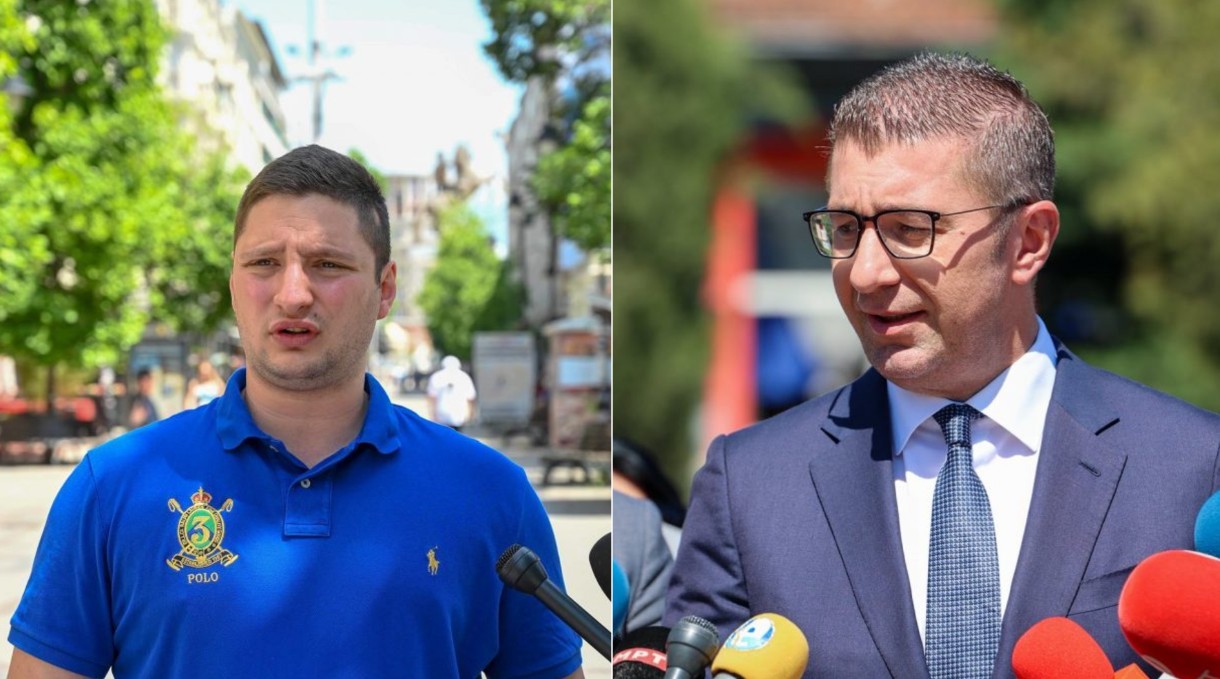
This is where my question to Jon Frčkovski begins, as well as to the political forces that are presenting this issue today as a national scandal:
Where was this sensitivity toward public money in previous years?
Where were the same dramatic headlines?
Where was the same political outrage?
Where was the same concern for every denar?
If every denar spent by the current government is to be placed under a microscope today, that is entirely legitimate.
But then the same microscope must also be turned on previous governments.
Not selectively.
Not along party lines.
But completely.
FRČKOVSKI AND THE “MORAL” LESSON
Jon Frčkovski has every right to criticize the Government.
That is democracy.
But the public also has the right to ask questions.
Information and photographs concerning alleged cocaine use had previously appeared in the public domain. In 2025, Frčkovski stepped down from his position at the SDSM Center for Research and Analysis, writing that he did not take pride in “mistakes from the past” and “weaknesses of his youth.”
In 2026, when publicly asked about cocaine, he stated that he had tried it once and that he had been photographed at the time.
That is not a reason to declare anyone guilty.
Nor is it a reason for a public lynching.
People make mistakes.
People can change.
People can acknowledge their mistakes.
But when the same person enters politics and assumes a position from which he delivers moral and political lessons to others, the public has the right to ask:
Do we apply to ourselves the same standards we apply to others?
That is the essence of the matter.
Not a double standard.
Not a public lynching.
But one standard for everyone.
THE PROBLEM IS NOT THAT SOMEONE ADMITTED A MISTAKE
Let me be absolutely clear.
I do not believe in public lynching.
I do not believe a person should be punished for life because of a mistake made in youth.
But neither do I accept the idea that someone can present himself as a flawless moral judge of others while placing his own past behind protective glass.
That is the heart of the issue.
I am not criticizing Frčkovski because he admitted a mistake.
I am asking him:
Do you apply to yourself the same level of scrutiny with which you judge the government?
That is a democratic question.
And no one has the right to forbid it.
AND NOW WE COME TO THE MOST IMPORTANT POINT
If Frčkovski is demanding transparency from Mickoski today —
let him demand it.
If he is demanding accountability —
let him demand it.
If he is demanding answers —
let him demand them.
But then let us not be afraid of the mirror.
Let every book be opened.
For every government.
For every political party.
For every state-owned company.
For every public enterprise.
For every tender.
For every sponsorship.
For every contract.
For every adviser.
For every trip.
For every expense account.
For every million.
And then let us see who truly wants justice — and who merely wants a political narrative.
AMERICA IS CELEBRATING ITS 250TH ANNIVERSARY — AND NO ONE IS PUTTING AMERICA ON TRIAL FOR EXISTING
And here we come to a comparison that cannot easily be avoided.
In 2026, the United States is marking the 250th anniversary of its independence, one of the most significant national anniversaries in American history.
And yes, there are political debates in America.
There are criticisms of the costs.
There are disagreements over the programs.
There are criticisms of the way the Trump administration has approached the celebrations.
There have also been public and political reactions to the high costs of some events, including the military parade.
But look at the essential difference.
No one seriously argues that America should not celebrate its independence.
No one declares the American 250th anniversary a national disgrace.
No one says:
“You are not allowed to celebrate because it costs money.”
The criticism is directed at the government, the spending, the organization, and the politicization of particular events — not at America’s right to exist, nor at its history.
That is precisely my point.
If America can celebrate the 250th anniversary of its independence, Macedonia can celebrate its 35th anniversary.
If Americans can ask:
“How much does it cost?”
“Who is paying?”
“Who organized it?”
“Are the funds justified?”
— then we in Macedonia should be asking the same questions.
But there is another crucial distinction:
Scrutinizing the cost of a celebration must never become a denial of a country’s right to celebrate its own independence.
America has no reason to be ashamed of its 250th anniversary.
Nor does Macedonia have any reason to be ashamed of its 35th.
Examine every denar.
Examine every contract.
Examine every procedure.
But do not put Macedonia in the dock simply because it wants to commemorate the day on which it became independent.
The problem is not that Macedonia is celebrating. The problem would be if someone did not want Macedonia to take pride in its own statehood.
And for me, that is where the political argument ends.
On September 8, it is not one government that celebrates.
It is not one political party.
It is not one prime minister.
Macedonia celebrates.
And Macedonia is greater than any government, any opposition party, and any day-to-day political dispute.
AND WHERE IS GJORGJI?
And here this column takes on a different weight.
Because I am not writing only as a journalist.
I am also writing as a father.
My son, Gjorgji Tomić, was a wonderful son, father, husband, friend, and human being.
He lived honestly, worked professionally, and through his knowledge and dedication gave a part of himself to Macedonia.
People from different professions and different walks of life spoke of him.
Not because he was my son, but because he left behind the name of an honest and dedicated man.
Gjorgji was a young Macedonian who professionally followed and reported on some of the most difficult events in contemporary Macedonian history — from the terrorist attacks in Kumanovo and the events of April 27 to major political and state developments.
And that is why today I have the right to ask one painful question:
Where were all those who now speak so loudly about justice, fairness, honesty, and morality when my child needed their voice?
Where was the sensitivity toward a young man?
Where was professional solidarity?
Where was humanity?
When a person is accused, persecuted, or pushed out of professional life, it should not matter whether his name is Gjorgji Tomić, whether he is a journalist, a professional, a son, a father, or a friend.
What should matter is whether an injustice was done to him.
And my pain is even greater because questions still remain before the public concerning the final days of my son’s life and the medical care he received.
I am not seeking a verdict through a column.
I am not asking anyone to be declared guilty.
I am asking that the truth not be swept under the rug.
I am asking institutions to provide answers.
I am asking that the facts be examined.
And I am asking that, if there was wrongdoing or responsibility, it be established through the law.
Because if we are so quick to speak about morality, honesty, and justice when our political opponents are involved, then we must have the courage to apply those same principles when the person who needs justice has no political power.
Gjorgji had no party machinery behind him.
He held no political office.
He had no power.
He had only his work, his profession, his family, and his dignity.
And today, as Macedonia marks 35 years of independence, I cannot help but think of him.
Had he been alive, Gjorgji would have celebrated Macedonia’s 35th anniversary of independence today.
He loved his Macedonia, just as he did while he was still with us.
But I also believe that, as an honest and professional man, he would have opposed every distortion of politics, every humiliation of truth, and every attempt to present false morality and false ethics as the highest social values.
Because Gjorgji understood that Macedonia is not defended by words alone.
Macedonia is defended by truth, honor, professionalism, and human dignity.
And that is why I write this not only as a father.
I write as a journalist who has devoted his entire life to Macedonia.
If we truly believe in justice, then justice cannot depend on who a person is, which political party he belongs to, or how much power stands behind him.
Justice is either equal for everyone — or it is not justice.
NO DOUBLE STANDARDS
I am not the lawyer of any government.
I am a journalist.
And therefore I have one standard:
evidence.
If the Government made a mistake — let it answer for it.
If the procedure was improper — let it be corrected.
If there was illegality — let the institutions act.
But if there was no illegality, then those making the most serious accusations today should have the courage to say:
“We were wrong.”
That is democratic maturity.
That is political responsibility.
That is respect for the citizens.
AND THAT IS WHY — FRČKOVSKI DID NOT “TAKE DOWN” MICKOSKI
No.
He raised a political question.
The Government responded.
The State Lottery offered its explanation.
And now it is up to the public to ask the most important question:
Who is speaking from principle, and who is speaking out of political interest?
Macedonia must no longer be a country in which one side is judged by one standard and the other side by another.
If we demand transparency — demand it from everyone.
If we demand accountability — demand it from everyone.
If we demand evidence — demand it from everyone.
For Mickoski.
For Frčkovski.
For SDSM.
For VMRO-DPMNE.
For DUI.
For the Government.
For the opposition.
For everyone.
Public money is neither left-wing nor right-wing.
It belongs to the people.
But an accusation is not evidence.
And a political slogan is not a verdict.
WHAT ABOUT INDEPENDENCE?
Independence is something far greater than an invoice.
Greater than a contract.
Greater than a government.
Greater than a political party.
On September 8, Mickoski does not celebrate.
Filipche does not celebrate.
SDSM does not celebrate.
DUI does not celebrate.
Macedonia celebrates.
And therefore:
Examine the money.
Examine the contracts.
Examine the institutions.
But do not criminalize independence.
Do not turn the 35th anniversary into partisan property.
Do not turn Macedonian statehood into a matter of daily political score-settling.
Because Macedonia is greater than all of us.
And it will remain long after all of us are gone.
And to those who today attack the celebration with grand political declarations, I ask one simple question:
Does the cost of the celebration really bother you — or does it bother you that Macedonia still knows who it is?
THE FINAL STANDARD
An accusation is not evidence.
A photograph is not a verdict.
A political statement is not a court ruling.
But neither is a moral lecture the exclusive property of those who deliver it.
Anyone who wants to act as the prosecutor of a government must also be prepared for the public to examine his own standards.
That is not revenge.
That is democracy.
That is not political persecution.
That is public scrutiny of credibility.
And that is why Frčkovski did not “take down” Mickoski.
Perhaps, without intending to, he simply held up a mirror.
And in the mirror, everyone should first be prepared to look at themselves
FINAL THOUGHT
“Anyone who wishes to judge others must first be prepared to live by the same law he demands of them.”
m-r Slobodan TOMIĆ
