

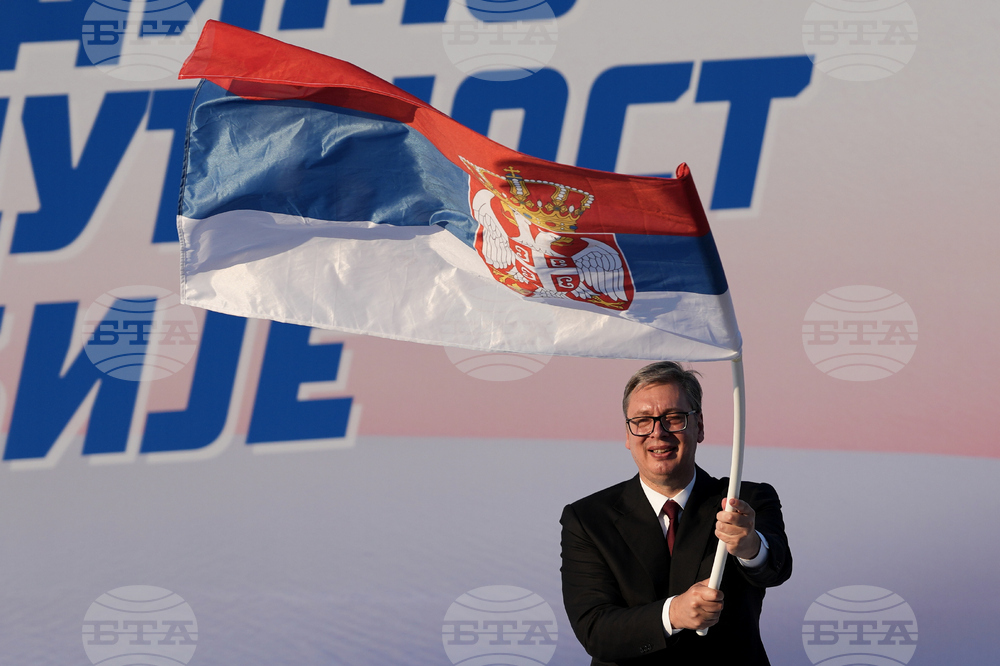
THE MAN SETTING THE CHESSBOARD
FROM POLITICIAN TO STATESMAN, FROM BELGRADE TO THE BALKANS
By: Slobodan TOMIĆ, M.A.

Slobodan TOMIĆ
“A statesman is not measured solely by how long he remains in power, but by the enduring legacy of the deeds he leaves behind.”
HE IS NOT WITHDRAWING FROM THE GAME — HE IS CHANGING HIS POSITION
Aleksandar Vučić is once again moving the political pieces.
On October 25, 2026, Macedonia and the broader region are closely monitoring a pivotal development: Serbia will hold extraordinary parliamentary elections. Vučić has dissolved parliament, and the Serbian Progressive Party has nominated him as their candidate for Prime Minister, pending the trust of the electorate.
This is no ordinary shift in office.
It is a calculated political maneuver.
Vučić has already served as Prime Minister. He has served as President. For years, he has been the central figure in Serbian politics. Now, he seeks to return to the helm of government as Prime Minister.
Why?
Because he evidently believes that from the position of Prime Minister, he can manage development processes, the economy, infrastructure, and state policy with greater direct control.
We may admire him, or we may not. We may agree with his vision, or dissent from it.
Yet one fact remains indisputable:
Aleksandar Vučić knows precisely how to remain at the center of the political arena.
A FIGURE WHO HAS DEFINED THE SERBIAN POLITICAL LANDSCAPE SINCE 2012
From 2012 onward, Vučić has stood as one of the most influential figures in Serbia.
He served as Deputy Prime Minister and Minister of Defence. Subsequently, as Prime Minister. Then, as President. And today, he prepares to re-assume the premiership.
This political longevity demands rigorous analytical examination.
However, the fundamental question is not merely: How long does Vučić endure?
Rather, it is: What has he built and left in his wake?
It is here that his true portrait begins to take shape.
THE GREATEST TRANSFORMATION IS NOT IN SPEECH — IT IS IN INFRASTRUCTURE
In politics, words last but a single day.
A road lasts for decades.
A railway endures across generations.
A bridge remains standing long after the politician departs.
It is precisely for this reason that infrastructure serves as one of the most critical metrics by which the policy of Vučić must be evaluated.
Serbia has channeled immense capital into roads, expressways, railways, rapid transit corridors, bridges, industrial zones, and regional connectivity.
According to official statistics from the Ministry of Construction, Transport and Infrastructure of Serbia, between 2012 and mid-2026, over 650 kilometers of motorways and expressways were constructed and opened to traffic, of which over 450 kilometers are full-profile motorways (such as Corridor 10 and the “Miloš Veliki” motorway).
This transcends mere construction.
It constitutes a comprehensive state strategy.
For a nation lacking modern infrastructure is a nation deprived of momentum. And a nation lacking momentum in the 21st century inevitably slips to the periphery.
EXPO 2027 — BELGRADE AS A GLOBAL FOCAL POINT
When evaluating Serbia’s infrastructural trajectory, EXPO 2027 stands as an indispensable landmark.
The Specialized Expo 2027 will take place in Belgrade from May 15 to August 15, 2027, under the overarching theme “Play for Humanity – Sport and Music for All.”
This is far more than a high-profile international event.
EXPO 2027 represents a strategic development catalyst designed to integrate infrastructure, tourism, commerce, culture, education, innovation, and international diplomacy.
As of March 2026, 137 countries had formally registered to participate, and during the Second International Participants Meeting in Belgrade, development roadmaps for 138 nations were presented. By June, confirmation was secured that participation had reached 138 states.
This underscores that EXPO 2027 is by no means an initiative confined to Belgrade alone. It elevates Serbia into a global host for an international convergence of ideas, culture, commerce, and innovation.
For Serbia, it presents a venue to showcase its achievements and articulate its aspirations. For the region, its significance is even greater.
Belgrade does not exist as an isolated island. It forms an integral part of the Balkans, tied into European transport and economic arteries, serving as a natural bridge connecting the region with Central Europe.
Consequently, EXPO 2027 must be evaluated through the lens of its permanent legacy: new infrastructure, transit links, expanded hospitality capacity, business networks, international visibility, and fresh investment horizons.
If EXPO is leveraged as a long-term development platform—rather than merely a 93-day exhibition—its real dividend will be measured for years long after the gates close.
This remains one of the defining questions of the political ledger of Vučić:
Not simply what Serbia will have built by 2027, but what will endure for Serbia beyond 2027.
ROADS ARE MORE THAN JUST ASPHALT
A highway is never merely asphalt. It represents:
- Commerce and trade expansion
- Tourism development
- Capital investment
- Modern logistics networks
- Job creation
- The expedited flow of goods
- The seamless movement of people
- Meaningful integration with neighboring states
A railway holds even greater transformative power. It links the producer directly to the market. It connects maritime ports to the hinterland. The North to the South. Central Europe to the Aegean Sea.
It is precisely why Corridor 10 is vastly more than a transit route.
It is the economic artery of the Balkans.
CORRIDOR 10 — WHERE SERBIA AND MACEDONIA INTERSECT
Belgrade. Niš. Skopje. Thessaloniki. Piraeus. Athens.
These are not merely geographic markers on a map. They form a powerful economic axis.
Here, the strategic interests of Serbia and Macedonia naturally align:
- Serbia benefits from ensuring Central European goods reach the Aegean rapidly.
- Macedonia benefits from serving as a vital continental bridge rather than a dead-end periphery.
- Greece benefits from establishing seamless, high-speed rail connectivity between Piraeus, Thessaloniki, and the European market.
Therefore, the Belgrade–Niš–Skopje–Thessaloniki railway must not be treated as a mere technical project. It must be pursued as a vision for the future of the Balkans.
It is within this framework that the practical value of relations between Vučić and Mickoski becomes evident.
VUČIĆ AND MICKOSKI — WHEN POLITICS SERVES DEVELOPMENT
The relationship between Aleksandar Vučić and Hristijan Mickoski must be viewed through the prism of state interests—not through partisan labels or fleeting daily political disputes, but through tangible progress:
- Modern railways and expanded highways
- Energy grid interconnections
- Trade expansion and foreign direct investment
- Streamlined border crossings
- The unhindered movement of people and cargo
In 2025, bilateral trade volume between Serbia and Macedonia reached approximately 1.5 billion euros, according to data from the Ministry of Foreign Affairs of Serbia.
This reflects an undeniable economic reality.
When two sovereign nations work to expand that trade, their political cooperation is not a concession.
It is an imperative of statecraft.
“SERBIAN WORLD” AS A POLITICAL LABEL
On this matter, I hold a serious objection to a segment of the opposition discourse in Macedonia.
When the Macedonian Government engages with Serbia regarding railways, trade, energy security, infrastructure, and regional connectivity, these talks should not be reflexively demonized under the banner of a “Serbian World.”
- Engaging in dialogue with Serbia does not make us a province.
- Cooperating with Greece does not reduce us to a sphere of influence.
- Partnering with the United States does not turn us into an American territory.
- Negotiating with Europe does not erase our Macedonian identity.
- Constructing railways alongside Serbia does not compromise our national integrity.
On the contrary. A self-assured state collaborates with all foreign partners.
MACEDONIA MUST NOT REMAIN ON THE PERIPHERY
My vision is clear and straightforward: Macedonia must serve as a central continental crossroads.
- Corridor 10 linking North and South
- Corridor 8 linking East and West
- Energy interconnections and high-speed rail
- Modern motorways and advanced logistics hubs
- Investment influx and deep-water port integration
- Market expansion and sustainable employment
Achieving this will ensure Macedonia is never treated as a minor state, but rather as a nation of immense geopolitical value.
Geography is a gift only when transformed into strategy.
VUČIĆ IS NOT MERELY A “RUSSIAN” OR “CHINESE” PROXY
One of the most persistent analytical errors regarding Vučić is the attempt to reduce his foreign policy to a single alignment.
- Russia? Indeed—Serbia maintains deep historical ties with Moscow.
- China? Indeed—relations with Beijing are exceptionally strong.
- Europe? Indeed—the European Union remains Serbia’s primary economic partner.
- The United States? Indeed—there exist vital political, economic, and security links.
- The Arab World, Africa, Regional neighbors? Yes.
This embodies a multi-vector foreign policy.
While one may debate the wisdom of individual decisions within this framework, it is impossible to claim that Vučić conducts a foreign policy anchored to a single global pole.
CHINA, BELGRADE, AND THE GREAT GEOPOLITICAL GAME
China’s presence in Serbia extends beyond diplomatic alignment; it is an indispensable economic partner and major investor.
In May 2026, Chinese President Xi Jinping awarded Vučić the Medal of Friendship—one of China’s highest state honors conferred upon foreign leaders.
This was no coincidence. It illustrates how Belgrade carefully maneuvers its standing among global powers.
The question for us in Skopje is:
Can Macedonia derive a meaningful lesson from this approach?
Not to imitate, but to learn. To define its own sovereign interests. To engage constructively with every global actor. And to reject any notion that friendship with one partner demands hostility toward another.
WHEN CRISIS BECOMES A TEST OF STATESMANSHIP
The pandemic served as a major trial.
In 2021, Serbia initiated mass vaccination at a time when many European nations faced severe supply bottlenecks. During that critical window, Serbia allocated 8,000 vaccine doses to Macedonia.
I highlight this not to craft a narrative, but because true regional leadership manifests during crises.
When a neighbor is in distress, assistance is not a sign of weakness.
It is a mark of civilized solidarity.
MACEDONIANS IN SERBIA — THE HUMAN BENCHMARK
This brings us to a matter that holds greater significance for me than miles of asphalt: The Macedonian community in Serbia.
They are not data points. They are not statistics. They are not names on a census roll.
They are Macedonians who have lived, worked, and contributed in Serbia across generations. Consequently, their rights must form an integral component of any serious analysis of Serbian-Macedonian relations.
Serbia maintains a formal system of National Councils of National Minorities, through which communities exercise self-governance in culture, education, media, and language usage.
The National Council of the Macedonian National Minority serves as the institutional voice of Macedonians in Serbia. Elections for this Council are far more than a technical formality—they represent the expression of community leadership for their voice, language, culture, and future.
My message to the Serbian state is clear: Provide maximum support for Macedonians in Serbia.
Not mere rhetorical declarations or ceremonial gestures, but institutional, cultural, educational, media, and democratic backing.
MACEDONIANS MUST ELECT THEIR OWN VOICE
The National Council must remain an authentic representative body for the community—not an instrument for opportunistic individuals, an arm of external interests, or a vehicle for personal gain.
It must be an institution chosen directly by Macedonians in Serbia.
Upcoming elections for the National Council must be approached with democratic maturity and a clear principle:
Macedonians in Serbia possess the absolute right to determine who represents them.
That is the essence of democracy.
MAJA ĐEORGJIJEVSKA AND THOSE WHO PRESERVE THE MACEDONIAN NAME
In this context, it is essential to acknowledge those who have dedicated years to serving the community.
Among them is Maja Đeorgjijevska, who has been active within the Macedonian community in Serbia, participating in the work of the National Council and civil organization.
Individuals like her deserve recognition—not to elevate anyone above constructive scrutiny, but because every community relies on dedicated figures who work tirelessly away from the spotlight.
They are the quiet custodians of national identity.
MACEDONIANS IN SERBIA MUST NOT BE TREATED AS POLITICAL SPOILS
To speak candidly:
- Macedonians in Serbia do not need figures who surface exclusively during election cycles.
- They do not need individuals who transform Macedonian patriotism into a personal commercial venture.
- They do not need those who invoke Macedonia while seeking self-advancement.
They require authentic community leaders who act alongside the people for the common good.
That is the distinction between patriotism and the commercialization of identity.
THE RECIPROCAL OBLIGATION — SERBS IN MACEDONIA
If we expect Serbia to respect Macedonians, we must evaluate our own domestic record with clarity.
Serbs in Macedonia occupy a recognized place in our political, institutional, and social life. Ivan Stoilković serves as a prominent example. From high-ranking government positions to his current role as Minister of Local Self-Government, his presence demonstrates that belonging to the Serb community is no barrier to serving at the highest levels of executive governance.
This extends beyond a single individual; Serbs in Macedonia hold roles across public life.
A state that affords space and representation to its constituent communities does not weaken itself—it grows stronger.
RECIPROCITY IS NOT A CONDITIONAL BARGAIN — IT IS DIGNITY
The principle is simple:
A Macedonian in Serbia must be respected as a Macedonian.
A Serb in Macedonia must be respected as a Serb.
And both should stand as loyal citizens of the states in which they reside.
These principles are not contradictory; they represent core European and democratic values.
“GLAS NARODA” — A BRIDGE TO MACEDONIANS WORLDWIDE
Allow me a personal note.
For decades through “Glas Naroda” (Voice of the People), I have broadcasted not only for Macedonians at home, but for our people in Serbia, across Europe, the United States, Canada, Australia, and wherever Macedonians live.
I prefer not to view our people abroad merely through the abstract term “diaspora.” I favor the phrase: Macedonians worldwide.
They are an indelible part of the Macedonian nation. Macedonia must maintain a coherent, long-term state policy toward them:
- Educational integration and cultural preservation
- Language programs and media connectivity
- Trade networks and investment channels
- Youth engagement and institutional integration
Every Macedonian, regardless of where they reside, must know that their homeland has not forgotten them.
VUČIĆ AND MICKOSKI — TWO LEADERS AND A VITAL LESSON
It is within this framework that I view the partnership between Vučić and Mickoski—not as personal political affection, but as strategic alignment.
If two leaders can accelerate rail links, upgrade highway networks, expand bilateral trade, integrate energy systems, and attract investment—that is pragmatic governance delivering measurable outcomes.
Serbia and Macedonia are engaged in discussions covering transport interconnections, energy infrastructure, bilateral trade, and rail modernization.
I support these initiatives because I stand for the interests of Macedonia, and Macedonia gains everything from strong, productive partnerships with its neighbors.
WHAT I REJECT IN THE CAMPAIGN AGAINST MICKOSKI
- I reject the narrative that equates regional cooperation with Serbia to political betrayal.
- I reject the framing of essential infrastructure projects as geopolitical concessions.
- I reject opposition tactics that rely on fear-mongering labels instead of substantive arguments.
Constructive criticism? Yes.
Parliamentary oversight? Yes.
Rigorous questioning? Always.
Rhetorical hysteria? No.
If Mickoski advances a project that serves the strategic interests of Macedonia, I will support it. If he takes an action contrary to the state interest, I will criticize it.
I am not an advocate for a party. I am an advocate for the state interest.
THE SOLDIER, THE STATE, AND THE BOUNDARY OF RESPONSIBILITY
Let me be unequivocal: I stand firmly against genocide, terrorism, the targeting of civilians, war crimes, and crimes against humanity.
At the same time, I recognize that nations possess the right to honor their history and remember their fallen soldiers. Historical remembrance and legal liability are distinct concepts.
Legal responsibility rests with individual perpetrators and those legally accountable for specific acts. A nation is not a collective criminal entity.
History must be evaluated through reason rather than hostility.
JEFFREY SACHS AND QUESTIONS SURROUNDING 1999
Prominent Western intellectuals, including economist Jeffrey Sachs, have voiced sharp critiques regarding NATO policy toward Serbia and the 1999 intervention.
His assessments regarding the causes and consequences of those events reflect his geopolitical perspective. Such views should neither be accepted blindly nor suppressed.
They must be examined, cross-referenced with empirical data, and evaluated objectively. That is the standard of independent journalism.
A PARALLEL LESSON FOR MACEDONIA
Macedonia understands the consequences when regional instability crosses sovereign borders. The 2001 conflict cannot be analyzed in isolation from the broader security environment across the Balkans and Kosovo at that time.
Yet history must not serve as a pretext for perpetual division; it must serve as an instructor.
Peace is far more valuable than short-term political victory.
A true statesman must discern when to remain resolute and when to exercise diplomacy.
NOT EVERY PROTEST SPRINGS FROM CONSPIRACY
We must remain fair.
Not every public protest is engineered from abroad. Not every student demonstrator is an agent of external influence. Not every non-governmental organization is an instrument of foreign power. Not every dissatisfied citizen is an adversary of the state.
At the same time, it is an established historical reality that major powers exert political, economic, media, and civic influence to advance strategic aims. A statesman must distinguish legitimate civic grievance from coordinated external destabilization.
Serbia today faces a complex political climate, marked by sustained student and anti-government demonstrations following the tragic canopy collapse at the Novi Sad railway station in 2024, which claimed 16 lives. Vučić and his administration confront sharp accusations from opposition movements—charges they firmly reject.
This represents the current political reality, and it must be documented accurately.
WHY DOES VUČIĆ CONTEND FOR A NEW POSITION?
Because he does not intend for his political trajectory to end in retirement.
He seeks to re-assume direct executive governance. He aims to retain political initiative. He intends to test his mandate through the ballot box.
For these reasons, October 25 represents far more than a standard electoral contest.
It will serve as a definitive test for Vučić, for the SNS, for the opposition, for the student movements, and for Serbian society as a whole.
WHO WILL ASSUME THE PRESIDENCY?
This remains a critical question. Should Vučić transition to the premiership, Serbia will require a new Head of State.
Yet leadership transitions should not be presaged by speculation before the electorate delivers its verdict.
History is written by outcome, not conjecture.
VUČIĆ AND EUROPE — A COMPLEX DIALOGUE
Serbia maintains its objective of European Union accession while concurrently preserving strategic relations with Russia and China.
This balancing act represents the most intricate dimension of the policy of Vučić. Brussels mandates alignment with EU foreign policy, adherence to the rule of law, and structural institutional reforms. Belgrade seeks strategic autonomy to chart its own course.
This structural tension will present one of the most formidable challenges for Serbia’s next Prime Minister.
CAN VUČIĆ EMERGE AS A STATESMAN OF A NEW ERA?
Here lies the fundamental question:
- A politician seeks office. A statesman builds the nation.
- A politician looks to the next election. A statesman plans for the next generation.
Vučić must now demonstrate which path he chooses to follow—not through rhetoric, but through institutions, infrastructure, economic stability, democratic standards, media freedom, minority protection, and constructive regional diplomacy.
I AM NOT AN ADVOCATE FOR VUČIĆ
This brings me to the core assertion of this analysis:
I am not an advocate for Aleksandar Vučić.
Nor am I an advocate for Hristijan Mickoski.
I am not an advocate for any political party.
I am a journalist. Above all, I am an advocate for the national interest.
When Vučić advances policies beneficial to Serbia and the region, I will document it. When he takes steps I view as miscalculated, I will state it. When Mickoski builds, I will support his efforts. When he errs, I will criticize his actions.
That is the independence of a commentator who has stood before the camera speaking under his own name for decades.
VUČIĆ AS A BALKAN PHENOMENON
Aleksandar Vučić cannot be understood merely as a domestic Serbian politician. He represents a broader Balkan political phenomenon.
He understands geography, history, power projection, public sentiment, global diplomacy, and above all, the imperative of infrastructure. He recognizes that whoever controls economic integration commands geopolitical weight.
Yet he must also recognize a fundamental truth: Influence lacking public trust cannot endure indefinitely.
THE STRATEGIC LESSON FOR MACEDONIA
Macedonia can derive valuable insights from Serbia’s approach—not to copy, but to learn: to build, to connect, to negotiate firmly, to defend national sovereignty, and to engage major powers without fear.
Macedonia possesses a primary strategic asset: Geography. We stand positioned between Central Europe and the Aegean, between East and West, between Corridor 8 and Corridor 10.
The decisive question is: Will we formulate a coherent state strategy to capitalize on this reality?
SERBIAN-MACEDONIAN RELATIONS MUST NOT BE REDUCED TO PARTY POLITICS
Serbia and Macedonia are bound by shared history, proximity, familial ties, cultural heritage, and mutual economic interests. Countless individuals travel between our nations daily.
These foundational bonds must not be undermined by partisan maneuvers—whether by SDSM, VMRO-DPMNE, or any other political force.
Relations between our peoples transcend party politics.
THE ULTIMATE METRIC OF POWER
Perhaps the greatest political asset of Vučić lies not merely in winning elections, but in his ability to establish Serbia as an indispensable regional actor.
Yet that very achievement carries inherent vulnerability:
Greater power entails greater responsibility. Extended tenure brings a heavier historical reckoning.
THE FINAL VERDICT BELONGS TO TIME
Today, commentators may offer praise or criticism, consensus or dissent. Yet the ultimate assessment will be rendered by time.
History will ask:
What did you construct? What legacy did you leave? What condition did you leave Serbia in? How did you cultivate relations with your neighbors? How did you protect minority rights? How did you fortify public institutions? And did Serbia emerge stronger or weaker following your tenure?
EPILOGUE — THE CHESSBOARD
Aleksandar Vučić is altering his position. Moving from the Presidency, he seeks the premiership to re-engage direct executive governance. The vote on October 25 will determine whether the Serbian electorate grants him that mandate.
This returns us to the broader geopolitical chessboard: Belgrade, Niš, Skopje, Thessaloniki, Piraeus, Corridor 10, Corridor 8, high-speed rail, EXPO 2027, regional stability, and above all, the people.
Vučić must remember: History does not honor those who merely held office. It honors those who built, reconciled, created, and respected the people under their governance.
For us in Macedonia, the message remains clear:
We need a Balkans of connected transit routes, constructive cooperation, and tangible outcomes.
“This is my state. This is my home. And my rights are respected.”
That represents true European integration. That represents a modern Balkans. And that represents the enduring foundation of friendship between Macedonia and Serbia.
WILL THE SERBIAN PEOPLE PERMIT ALEKSANDAR VUČIĆ TO MAKE THE NEXT MOVE?
OCTOBER 2026
The chessboard is set. The move belongs to the people.
Slobodan TOMIĆ, M.A.
