

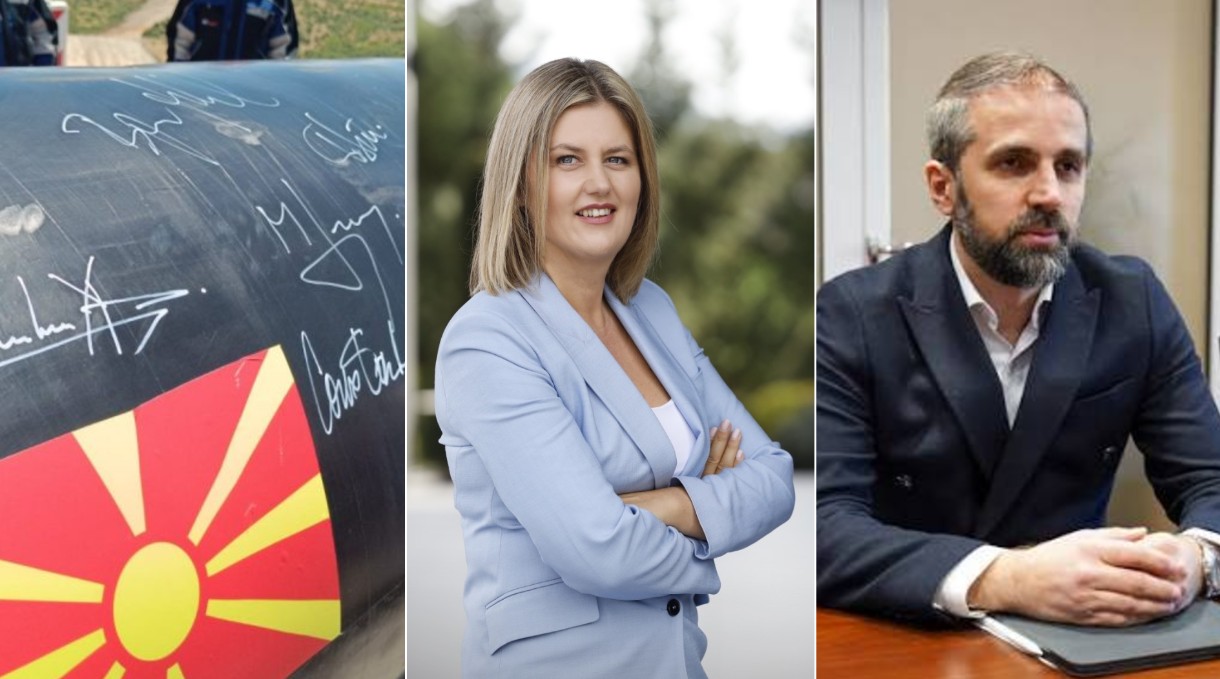
FROM ENERGY DEPENDENCE TO AN ENERGY CROSSROADS
WHEN A COUNTRY HAS NO SECOND PIPELINE, IT HAS NO SECOND OPTION
By: Slobodan TOMIĆ

“The most dangerous dependence is the one you recognize only when it is already too late.”
— Henry Kissinger
Energy is never merely energy.
It is politics.
It is economics.
It is security.
It is geopolitics.
And in times of war, it can become a matter of national survival.
That is why the story of Sanja Bozhinovska and Nedim Rama is not simply a story about gas, pipelines, contracts and interconnectors.
It is a story about Macedonia attempting to make a strategic transition — from a country dependent on limited energy routes to a country positioned at an energy crossroads.
And that difference is enormous.
Because a country that depends on one supplier, one route or one political direction does not truly have an energy policy.
It has an energy vulnerability.
And vulnerability, sooner or later, becomes a geopolitical weakness.
THE MINISTER WHO PUT ENERGY AT THE CENTRE OF STRATEGY
Sanja Bozhinovska enters this story not simply as Minister of Energy, Mining and Mineral Resources, but as the political face of an attempt to redefine Macedonia’s energy position.
Her professional and international background in business and energy, her participation in international energy forums and her experience in dealing with major energy issues provide the foundation for a different approach.
The key question is no longer only how much energy Macedonia has.
The more important question is:
Where does that energy come from?
Through which route?
From how many sources?
With how many partners?
And what happens if one route is suddenly interrupted?
These are not theoretical questions.
The war in Ukraine demonstrated that energy infrastructure can become one of the most important instruments of geopolitical power.
Europe learned that dependence on a single source can become a strategic vulnerability.
And the countries of Southeast Europe learned an even harder lesson:
A pipeline is not simply a pipeline.
A pipeline is a strategic line of security.
FROM ONE DIRECTION TO MULTIPLE DIRECTIONS
For years, Macedonia remained in a position where the gas system was characterized by limited diversification and dependence on a narrow supply route.
That model may have been tolerable in a different geopolitical environment.
Today, it is not.
The new energy reality demands alternative sources, alternative routes and alternative partners.
This is where interconnectors become far more than construction projects.
They become instruments of national security.
The Vertical Corridor is precisely such a project.
On September 4, 2026, in Thessaloniki, Nedim Rama, Executive Director of NOMAGAS, signed the Memorandum of Understanding that formally connects Macedonia to the Vertical Corridor.
This is not merely another international agreement.
It is a strategic step.
The Vertical Corridor links gas systems across Southeast and Central Europe, creating the possibility of greater diversification, increased capacity and bidirectional gas flows.
Greece.
Bulgaria.
Romania.
Hungary.
Slovakia.
Serbia.
Ukraine.
Moldova.
And now Macedonia.
That is the map.
And maps matter in geopolitics.
Because once Macedonia becomes part of a regional energy network, its strategic position changes.
NEDIM RAMA — THE OPERATIONAL FACE OF THE ENERGY TURN
If Sanja Bozhinovska represents the political and strategic face of this energy transformation, Nedim Rama represents its operational face.
The difference is important.
A strategy written on paper means little if there is no institution capable of turning it into infrastructure.
And infrastructure means contracts, engineering, financing, construction, permits, coordination and, finally, gas flowing through the pipeline.
That is the responsibility of NOMAGAS.
Rama’s role therefore goes beyond the title of executive director.
He is one of the key operational figures responsible for turning the state’s energy strategy into physical infrastructure.
In April 2026, Rama was also part of the Macedonian government delegation in Washington during the Strategic Dialogue with the United States.
That participation placed energy infrastructure within a broader framework of strategic relations, security and international cooperation.
And in September, Thessaloniki brought another important step:
Macedonia formally entered the Vertical Corridor.
The message is clear.
The energy map of Macedonia is beginning to change.
THE SOUTHERN GATE — GREECE
The Greece–Macedonia gas interconnector is perhaps the most visible symbol of that transformation.
It represents the southern gate.
Through Greece, Macedonia gains access to a broader regional and European gas system.
That means diversification.
It means access to alternative supplies.
It means greater flexibility.
And it means the possibility of connecting Macedonia to the wider energy infrastructure of Southeast Europe.
The strategic importance is even greater when one considers the development of LNG infrastructure in Greece and the possibilities connected with the Alexandroupoli region.
The question is therefore no longer whether Macedonia can remain dependent on one direction.
The question is how quickly Macedonia can become connected to several directions.
The Greece–Macedonia interconnector is expected to be completed and commissioned in the third quarter of 2027.
If that timetable is achieved, Macedonia will enter a new energy phase.
THE NORTHERN DIRECTION — SERBIA
But the strategic picture does not end in the south.
There must also be a northern direction.
And that is the Macedonia–Serbia gas interconnector.
On September 4, 2026, a contract was signed for the design and construction of the interconnector.
The value of the contract is approximately €29.4 million.
The project is being implemented under a turnkey model and FIDIC standards, covering urban planning, design, construction and the procedures required for obtaining the use permit.
The presence of Prime Minister Hristijan Mickoski and Minister Sanja Bozhinovska at the signing was not merely ceremonial.
It was a political signal.
Macedonia is building connections in more than one direction.
And when a country has more than one energy route, its negotiating position changes.
Its security changes.
Its economic potential changes.
Its geopolitical importance changes.
FROM ENERGY CONSUMER TO POTENTIAL TRANSIT COUNTRY
This is where the story becomes much bigger than gas.
If Macedonia succeeds in connecting the southern and northern directions, it could gradually move from being primarily an energy consumer toward becoming a potential regional transit country.
That creates an entirely different economic perspective.
Transit revenues.
Infrastructure investment.
New energy projects.
Industrial development.
Greater regional importance.
And a stronger position in negotiations with international partners.
Geography, which has often been described as Macedonia’s disadvantage, can become an advantage.
Greece is to the south.
Serbia is to the north.
Bulgaria is to the east.
Europe is ahead.
The question is whether Macedonia will remain a country through which others merely pass — or whether it will become an active participant in the regional energy system.
That is the real strategic opportunity.
WHERE WAS MACEDONIA WHEN THE WAR BEGAN?
The Russian invasion of Ukraine fundamentally changed Europe’s energy architecture.
The old assumption that energy and geopolitics could be treated as separate questions disappeared almost overnight.
Europe began searching for alternative sources.
Alternative routes.
LNG.
Interconnectors.
Storage.
Renewable energy.
New partnerships.
Energy security became national security.
And that inevitably raises a question about Macedonia.
Where was Macedonia when the war began?
Had earlier governments done enough to prepare alternative routes?
Had the state understood the geopolitical risk of excessive dependence?
Had the necessary infrastructure been built in time?
These questions are legitimate.
They are not an accusation.
They are questions of political accountability.
Because governments are not judged only by what they announce.
They are judged by what they build.
THE WARNINGS OF THE GEOPOLITICAL MOMENT
Former President Stevo Pendarovski publicly spoke about the geopolitical consequences of Russia’s invasion and the transformation of the European security environment.
The war created a new strategic reality for Europe and opened a new window of opportunity for the countries of the Western Balkans to accelerate their European integration.
But political recognition of a geopolitical moment is not enough.
A geopolitical warning must eventually become policy.
And policy must become infrastructure.
Otherwise, the warning remains only a statement.
That is the lesson Macedonia must not ignore.
The European path is not only about declarations, political meetings and diplomatic photographs.
It is also about pipelines.
Interconnectors.
Electricity networks.
Renewable capacity.
Storage.
Infrastructure.
And energy security.
THE ENERGY LEGACY OF SDSM AND DUI
This is also where the energy legacy of previous governments must be examined.
SDSM and DUI have every right to criticize the current government.
That is part of democracy.
But criticism also carries a responsibility.
They must answer for their own energy legacy.
What was built?
What was delayed?
What was prepared?
What was left unfinished?
And, above all:
Why did Macedonia remain so vulnerable to energy dependence for so long?
These are political questions.
They should be answered politically.
Without unsupported criminal accusations.
Without political theatre.
But also without historical amnesia.
Because infrastructure has a memory.
Every pipeline that was not built.
Every project that was delayed.
Every opportunity that was missed.
Eventually appears on the balance sheet of the state.
BOZHINOVSKA — A BROADER ENERGY DOCTRINE
Sanja Bozhinovska’s energy policy is not limited to gas.
It includes electricity.
Renewables.
Wind power.
Photovoltaics.
Gasification.
Cogeneration.
Energy efficiency.
And, perhaps most importantly, the problem of energy poverty.
This is crucial.
Because an energy strategy that speaks only about infrastructure but does not address citizens’ ability to pay their energy bills is incomplete.
The final test of every energy policy is the citizen.
Can families afford energy?
Can industry obtain reliable supplies?
Can businesses plan long term?
Can Macedonia attract investment?
Can the country reduce its vulnerability to external shocks?
Those are the questions that determine whether an energy strategy is successful.
GAS AS AN INDUSTRIAL ENABLER
Gas is not the enemy of renewable energy.
That false choice must be rejected.
A modern energy system requires a combination of sources.
Wind.
Solar.
Gas.
Hydropower.
Storage.
Transmission.
Distribution.
Gas can provide flexibility to the electricity system while renewable capacity expands.
It can support industry.
It can enable cogeneration.
It can help stabilize the system during periods when wind and solar production are insufficient.
The real question is not whether Macedonia should choose gas or renewables.
The real question is how Macedonia can intelligently combine them.
That is what a serious energy strategy looks like.
SKOPJE — THE BIGGEST TEST
Skopje will be one of the biggest tests.
The capital consumes enormous quantities of energy.
Cogeneration and district heating are therefore not simply technical issues.
They are economic and social issues.
A reliable gas supply can create new possibilities for more efficient energy production and a more stable heating system.
But the benefits must ultimately reach citizens.
The energy transition cannot be measured only in megawatts and kilometres of pipeline.
It must also be measured in household bills.
In cleaner air.
In industrial competitiveness.
And in energy security.
WIND, SOLAR AND GAS — NOT ENEMIES
Macedonia has significant potential in renewable energy.
Wind and solar projects can change the country’s electricity structure.
But renewables need a reliable system around them.
The wind does not always blow.
The sun does not always shine.
Consumption does not stop.
Industry does not stop.
Hospitals do not stop.
Cities do not stop.
That is why a modern energy system requires complementary sources.
According to statements by Minister Bozhinovska, a major wind investment of around €500 million is planned, with the first phase expected to provide 131 MW.
That is not a small investment.
It is a structural intervention in the country’s energy future.
At the same time, Bozhinovska has pointed to a major increase in installed renewable capacity, from around 7 percent to 58 percent.
But one distinction must be made clearly:
Installed capacity is not the same as actual electricity generation.
The real test is how much electricity is produced, when it is produced and how effectively the system can use it.
That is where infrastructure again becomes decisive.
THE THIRD LINK — MICKOSKI
There is another figure in this story who cannot be ignored.
Hristijan Mickoski.
Because a strategy needs political backing.
Bozhinovska represents the strategic and policy dimension.
Nedim Rama represents the operational and infrastructure dimension.
NOMAGAS is the institutional instrument.
The interconnectors are the arteries.
The Vertical Corridor is the regional network.
But the political decision to pursue this direction requires leadership.
That is where Mickoski enters the equation.
The significance of the current energy turn is therefore not in one minister, one director or one project.
It is in the combination of political vision, strategic planning and operational implementation.
If those three elements work together, Macedonia can change its energy position.
If they do not, the opportunity can be lost.
2027 AND 2028 — THE YEARS OF TRUTH
The next two years will be critical.
2027 and 2028 should become the years of truth.
Because by then, words must begin turning into pipelines.
Plans must become construction.
Contracts must become infrastructure.
And infrastructure must become gas flow.
That is the only real measure.
Not the number of press conferences.
Not the number of signed documents.
Not the number of political speeches.
The pipeline must work.
Gas must flow.
Industry must feel the difference.
Citizens must feel the difference.
And Macedonia must become harder to pressure from the outside.
THE QUESTION FOR DUI AND SDSM
DUI and SDSM can criticize.
They can question.
They can challenge.
That is legitimate.
But they should also answer.
Why was Macedonia not better prepared?
Why did diversification take so long?
Why were alternative routes not developed earlier?
Why was the country left with such limited options?
These questions should not be avoided simply because they are politically uncomfortable.
A serious state must examine its own past if it wants to build a better future.
THE NEW ENERGY POSITION OF MACEDONIA
The strategic objective is not to produce everything domestically.
No modern country can realistically isolate itself from the international energy market.
Energy independence does not mean autarky.
It means diversification.
It means multiple suppliers.
Multiple routes.
Multiple partners.
Strategic reserves.
Interconnected systems.
And the ability to choose.
That is the true meaning of energy sovereignty.
A country is more sovereign when no single external actor can easily turn off its energy supply and dictate its political behaviour.
That is why pipelines are political infrastructure.
And why interconnectors are instruments of sovereignty.
MACEDONIA AT THE ENERGY CROSSROADS
For the first time in a long time, Macedonia has the possibility of turning its geography into a strategic asset.
South toward Greece.
North toward Serbia.
East toward Bulgaria.
And through the regional network, toward Central and wider Europe.
This is not simply a map.
It is a strategic opportunity.
But opportunities do not become reality by themselves.
They require political decisions.
Money.
Engineering.
Institutions.
Discipline.
And continuity.
Above all, they require the state to understand that infrastructure is not an expense.
It is an investment in national power.
EUROPEAN INTEGRATION IS ALSO INFRASTRUCTURE
There is another important dimension.
Macedonia’s European integration is not only a political process.
It is also an infrastructure process.
A country that connects its gas system to Greece, Serbia and the wider European energy network is physically moving closer to Europe.
Interconnectors are not merely pipes.
They are links between systems.
Between markets.
Between economies.
Between security structures.
Between countries.
The European future of Macedonia will therefore be measured not only by political declarations in Brussels.
It will also be measured by kilometres of pipeline, megawatts of renewable capacity, storage capacity and the number of functioning connections with neighbouring countries.
THE POLITICAL FACE AND THE OPERATIONAL FACE
This is why the two names at the centre of this portrait matter.
Sanja Bozhinovska is the political and strategic face of the new energy doctrine.
Nedim Rama is the operational face responsible for turning that doctrine into infrastructure through NOMAGAS.
And above them stands the political responsibility of the government led by Hristijan Mickoski.
The equation is simple:
Political vision.
Strategic energy policy.
Operational implementation.
Infrastructure.
Regional connectivity.
Energy security.
Economic opportunity.
If these elements are connected, Macedonia can change its position on the regional map.
THE PIPELINE AS A STATE ARTERY
The most important question is not who will stand for a photograph beside the pipeline.
The most important question is:
Who will put it into operation?
Because a pipeline without gas is only steel.
An interconnector without flow is only infrastructure on paper.
A strategy without implementation is only a political slogan.
The real test begins when the system starts operating.
When gas begins to flow.
When industry receives new opportunities.
When households gain greater security.
When Macedonia becomes part of a broader regional energy market.
That is when the energy turn becomes real.
THE NEW ENERGY DOCTRINE
The story of Sanja Bozhinovska and Nedim Rama therefore cannot be reduced to two people.
It is a story about a state trying to change its strategic position.
It is about moving from dependence to diversification.
From vulnerability to resilience.
From a single route to multiple routes.
From being merely a consumer to potentially becoming a transit country.
From energy isolation to regional connectivity.
And from geopolitical vulnerability to greater energy sovereignty.
The Vertical Corridor is an important piece of that puzzle.
The Greece–Macedonia interconnector is another.
The Macedonia–Serbia interconnector is another.
Renewable investments are another.
And the political will to connect all of them into one coherent strategy is the decisive element.
THE FINAL TEST
History will not remember how many agreements were signed.
It will remember whether they worked.
It will not remember how many times politicians spoke about energy security.
It will remember whether citizens and businesses actually became more secure.
It will not remember who stood beside the pipeline at the opening ceremony.
It will remember who built it, who connected it and who made it function.
That is the difference between political marketing and state policy.
And that is why 2027 and 2028 may become the years when Macedonia discovers whether its energy strategy has truly entered a new era.
THE FINAL WORD
Sanja Bozhinovska represents the political and strategic face.
Nedim Rama represents the operational face.
Mickoski represents the political bearer of the direction.
NOMAGAS is the institutional instrument.
The interconnectors are the arteries.
The Vertical Corridor is the regional network.
And the citizens are the final users and the ultimate measure of success.
If the pipelines are built, connected and put into operation, Macedonia will not simply have more gas.
It will have more choices.
And in geopolitics, choice is power.
“The greatest strength of a state is not how large it is, but how difficult it is to blackmail.”
— Zbigniew Brzezinski
ENERGY IS NOT JUST A FUEL.
ENERGY IS SECURITY.
ENERGY IS THE ECONOMY.
ENERGY IS SOVEREIGNTY.
AND ENERGY INFRASTRUCTURE IS — STATE POWER.
