

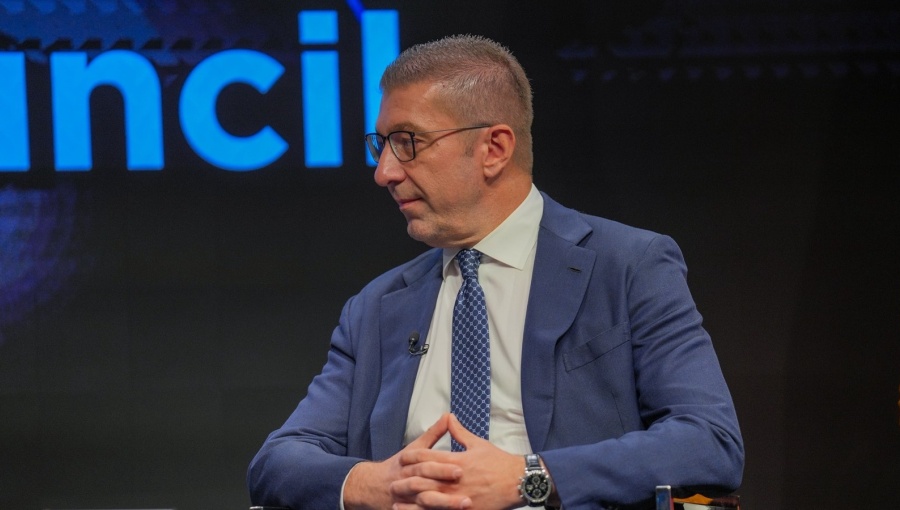
BY SLOBODAN TOMIC

“When politics loses its sense of proportion, words become larger than the state.”
— Aristotle
Sometimes a single photograph conveys more than a thousand words; other times, a thousand partisan words fail to obscure the broader reality.
This exact dynamic characterizes the current political discourse surrounding Prime Minister Hristijan Mickoski’s official visit to the United States.
Where the domestic opposition sees a isolated snapshot, a sovereign nation must evaluate its strategic agenda.
Beyond political framing, the delegation’s itinerary across Washington and New York encompasses engagements with U.S. governance institutions, bilateral economic dialogues, interactions with the Macedonian diaspora, and an upcoming address before the United Nations General Assembly. Critical discussions surrounding energy interconnectors, critical mineral supply chains, and technology transfers constitute the core substance of statecraft.
Yet, opposition rhetoric seeks to reduce this broader diplomatic endeavor to a single dismissive descriptor: “corridor diplomacy.”
The Rubio-Landau Contrast: Media Frames vs. Protocol Reality
To evaluate this critique, one must distinguish between brief high-level encounters and formal diplomatic bilateralism.
Prime Minister Mickoski’s brief interaction with U.S. Secretary of State Marco Rubio in New York provided a initial touchpoint during a congested UN session. SDSM positioned this informal dialogue as evidence of secondary protocol status. While partisan entities maintain the right to challenge diplomatic optics, focusing exclusively on this encounter ignores the structured proceedings that followed.
On September 21, 2026, Prime Minister Mickoski convened a comprehensive, structured bilateral meeting with U.S. Deputy Secretary of State Christopher Landau.
This formal session included key state department leadership: Brendan Hanrahan, Assistant Secretary of State for European and Eurasian Affairs, alongside Daniel Lawton, Deputy Assistant Secretary overseeing Balkan state portfolios.
                              U.S. DIPLOMATIC ENGAGEMENT
                                          │
                ┌─────────────────────────┴─────────────────────────┐
                │                                                   │
     Informal Engagement                                Diplomatic Framework
     • Marco Rubio                                       • Christopher Landau (Dep. Sec. of State)
     • Brief interaction                                 • Brendan Hanrahan (Asst. Sec. Eur/Eurasian)
     • Media focus                                       • Daniel Lawton (Dep. Asst. Sec. Balkans)
                                                         • Agenda: NATO, Security, Energy, Trade
This contrast clarifies the distinction between symbolic networking and policy negotiation. The presence of key regional policy directorates confirms an active, expanding diplomatic agenda—refuting the assertion that the delegation’s output is bounded by an informal photograph.
The Substantive Policy Agenda
A rigorous opposition standard demands scrutiny of economic and strategic deliverables rather than venue layout. The agenda currently presented to U.S. institutions and commercial capital involves long-term state assets:
Energy Interconnectivity & Generation: Progress regarding the Čebren and Galište hydroelectric initiatives, Alongside regional gas interconnectors aimed at strengthening energy independence.
Strategic Mineral Resources: Framework discussions regarding antimony extraction and processing capabilities near Kriva Palanka.
Infrastructure & Advanced Technology: Initiatives surrounding regional data centers, supply chain security, and attracting foreign direct investment.
A constructive opposition evaluates policy through concrete questions: What are the financial guarantees? What environmental safeguards govern resource extraction? What is the implementation timeline? Reducing complex industrial and security negotiations to partisan mockery abdicates meaningful oversight in favor of political spectacle.
National Discourse and the Strategic Boundary
When partisan rhetoric targets diplomatic partners, domestic political language risks compromising external credibility. Standard opposition critiques—such as calling for fiscal transparency regarding delegation expenses or demanding contract details—serve the public interest. However, reducing state visits to “excursions” or targeting U.S. administration figures within domestic skirmishes demonstrates a lack of institutional boundaries.
The U.S. State Department is not a domestic party headquarters. When Macedonian representatives engage foreign leadership, their statements reflect upon the republic as a whole. Domestic political rivalry must stop at the water’s edge.
This institutional principle extends to engagement with the diaspora. The Prime Minister’s participation in the morning liturgy for the Nativity of the Most Holy Mother of God at the Church of Saints Cyril and Methodius in New Jersey represents an established civic function connecting the state with its overseas population. Treating cultural and spiritual ties with the diaspora as targets for domestic satire undermines broader national cohesion.
The UN Podium: A State Imperative
The diplomatic mission culminates in New York at the United Nations General Assembly. On this platform, internal political divisions yield to international representation.
DOMESTIC POLITICS INTERNATIONAL PLATFORM
┌─────────────────────────┐ ┌─────────────────────────┐
│ Party Headquarters │ vs. │ United Nations Podium │
│ Factional Narratives │ │ Sovereign Representation│
│ Partisan Mockery │ │ National Security & Trade│
└───────────────────
Address from the UN podium transcends party leadership; the speakerb addresses the international community as Prime Minister of Macedonia. The global audience assesses position statements on regional stability, European integration, security commitments, and economic policy.
Partisan narratives eventually fade from public memory, but official declarations entered into the international record endure. When a head of government steps into the global diplomatic arena, internal political factions must allow the state to take precedence.
Macedonia is not defined by a hallway, a single photo opportunity, or a temporary press release. Macedonia is a sovereign state. As the United Nations General Assembly convenes, the nation’s standing will be determined by policy substance, strategic alignment, and tangible results.
