

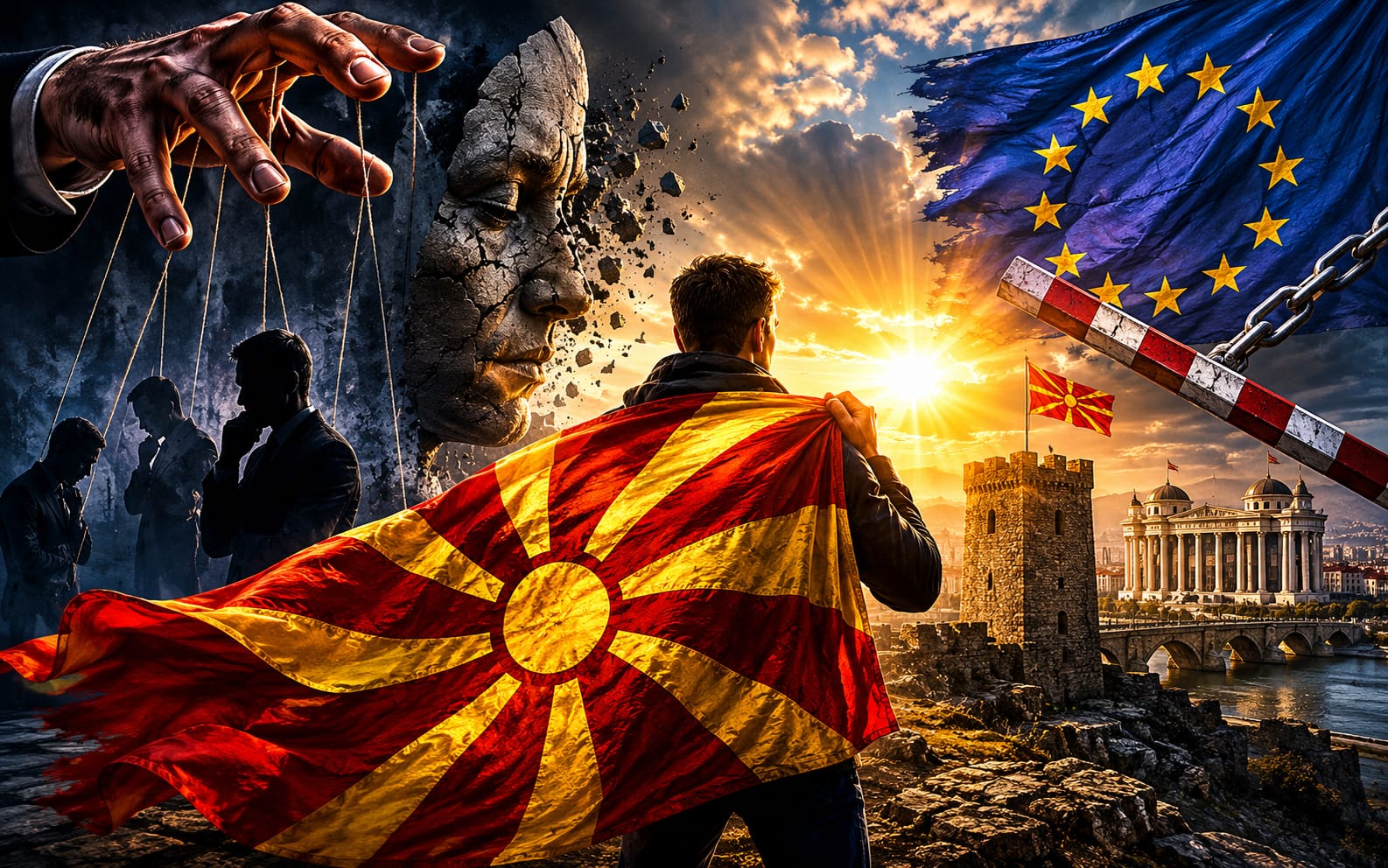
THE POWER OF POWER
“The impediment to action advances action. What stands in the way becomes the way.”
— Marcus Aurelius
A PRECEDENT, A PRECEDENT, A PRECEDENT: WHO CREATED THE BLOCKADE, WHO SHIFTED THE RESPONSIBILITY, AND WHO WILL PAY THE PRICE?
By M.Sc. Slobodan Tomić, Political Analyst and Publicist

There are moments in politics when diplomatic language is no longer enough.
Not because diplomacy has lost its value, but because fine words, when unsupported by tangible results, can become an instrument for postponing the truth. And when the subject is Macedonia’s European future, the truth cannot be deferred indefinitely.
Having followed Macedonia’s European path for more than two decades as a journalist, analyst and publicist, I believe I have every right to ask questions that must not be evaded. Questions directed not against Europe, but against political irresponsibility, double standards and the dangerous practice of repeatedly telling a candidate country to engage in yet another round of talks while the fundamental obstacle remains untouched.
The message, therefore, is clear:
We are not naïve.
We are not naïve when we are told that Macedonia must once again talk to Sofia.
We are not naïve when we see the European Union treating the dispute between Macedonia and Bulgaria as a bilateral matter while Macedonia’s European prospects remain contingent on its political resolution.
We are not naïve when words such as predictability, guarantees and dialogue are repeated without a sufficiently clear answer to the central question: what, precisely, happens after Macedonia fulfils the demands placed before it?
Above all, we are not naïve when we recognise that an EU member state possesses institutional mechanisms capable of blocking the process, while the candidate country has no equally effective mechanism to protect itself against renewed political conditionality.
This is where the analysis begins: at the intersection of European principles and European practice, diplomatic rhetoric and political power, the promise of membership and the uncertainty that has accompanied Macedonia for years.
PILATE WASHES HIS HANDS — BUT WHO ACCEPTS RESPONSIBILITY?
Two political images stand before us.
The first is Pontius Pilate, the enduring symbol of someone who distances himself from responsibility, washes his hands and leaves someone else to bear the consequences of a decision.
The second is the ancient warning embodied in the phrase the Greeks bearing gifts: not every gift is truly a gift, particularly when it conceals a bill that will come due later.
Between these two images stands Macedonia today.
Brussels says: talk to Sofia.
Dialogue is, of course, necessary. Good neighbourly relations are necessary. Diplomacy is necessary.
But the fundamental question is not whether the parties should talk. It is what follows the talks.
Who guarantees that an agreement reached today will not become the subject of conflicting interpretations tomorrow?
Who guarantees that fulfilment of one condition will not open the door to another?
Who guarantees that a future political administration in Sofia will not reactivate the same instrument of obstruction?
And who will accept responsibility if Macedonia fulfils its obligations only to find its European path blocked once again?
These are not rhetorical questions.
They concern institutional trust, political predictability and the credibility of the European Union itself.
When European Commission President Ursula von der Leyen visits Skopje, reaffirms Macedonia’s European perspective and reiterates the demand for constitutional amendments, she sends a political message. But when that message is accompanied by calls for further dialogue with Sofia, Brussels also has an obligation to address the other half of the problem: how can it prevent dialogue from becoming yet another endless waiting room?
If Bulgaria retains the ability to obstruct the process while Macedonia lacks an effective safeguard against renewed blockades, a formal appeal for dialogue is simply not enough.
Macedonia does not need dialogue alone.
Macedonia needs rules that ensure dialogue leads to results.
Otherwise, Pilate will continue washing his hands, Sofia will retain the key, and Macedonia will once again find itself standing before a closed European door.
THE GIFT OF THE DANAIANS AND EUROPE’S POLITICS OF PROMISES
I am not claiming that every European proposal is a deception, nor that every diplomatic initiative conceals ulterior motives. But Macedonia has accumulated enough political experience to understand that reassuring language is not the same as a guaranteed outcome.
Predictability.
Guarantees.
Dialogue.
The European perspective.
Every one of these words has value only when translated into clear commitments, verifiable procedures and concrete deadlines.
Citizens do not live on diplomatic communiqués.
They live with the consequences of political decisions: uncertainty about their country’s future, the emigration of young people, declining confidence in institutions and the growing sense that national destiny is once again being determined at negotiating tables where Macedonia does not possess equal bargaining power.
Every new European initiative must therefore answer three questions.
First, what exactly is required of Macedonia?
Second, what concrete obligations will the European Union and its member states assume?
Third, what institutional mechanism will ensure that fulfilment of those obligations is followed by corresponding progress?
Without answers to these questions, a new promise may sound encouraging, but it does nothing to remove the underlying uncertainty.
Macedonia is not asking for membership as a gift. It is not asking to bypass reforms. Nor is it demanding privileges denied to other candidate countries.
It is asking for a process in which the criteria are clear, the conditions are applied consistently, and the political will of one country cannot indefinitely negate the progress made by another.
That is the European test confronting Brussels today.
GREECE AND BULGARIA: TWO DISPUTED RELATIONSHIPS, ONE MACEDONIAN DILEMMA
For decades, Macedonia’s statehood and European prospects have been affected by disputes with its southern and eastern neighbours.
The dispute with Greece centred on the country’s name, with profound consequences for national politics, its international standing and the sense of historical continuity among Macedonian citizens.
The dispute with Bulgaria, in its present political form, encompasses questions of history, language, identity and the interpretation of the past, with direct consequences for European integration.
These disputes are not identical.
They have different historical circumstances, different treaty frameworks and different political consequences. Yet, for Macedonia, they create a common dilemma: for how long can the European path remain vulnerable to questions that go beyond the ordinary criteria for accession?
This is not an accusation against entire peoples.
I do not blame the citizens of Greece or Bulgaria. My criticism concerns state policies, diplomatic positions and the way historical interpretations are turned into instruments of contemporary politics.
The history of the Balkans is complex, multilayered and burdened by competing national narratives. Precisely for that reason, it must not be monopolised by one state or turned into an endless negotiating account presented to another.
How can a country aspiring to join the European family be repeatedly compelled to prove its own historical and cultural existence to its neighbours?
That is a question Europe must answer.
The Macedonian people have the right to preserve their historical memory, language, culture and national identity, just as other peoples have the same right.
Respect for one’s own identity does not require the denial of another’s. On the contrary, genuine European maturity means accepting that different historical experiences can coexist without one becoming a political threat to the other.
Complex history must never become an alibi for permanent obstruction.
MACEDONIA DID NOT APPEAR YESTERDAY
Macedonia is not a geopolitical invention of yesterday.
The Macedonian name was not created by a twenty-first-century diplomatic formula. The Macedonian language and contemporary Macedonian national identity cannot legitimately be treated as matters to be redefined according to the changing political needs of neighbouring states.
The historical heritage of the Macedonian region is multilayered and forms part of the wider civilisational history of the Balkans. Archaeology, historical sources, linguistic research and cultural heritage are subjects for scholarly investigation, not diplomatic bargaining.
This does not mean that history should be weaponised against other peoples. Nor does it mean that every historical question has a simple answer or that scholarly debate should be replaced by nationalist slogans.
It means that no state should be granted the right to monopolise another people’s past.
Macedonia has the right to investigate its history, preserve its cultural traditions and develop its national identity without these rights being repeatedly transformed into political obstacles.
If Europe is genuinely founded on respect for diversity, it must recognise a fundamental distinction: historical debate is legitimate; using unilateral historical interpretations to condition another country’s European prospects is an entirely different matter.
Macedonia is not asking anyone to give it a history.
It is asking that no one deprive it of the right to investigate, interpret and preserve its own historical and cultural memory.
WHERE WOULD MACEDONIA BE TODAY IF EUROPE HAD INVESTED THE SAME POLITICAL ENERGY IN ITS FUTURE AS IT HAS IN UKRAINE?
This is an uncomfortable question. That is precisely why it must be asked.
The European Union regards Ukraine as a matter of exceptional geopolitical and security importance. The war, Russia’s aggression, the security of the European continent and the future of the European order have generated intense political mobilisation and accelerated decision-making.
Ukraine’s circumstances are specific and cannot be mechanically compared with Macedonia’s. I am not arguing that Ukraine should receive less support. On the contrary, every European policy that contributes to the continent’s security and stability must be assessed in the context of the real threats involved.
But this raises a broader question about European political will.
Where would Macedonia stand today if its European journey had been accompanied, for years, by an equally determined political effort to remove blockades, guarantee predictability and preserve the credibility of enlargement?
Macedonia is a NATO member. It has strategic significance for the stability of the Western Balkans and the broader security architecture of southeastern Europe.
The European Union is right to be concerned about its security. But security is not built exclusively through military and geopolitical decisions. It also depends on stable institutions, reliable partnerships, economic connectivity and a credible future for societies that have spent years pursuing European integration.
We are not asking Europe to give Ukraine less.
We are asking Europe to give Macedonia more.
European policy must not create the impression that some countries advance when geopolitical urgency demands action, while others remain trapped in political disputes that have been repeated for years.
If enlargement is a strategic interest of the Union, that interest must be demonstrated through concrete solutions for the Western Balkans.
Macedonia must not become a permanent periphery on the periphery of Europe.
MARTA KOS, CANADA AND THE QUESTION OF DOUBLE STANDARDS
Particular attention should be paid to the debate over future forms of association with the European Union.
European Commissioner for Enlargement Marta Kos has discussed different models of cooperation and institutional engagement, including possible forms of closer relations between the Union and Canada. In discussions about an associative model, Canada was cited in the context of broader thinking about the EU’s relations with partners outside the Union.
When the question arose as to whether a comparable model might be considered for Macedonia, Bosnia and Herzegovina, and Kosovo, Kos emphasised the prospect of full membership for candidate countries.
Precision matters here. These are different political and institutional contexts. Discussion of a possible model involving Canada does not mean that an approved proposal for its associative membership exists, nor that such a model could automatically be applied to the countries of the Western Balkans.
Nevertheless, the fundamental question remains.
If the European Union is prepared to consider new forms of institutional cooperation when they serve its strategic interests, why does it not demonstrate comparable creativity in resolving Macedonia’s longstanding impasse?
If full membership is the intended ultimate destination for candidate countries, the Union must explain how that journey will be made genuinely accessible.
It is not enough to tell a candidate country: “Keep going.”
The Union must also answer: “How will you ensure that progress is not blocked again by bilateral disputes?”
Full membership is Macedonia’s legitimate objective. But the path towards it must not be a political labyrinth in which the rules change according to the immediate interests of individual member states.
Europe must demonstrate that its vision for the Western Balkans extends beyond repeating the ultimate destination. It must include a credible mechanism for reaching it.
THE VETO: AN INSTRUMENT OF EUROPEAN COOPERATION OR A WEAPON OF INDEFINITE OBSTRUCTION?
Here lies one of the most significant institutional contradictions in European integration.
Unanimity has its rationale. It protects member states on matters of particular importance and reflects the need for broad consensus within a Union composed of countries with different interests.
But any institutional mechanism can become problematic when it is used in a way that paralyses the wider process.
If one state can condition another country’s European prospects on issues that fall outside the ordinary accession criteria, the question arises whether the existing system maintains a sufficient balance between national interests and common European objectives.
European debates about reforming the accession process have included proposals for a broader use of qualified majority voting at certain stages and for limiting the ability of bilateral disputes to obstruct future enlargement. The precise scope and legal consequences of such ideas depend on the proposals concerned, the applicable treaty provisions and the decisions that EU institutions and member states would have to take.
Nevertheless, the fact that these questions are being raised demonstrates that unanimity and the obstruction of institutional processes are matters of serious European debate.
Macedonia therefore has every reason to ask legitimate questions.
If the Union believes it must strengthen its decision-making capacity and prevent bilateral disputes from blocking future enlargement, why should it not openly examine Macedonia’s experience?
Why should a country that has held candidate status since 2005 have to live for so long with the consequences of political blockades?
Why should progress towards European integration depend on whether a government in one member state decides to exercise its veto?
And how can the Union expect candidates to place their full trust in the process if it cannot provide sufficiently predictable rules?
The veto is not merely a legal instrument. It is an instrument of power.
The question is not whether member states should be able to protect their legitimate interests. The question is whether that right should be capable of suspending another candidate’s European future indefinitely.
Europe must not allow the national veto to become a permanent prison for another country’s European aspirations.
SOFIA AND THE POLITICS OF CONDITIONALITY
Let us be clear: this criticism is not directed against the Bulgarian people. It is directed against a political position that retains the instrument of obstruction as a means of pressure on Macedonia.
When one state knows that its vote can halt another country’s progress, an asymmetry of power emerges. That asymmetry does not automatically mean that every decision taken by the more powerful side is unjust. But it creates the danger that a negotiating position will become a mechanism of permanent conditionality.
That is the heart of the problem.
Bulgaria can choose to become part of the solution.
It can demonstrate that good neighbourly relations mean predictability, respect and a willingness to establish mutually acceptable mechanisms.
Or it can continue with a political approach in which every condition fulfilled by Macedonia leaves room for renewed uncertainty.
The first option builds trust.
The second deepens mistrust.
European maturity is not measured by how effectively one country can obstruct its neighbour, but by how willing it is to use its institutional power to help find a solution.
If Bulgaria genuinely wants stable and constructive relations with Macedonia, the strongest evidence will not be another political declaration.
It will be a clear assurance that fulfilment of agreed obligations will not be followed by yet another set of political obstacles.
Macedonia is not asking Bulgaria to abandon its interests. It is asking that those interests not be turned into an instrument for indefinitely postponing Macedonia’s European future.
HISTORY MUST NOT BECOME A EUROPEAN PASSPORT FOR THE VETO
European integration has established criteria. The rule of law, functioning institutions, democracy, the fight against corruption, economic preparedness and alignment with European legislation are essential components of the accession process.
Macedonia must not evade its own responsibilities. No government should use bilateral disputes as an excuse for failing to deliver domestic reforms.
But there must be a clear distinction between reform-related criteria and political demands that turn history into an arena for endless conditionality.
Historical questions should be investigated through scholarly methods, drawing on archives, documents, primary sources and critical analysis. Historians may agree or disagree. Scholarly debate can be lengthy, complex and, at times, uncomfortable.
But historical truth cannot be established through a diplomatic veto.
No state can claim a monopoly over the historical interpretation of another people.
If the accession process is to be based on merit and the fulfilment of criteria, those criteria must be clear, measurable and consistently applied.
Otherwise, the process risks being transformed from institutional reform into a political contest over the past.
That is not a European perspective that inspires confidence.
It is a model that produces uncertainty.
WHO WILL BE HELD ACCOUNTABLE FOR THE POLITICAL DECISIONS OF THE PAST?
We now come to Macedonia’s domestic political landscape.
Anyone who criticises the current government has the right to demand results. But no one has the right to behave as though Macedonia’s European journey began yesterday, with the arrival of the present administration.
Politics has a memory. State obligations have continuity. Agreements and decisions do not disappear when ministers or governing coalitions change.
For that reason, the previous governments led by Zoran Zaev and Dimitar Kovačevski, as well as the role of Bujar Osmani and other figures responsible for foreign policy at the time, deserve serious institutional and public scrutiny.
Who agreed to what?
Who signed what?
Which obligations were undertaken?
What guarantees were obtained?
What results were promised?
What was presented to the Macedonian public as a settled matter, and what remained unresolved?
These are not questions intended to stage a political witch-hunt.
They are questions of democratic accountability.
If a previous government undertook obligations on behalf of the state, the public has the right to know exactly what was agreed and what consequences followed.
If political assurances were given, it must be established whether they were realistic and whether they were supported by adequate guarantees.
If the present government is dealing with the consequences of those decisions, a distinction must be made between the problem it inherited and the way it is attempting to resolve it.
No one should be allowed to hand the political bill to the next government and then behave as though they had never been involved in creating it.
At the same time, the present government cannot invoke its inheritance indefinitely as the sole justification for the absence of results.
The legacy explains. The results justify.
That rule applies to everyone.
MICKOSKI DID NOT CREATE THE BLOCKADE — BUT HE MUST NOW SHOW HOW HE INTENDS TO RESOLVE IT
This analysis must distinguish clearly between responsibility for creating a problem and responsibility for resolving it.
The current government led by Hristijan Mickoski did not create all the circumstances burdening Macedonia’s European path. Bilateral disputes, political agreements and commitments undertaken by previous administrations have a history stretching across multiple government mandates.
It is therefore inaccurate to treat today’s government as the sole culprit for a situation that has developed over many years.
But it would be equally wrong to grant the present administration unlimited time and an unlimited political excuse.
Mickoski must demonstrate whether his government can defend Macedonia’s negotiating position, build broader international support and offer a strategy capable of moving the country forward without sacrificing its legitimate interests.
That requires diplomacy, but also results.
It requires a firm position, but also negotiating skills.
It requires national self-confidence, but also serious work on reforms.
It requires clearly defined red lines, but also concrete proposals for overcoming the impasse.
It is not enough to say that the problem was inherited.
The government must demonstrate what it is doing to ensure that the problem does not become the country’s permanent destiny.
If the government expects public support, it must show that its strategy produces results, that diplomatic contacts have a clear purpose, and that reforms are not merely a formal exercise in meeting European demands but a genuine transformation in the way the state functions.
Mickoski did not create the blockade.
But responsibility for the next move is also his.
BREAKING THE CYCLE OF POLITICAL CAPTIVITY
Macedonia must escape the political cycle in which every decision becomes another domestic confrontation while the country’s European future remains on hold.
If you talk to your neighbour, some accuse you of surrendering.
If you refuse to talk, others accuse you of obstructing the country.
If you demand guarantees, you are told that you are untrusting.
If you accept a compromise, you are accused of abandoning national interests.
If you reject a condition you consider unacceptable, you are labelled anti-European.
If you accept it, you are accused of betrayal.
In such an environment, rational debate is drowned out by partisan noise, while citizens remain hostages to a conflict that offers no solution.
Macedonia needs a serious state strategy that rises above the interests of the day.
That means clearly defined national priorities, professional diplomacy, institutional memory, transparency in agreements and a broader political consensus on the country’s fundamental interests.
It does not mean that every party must think alike. Disagreement is an essential feature of democracy.
But disagreement must be grounded in arguments, documents and concrete alternatives, not in an endless exchange of accusations.
Macedonia cannot afford to have every change of government mean the wholesale abandonment of the previous diplomatic strategy, nor can every change in Brussels send the country back to square one.
What is needed is a consistent state policy.
Not a politics of distraction.
Not a politics of perpetual agony.
Not a system in which one government signs, another inherits the consequences, a third profits from criticism, and the citizens pay the bill.
ALBANIA, MONTENEGRO, UKRAINE AND MOLDOVA — WHERE DOES MACEDONIA STAND?
The European Union is once again debating the future of enlargement. Different countries are progressing at different speeds, depending on their reforms, political circumstances and the decisions of European institutions and member states.
Montenegro, Albania, Ukraine and Moldova are among the countries receiving particular attention in discussions about the renewed momentum of enlargement and concrete roadmaps towards subsequent stages of integration.
Macedonia, despite having held candidate status since 2005, has not advanced in the same way.
That discrepancy demands serious examination.
After years of pursuing membership, Macedonia has reached a point at which it watches other candidates move forward while its own process remains burdened by political obstacles.
The answer cannot consist solely of blaming Brussels. Nor can it consist solely of blaming Macedonian governments.
All relevant factors must be examined: the quality of reforms, the political will of member states, bilateral disputes, domestic political stability and the ability of Macedonian diplomacy to secure broader international support.
I would not declare in advance that any of the other countries will fail to become members. Such predictions require concrete evidence and cannot rest merely on political assumptions.
But one point is beyond dispute: if the European Union wants enlargement to remain a credible, merit-based process, it must demonstrate that merit carries real weight and that political blockades cannot indefinitely erase the progress achieved.
Macedonia must implement reforms.
But Europe must demonstrate that reforms and the fulfilment of criteria genuinely lead to progress.
Otherwise, the European perspective risks becoming a promise without a deadline, and candidate status a form of political waiting without a clear end.
“ALMAKOS” AND GEOPOLITICAL SCENARIOS: QUESTIONS THAT REQUIRE DOCUMENTS
Various ideas, concepts and geopolitical scenarios concerning the future of the Western Balkans have circulated in regional political debates for years.
Some concern economic integration.
Others concern infrastructure corridors.
Still others involve political alliances, regional formats or broader strategies of influence.
In this context, renewed discussion of a possible concept such as “Almakos”, associated with Albania, Macedonia and Kosovo, demands particular caution.
If concrete documents, authors, political statements or institutional traces exist relating to a specific initiative, they should be identified, verified and analysed.
But we must not move from the existence of a geopolitical hypothesis to the assertion that a proven secret plan exists without supporting evidence.
Serious analysis does not shy away from uncomfortable questions. But serious analysis must distinguish between fact, assessment and hypothesis.
The question, therefore, is not whether every scenario circulating in political circles should be believed.
The question is whether Macedonia has a sufficiently clear strategy of its own to assess regional initiatives according to its national interests.
Who defines Macedonia’s strategic priorities?
Which infrastructure and economic projects serve the national interest?
How will Macedonia use its geographical position and security significance?
And how can the country prevent its position from being determined exclusively by the strategies of larger regional and international actors?
These are legitimate questions for any state determined to be a subject, rather than an object, of geopolitics.
Macedonia is not an appendage to someone else’s regional formula.
It is not a subordinate partner.
It is not merely a transit corridor.
It is not a geographical point to be used by others for their own plans.
Macedonia is a state entitled to its own strategy, its own priorities and the sovereign right to determine its future.
THE ENTIRE CHESSBOARD — FROM CORRIDOR VIII TO EUROPE’S NEW SECURITY ARCHITECTURE
To understand Macedonia’s position, it is not enough to examine a single meeting in Sofia or one communiqué from Brussels.
The entire regional and international picture must be considered.
Ukraine and Moldova are part of the wider European security and geopolitical landscape. Albania and Montenegro are part of the enlargement process. Corridor VIII matters for southeastern Europe’s connectivity and regional infrastructure. The Black Sea, Turkey, energy routes, transport networks and changes in European decision-making all form part of the wider context in which national interests are shaped.
This does not mean that all these developments belong to a single secret plan.
Nor does it mean that one central authority is coordinating every event in advance.
It means that Macedonia must think strategically.
Geopolitics is not simply a collection of isolated meetings. It is the intersection of interests, resources, security priorities, economic projects and political decisions.
Macedonian diplomacy must therefore recognise where opportunities are emerging, where risks are developing and which partnerships can strengthen the country’s position.
Corridor VIII, for example, should not be viewed merely as an infrastructure project.
It is also a question of regional connectivity, economic competitiveness and strategic communication.
But infrastructure cooperation must not automatically become political dependence. Relations with neighbouring countries should develop on the basis of mutual benefit, concrete agreements and respect for national interests.
Macedonia must see the entire chessboard.
More importantly, it must know its own moves.
MACEDONIA IS ON THE CHESSBOARD — BUT IT MUST NOT BECOME A PAWN
This is the essence of the entire analysis.
Macedonia must not behave like a pawn waiting for someone else to move it.
It must act as an independent political subject.
That means diplomacy that goes beyond protocol meetings to build coalitions of support and advance concrete initiatives.
It means an economy that strengthens the country’s resilience.
It means functioning institutions that increase the confidence of citizens and international partners.
It means reforms undertaken because Macedonia needs them, not merely because they are demanded from abroad.
It means infrastructure development, constructive relations with neighbours, active participation in NATO and a clearly defined European perspective.
It also means establishing red lines wherever national interests require caution and responsibility.
A firm position is not the same as isolation.
Compromise is not automatically betrayal.
Dialogue is not automatically capitulation.
And European integration does not require a state to stop thinking about its own interests.
On the contrary, the most successful European countries are those that know how to reconcile national priorities with common rules.
Macedonia must do the same.
Be constructive, but not naïve.
Be European, but not voiceless.
Be prepared to compromise, but not to accept endless conditionality.
BRUSSELS HAS THE OPPORTUNITY TO PROVE THAT IT IS MORE THAN PILATE
If the European Union genuinely wants to accelerate enlargement and strengthen its geopolitical position, it must demonstrate that it can address its own institutional weaknesses.
It is not enough to repeat that the Western Balkans belongs to Europe.
It is not enough to issue political statements about the region’s strategic importance.
Nor is it enough to demand reforms from candidate countries while leaving the process exposed to unpredictable blockades.
The European Commission and the member states should launch a serious debate on how to make accession more predictable and transparent, and less vulnerable to bilateral obstruction.
Any change must comply with the EU treaties and the legal competences of its institutions.
But that is no reason to avoid the issue.
On the contrary, it is a reason to address it seriously.
If weaknesses in the European model can obstruct the Union’s own strategic objectives, those weaknesses must be examined.
Macedonia has the right to insist that its experience form part of that discussion.
Not as a demand for special privileges, but as an example of a problem that could affect any candidate country.
For if one state can indefinitely obstruct another’s progress, the problem is not merely Macedonian.
It is a question of the credibility of the entire enlargement process.
Brussels has the opportunity to prove that it is not merely an observer of the problem, but an actor prepared to work towards resolving it.
Pilate can wash his hands.
The European Union, if it wishes to remain credible, must accept its political responsibilities.
SOFIA MUST CHOOSE BETWEEN OBSTRUCTION AND GOOD NEIGHBOURLY RELATIONS
Bulgaria has a choice.
It can continue to treat its institutional power as an instrument of pressure on Macedonia.
It can persist with a political logic in which every agreement leaves room for fresh uncertainty.
Or it can demonstrate that good neighbourly relations mean more than declarations.
That would require clearly defined conditions, consistency in their interpretation and a willingness to reach a solution that respects Macedonia’s European prospects.
If an agreement exists, it must be implemented in good faith.
If a dispute exists, it must be addressed through dialogue and agreed mechanisms.
If mistrust exists, it cannot be overcome by fresh threats of obstruction, but through predictable conduct.
The strongest evidence of European maturity is not the ability to stop a neighbour. It is the willingness to build a relationship in which neither side lives in constant fear of renewed conditionality.
Macedonia is not asking Bulgaria to abandon its positions.
It is asking that Macedonia’s European future not become the subject of endless political negotiations over issues that cannot be settled through unilateral declarations.
Sofia has the opportunity to demonstrate that it is part of the European solution.
But that requires political will, not merely formal appeals to European principles.
AND THE OPPOSITION? CRITICISM IS NOT AN ALTERNATIVE WITHOUT A CONCRETE PLAN
SDSM and Venko Filipche have every right to criticise the government.
That is legitimate and necessary in a democratic society.
But political criticism must be accompanied by accountability for one’s own record.
The current blockade cannot be discussed as though it began with the present government.
Results cannot be demanded without explaining previous decisions.
Nor can public trust be demanded without accounting for the agreements and policies that shaped the current situation.
If the previous government believes its approach was correct, it should present the evidence.
What guarantees did it secure?
What obligations did Macedonia undertake?
What results were achieved?
Which issues remained unresolved?
And what, specifically, would it do today to move the country forward?
It is not enough to repeat that the current government has failed to deliver. An alternative must be presented that can be examined, compared and judged.
The same standard applies to the government. If it claims that its approach is better, it must demonstrate concrete diplomatic, institutional and reform-related results.
No one should be politically untouchable in this debate.
The previous government is not exempt from accountability, and the present government is not exempt from its obligation to deliver.
Macedonian citizens are not an audience watching an endless partisan performance.
They are the people who pay the price.
They are therefore owed documents, arguments, clear strategies and results — not merely mutual accusations.
WE DO NOT NEED ANOTHER EUROPEAN FAIRY TALE. WE NEED A SOLUTION.
Today, Macedonia should not have to choose between Europe and its own dignity.
That is a false dilemma.
European integration and national dignity are not opposing values. On the contrary, integration should strengthen the state, its institutions, its economy and the position of its citizens.
But for that to happen, the process must be credible.
We do not need another photograph of a diplomatic meeting if it produces no tangible progress.
We do not need another promise if no one can explain what follows its fulfilment.
We do not need another declaration without a mechanism for implementation.
We do not need another postponement without an explanation and a deadline.
We need clear criteria.
We need concrete obligations.
We need guarantees within the applicable treaty and institutional frameworks.
We need reforms that make Macedonia stronger and more competitive.
We need diplomacy that defends the country while building alliances.
We need a European perspective that does not remain indefinitely dependent on the domestic politics of neighbouring states.
Above all, we need an end to the practice of using political rhetoric as a substitute for solutions.
Macedonia is not asking Europe to turn a blind eye to its weaknesses.
It is asking Europe not to turn a blind eye to the weaknesses of its own process.
THE FINAL WORD BELONGS TO MACEDONIA
I do not want Macedonia to become anti-European.
But neither do I want European policy to turn into a mechanism that undermines Macedonian citizens’ confidence in European principles.
I do not want Macedonia to become isolated.
But neither do I want it forced to accept endless uncertainty.
I do not want the doors to dialogue with Bulgaria to close.
But I do not want Bulgaria to retain a monopoly over Macedonia’s European future.
I do not want compromise to be abandoned.
But compromise must be the outcome of negotiation, not another name for permanent conditionality.
I do not want reforms to be abandoned.
But reforms must not be exploited as an endless pretext for political obstruction.
The message is clear:
YES TO EUROPE.
YES TO DIALOGUE.
YES TO GOOD NEIGHBOURLY RELATIONS.
YES TO COMPROMISE THAT DELIVERS RESULTS.
YES TO REFORMS AND THE RULE OF LAW.
But equally:
NO TO ENDLESS CONDITIONS.
NO TO POLITICAL OBSTRUCTION AS A SUBSTITUTE FOR DIPLOMACY.
NO TO HISTORY AS AN INSTRUMENT OF THE VETO.
NO TO DOUBLE STANDARDS.
NO TO A POLITICS OF DISTRACTION.
Macedonia is not asking for a special path outside European rules.
It is asking for those rules to be applied consistently.
It is not asking for a place above others.
It is not asking for a place beneath others.
It is asking for an equal place among them.
PILATE MAY WASH HIS HANDS — MACEDONIA WILL NOT ABDICATE ITS RESPONSIBILITY
This is not a struggle against Europe.
It is a struggle for a Europe that remains faithful to its own principles.
A Europe of rules, not arbitrariness.
A Europe of agreements, not endlessly shifting conditions.
A Europe of predictability, not political uncertainty.
A Europe in which the size of a country does not determine the value of its rights.
If Brussels wants Macedonia to trust it, it must demonstrate that European principles apply even when the candidate is small and the political problem is complex.
If Sofia wants Macedonia to trust it, it must demonstrate that good neighbourly relations are not an instrument of obstruction, but an obligation of mutual respect.
If the Macedonian government wants citizens to trust it, it must deliver results, implement reforms and defend the country’s negotiating position.
If the Macedonian opposition wants to be taken seriously again, it must provide arguments, account for its own record and offer a concrete alternative for the future.
No one should be exempt from responsibility.
But responsibility must not be turned into a political weapon used to conceal one’s own role.
Macedonia must understand its interests, defend them with sound arguments and pursue them through serious state policy.
Because a European future is not built through declarations alone.
It is built on trust. And trust cannot be demanded indefinitely from one side while the other continually postpones its own responsibility.
Europe now has the opportunity to demonstrate that enlargement is a strategic objective, not merely a diplomatic formula.
Bulgaria has the opportunity to demonstrate that it is a good neighbour, not a permanent obstacle.
The Macedonian government has the opportunity to demonstrate that it can turn political promises into results.
The Macedonian opposition has the opportunity to demonstrate that it can offer a responsible alternative.
Now is the time for everyone to assume their obligations.
One member state must not be allowed to keep Europe’s door closed indefinitely while the Union expects a candidate country to continue believing in the process.
If that becomes normal practice, no candidate country will be able to trust that meeting the criteria is enough to make progress.
And a Europe without predictable rules risks losing the confidence of precisely those countries most determined to become part of it.
That is why we say today:
We are not naïve.
We see the veto.
We see the political interests.
We see the unanswered questions surrounding guarantees.
We see the historical disputes.
We see the double standards.
We see the weaknesses in the European process.
But we also see the opportunity for Macedonia to become stronger, more responsible and better prepared to defend its future.
Not through isolation.
Not through empty slogans.
Not through claims about secret plans unsupported by evidence.
But through diplomacy, arguments, documents, reforms and a clear national strategy.
Enough of the political agony.
Enough of shifting responsibility.
Enough of promises without guarantees.
Enough of a process in which Macedonia must continually prove that it deserves to move forward while its progress remains hostage to political decisions beyond its control.
Macedonia is not asking for what belongs to someone else.
Macedonia is not demanding a privilege.
Macedonia is not asking to stand above the rules.
It is demanding equality, predictability and its own place in the European family.
Not above others.
Not beneath others.
Among equals.
And if Europe truly is a community of values, no one needs to give Macedonia its European future as a gift.
What must end is the obstruction of that future through political mechanisms that undermine confidence in Europe’s own principles.
Pilate may wash his hands.
Sofia may keep the key.
Brussels may continue speaking of a European perspective.
But Macedonia must continue to defend its position, implement reforms and demand clear answers.
Because statehood does not mean remaining silent in the face of injustice.
Statehood means having the courage to speak without fear, negotiate without naïveté and defend national interests without abandoning the European future.
Macedonia must not become a pawn on someone else’s chessboard. It must act as a sovereign political subject that knows its own moves.
And when a country knows what it wants, understands its interests and has the courage to demand consistent rules, its future must not depend on the goodwill of others.
That future must be built on law, agreements and shared responsibility.
That is the European principle.
That is the Macedonian interest.
And that is the message that must be heard today in Skopje, Sofia and Brussels:
MACEDONIA IS NOT ASKING FOR THE DOOR TO BE OPENED OUT OF CHARITY.
IT IS DEMANDING THAT THOSE KEEPING IT CLOSED STOP DOING SO.
We are not naïve.
And we will not surrender our right to a European future of our own.
