

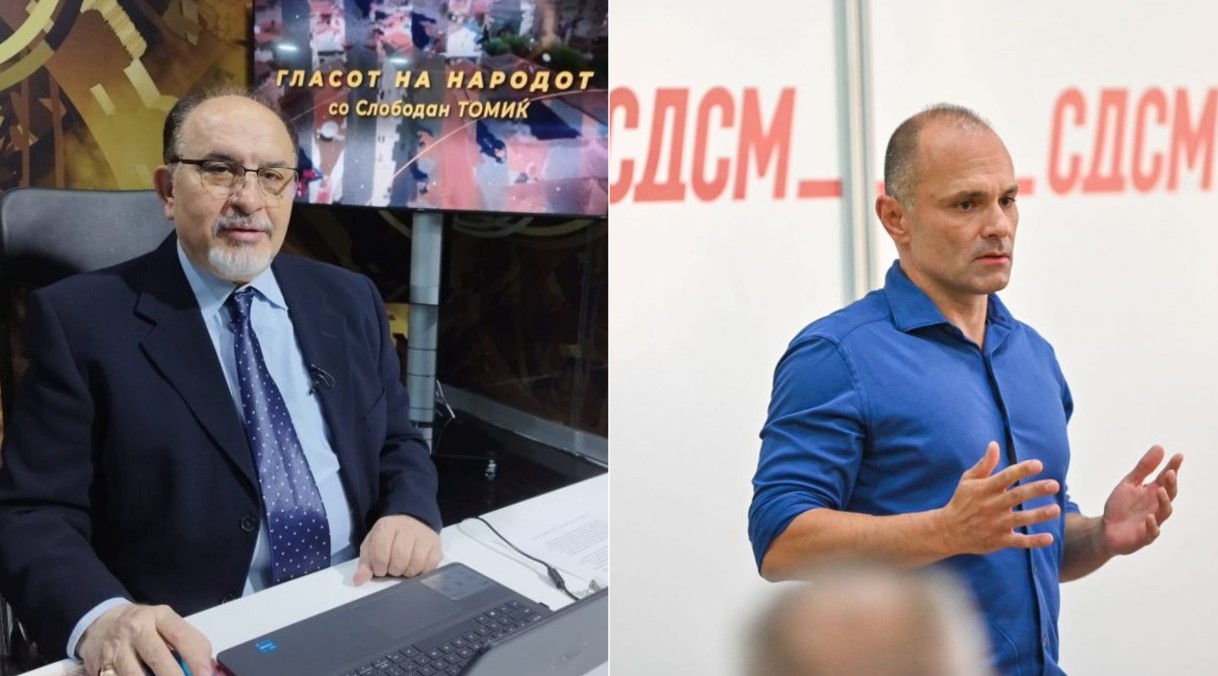
FROM PRESPA, THE TREATY WITH BULGARIA AND THE PROTOCOLS — TO TODAY’S BATTLE OVER DATA CENTERS: ONE PARTY CANNOT FOREVER BE AGAINST EVERYTHING THAT BRINGS A NEW MACEDONIA
By Slobodan Tomic

Slobodan Tomic
There is one question that must be put to Venko Filipče today.
Not tomorrow.
Not after the elections.
Not when the political subject changes again.
Today.
Filipče, why are you so afraid of every major investment?
Why is there this constant need to turn every development initiative into a danger, every investor into a suspicious player, every project into a threat, and every attempt at economic growth into a political scandal?
Today it is data centers.
Tomorrow it will be something else.
But the pattern remains the same.
SDSM once again wants to convince Macedonia that development is dangerous.
And that is why this is no longer merely an argument about data centers.
This is a clash between two political philosophies.
On one side is a Macedonia that wants to build, invest, produce, create infrastructure, attract capital, develop its energy sector and enter the new technological era.
On the other is the politics of fear, obstruction, suspicion and the endless search for reasons why something should not be done.
And today I ask:
How long, Filipče?
How long must Macedonia remain hostage to the politics of “NO”?
DATA CENTERS ARE NOT A PARTY POLITICAL TOY
Prime Minister Hristijan Mickoski has publicly stated that the Government is negotiating with five to six potential investors, including a major multinational company. He has said that the process will be public and transparent and that the Government will not abandon its strategy for developing data centers.
That is a political position.
It can be supported.
It can be criticized.
Additional guarantees can be demanded.
But one thing cannot be done:
the mere fact that Macedonia is negotiating new investments cannot be turned into a national catastrophe.
And that is precisely what we are seeing these days.
Filipče warns about water, electricity, agriculture and alleged agreements being made “behind closed doors.”
Fine.
Let there be oversight.
Let there be public scrutiny.
Let there be expert analysis.
Let there be assessments of the impact on water, the electricity system, the environment and agriculture.
But where is the argument that Macedonia must not enter one of the fastest-growing technological sectors in the world?
Where?
FILIPČE, HERE IS THE MACEDONIA YOU LEFT BEHIND
Filipče speaks today as if Macedonia had just become a state and as if he were the first person who needed to defend it.
But where was SDSM when decisions were being made that permanently changed the country’s political and national course?
Where was the concern for Macedonian citizens then?
Where was the question directed at the people?
Was the Macedonian people asked about the Prespa Agreement?
Were they asked about the Treaty with Bulgaria?
Were they asked about the protocols?
Were they asked about all the major political decisions that changed Macedonia’s position?
And if there was no referendum for every major political decision, why should people today suddenly be frightened by every new investment project?
That is the essence of the matter, Filipče.
You cannot say one day that the country must change because “reality” demands it, and then demand that Macedonia stand still today because every new step seems suspicious to you.
WHO STRIPPED MACEDONIA OF ITS IDENTITY?
This question hurts.
And that is precisely why it must be asked.
Macedonia is not the property of any political party.
It is not the property of SDSM.
It is not the property of VMRO-DPMNE.
It is not the property of any leader.
Macedonia is a homeland.
For Macedonians by origin.
For Macedonian citizens.
For everyone who feels it as their own.
For everyone who has no alternative homeland.
For everyone who, when they say “my country,” mean Macedonia.
And therefore nobody has the right to turn Macedonia into a laboratory for their own political interests.
Neither one side.
Nor the other.
AND NOW WE COME TO THE MOST PAINFUL QUESTION
Filipče, if you are so concerned about Macedonia’s resources — show us the numbers.
If you are concerned about water — show us the analysis.
If you are concerned about electricity — show us the energy calculations.
If you are concerned about agriculture — show us the study.
If you claim that obligations have been undertaken secretly — show us the document.
If there is a harmful agreement — publish it.
If there is a crime — report it.
But if none of that exists, what remains?
Political fear.
And Macedonia has no time for political fear.
WHEN DID DEVELOPMENT BECOME THE ENEMY?
Do we want Macedonia to remain a country from which young people leave?
Do we want to export our children while importing workers?
Do we want our brightest minds to build other economies while here we argue about whether we are even allowed to negotiate with major investors?
Or do we want Macedonia to become a place where knowledge is created?
Where artificial intelligence is developed?
Where data is stored?
Where digital infrastructure is built?
Where capital and technology come?
Where a young Macedonian engineer does not have to go to Germany, America or the Netherlands to work on cutting-edge technology?
That is the real question.
Not whether a data center sounds frightening.
But this:
Will Macedonia be a participant in the future — or once again merely a spectator?
ARE THERE RISKS? YES.
And this is exactly where we must be serious.
Data centers require enormous amounts of energy. Depending on the technology and cooling systems, they can also have significant water requirements.
That is why every individual project must have clear conditions, studies, environmental standards, an energy plan, contractual obligations and public oversight.
But that does not mean Macedonia should close its doors.
Quite the opposite.
It means Macedonia should open its doors — but with agreements that protect Macedonia.
With rules.
With guarantees.
With transparency.
With oversight.
With the national interest first.
PEHČEVO IS A DIFFERENT QUESTION
And here there is no need to mix apples and oranges.
Mickoski has publicly explained that the initiative in Pehčevo is a private initiative, specifically a draft urban-planning proposal, and that the state has no direct involvement in that particular project.
If the local government has objections — let it explain them.
If citizens have concerns — let them be answered.
If there is a risk to water — measure it.
If there is a risk to electricity — calculate it.
But one local procedure cannot be turned into proof that Macedonia should not have data centers.
That is political manipulation.
AND NOW — THE QUESTION FOR FILIPČE
Filipče, before lecturing Macedonia on how to protect its resources, answer one simple question:
What did you leave behind?
Not with a press conference.
Not with a party statement.
Not with accusations.
But with numbers.
How much new productive infrastructure?
How many major investments?
How many strategic energy projects?
How many new technological capacities?
How many permanent jobs?
How many young people stayed because Macedonia offered them a future?
And where are the results of the money the state spent during the years when SDSM was in power?
As for the claim that “€32 billion disappeared,” it should not be presented as an established fact without an official audit and documentation.
But the question of where public money went, what was built and what result citizens received — that is absolutely legitimate.
And Filipče should answer it.
NO MORE POLITICAL AMNESIA
Politicians who yesterday convinced Macedonia that major changes were an “historic necessity” cannot today pretend that every major project is a national danger.
Those who spent years dividing Macedonia along political, identity and social lines cannot today present themselves as the sole guardians of the national interest.
And a party that left behind deep political divisions cannot today speak about national unity as though it owns the concept.
Macedonia needs unity.
Not party unity.
Not obedience.
But a national strategy.
Energy.
Infrastructure.
Digitalization.
Investment.
Education.
Technology.
Agriculture.
Water.
Environmental protection.
All of it together.
That is state policy.
AND DIMITAR KOVACHEVSKI, FILIPČE?
And let us not forget Dimitar Kovačevski.
The man said:
“YES” to data centers.
There you have it, Filipče.
That is where your final argument collapses.
Because if your own former prime minister does not see data centers as a national catastrophe, but as an opportunity for development, then whom exactly are you trying to convince that Macedonia should be afraid?
Kovačevski said “YES.”
You say “danger.”
Which one of you speaks for SDSM?
Or is party policy now determined by whoever finds the fastest way to attack the Government?
If Kovačevski says “YES” and Filipče says “NO,” then the problem clearly is not the data centers.
The problem is SDSM.
And therefore, Filipče, before your next press conference — first agree among yourselves on what you actually believe.
And about Kovačevski, I can only ask ironically:
Zoki, what did Dimitar whisper to you in the Aegean, that the man came back saying “YES” to data centers?
Or perhaps, while some were taking a break, Macedonia finally started thinking about the future?
Whatever the answer, one thing is certain:
With Kovačevski saying “YES” and Filipče saying “NO,” SDSM is no longer fighting the data centers. SDSM is fighting itself.
MICKOSKI SHOULD NOT BACK DOWN — BUT THERE MUST BE PROOF
On one thing I am absolutely clear.
If the Government believes data centers are a strategic opportunity for Macedonia — then go all the way.
But do it with Macedonia’s interests at the center.
Do not sign anything that impoverishes the state.
No hidden obligations.
No privileges without public benefit.
Clear agreements.
Public studies.
Oversight.
Accountability.
And then, Filipče, you have no right to demand that Macedonia be afraid.
You have the right to ask questions.
You have the right to exercise oversight.
You have the right to criticize.
But you do not have the right to turn every investment into a national apocalypse.
MACEDONIA MUST NOT REMAIN AT THE BOTTOM OF SOMEONE ELSE’S FUTURE
The world is moving toward artificial intelligence.
Toward massive data centers.
Toward new energy infrastructure.
Toward the digital economy.
Toward investments that may seem enormous today but will become the foundation of entire economies tomorrow.
Mickoski says Macedonia wants to seize that moment.
I would put it even more strongly:
Macedonia has no right to miss the moment again.
We have already watched other countries race ahead while Macedonia argued with itself.
We have watched young people leave.
We have watched capital go elsewhere.
We have watched politicians waste energy on mutual hatred instead of construction.
Now we have an opportunity.
Not a guarantee.
Not a finished success.
An opportunity.
And opportunities are not killed with fear.
They are examined, controlled and turned into results.
FILIPČE, ANSWER ME!
When you talk about water — tell us how much water the specific project will consume.
When you talk about electricity — tell us how many megawatts.
When you talk about agriculture — show us the study.
When you talk about secret agreements — show us the agreement.
When you talk about damage — show us the calculation.
But do not sell Macedonia fear instead of politics.
Because Macedonia already has enough fear.
Macedonia needs a future.
And the future will not come if every investment is greeted with a scream.
It will come when we learn to say:
YES — but under Macedonian conditions.
YES — but in the public interest.
YES — but with protection of our water, land and energy.
YES — but with agreements that protect the state.
YES — but with no secrets.
And above all:
YES TO A MACEDONIA THAT BUILDS!
Not a Macedonia that blocks.
Not a Macedonia that is afraid.
Not a Macedonia that fights itself.
Not a Macedonia that drives away its young people.
But a Macedonia that produces.
A Macedonia that invests.
A Macedonia that creates.
A Macedonia that protects its water, energy and land — while opening the door to the technology of the 21st century.
And therefore the final question to Venko Filipče is the simplest one:
Filipče, do you want Macedonia to build — or do you want Macedonia to stand still again?
Because this time the people will watch.
They will remember.
And they will compare.
Who left words.
And who left results.
MACEDONIA HAS NO ALTERNATIVE HOMELAND.
And precisely for that reason, its future must never be a secondary issue for any political party.
