

PROF. DR. OGNEN KOSTOVSKI — THE SCIENTIST WHO TURNED KNOWLEDGE INTO A SERVICE TO HUMANITY
Surgeon, PhD, professor, researcher, teacher and humanitarian — and behind all the titles: a father
By Slobodan Tomic

There are people who build a profession.
There are people who build a career.
There are people who collect titles.
And then there are those rare individuals for whom a profession, over the course of decades, ceases to be merely a profession.
It becomes a calling.
It becomes a service.
It becomes a way of life.
And when medicine becomes service, the white coat ceases to be merely clothing.
It becomes a symbol.
It becomes a beacon.
That is why I do not want to begin the story of Prof. Dr. Ognen Kostovski with a position or an office.
I want to begin with the man.
With the physician.
With the surgeon.
With the scientist.
With the professor.
With the teacher.
With the humanist.
And, beyond all the titles, with the greatest and most human one:
father.
THE FIRST STEP — THE PHYSICIAN
After graduating from the Faculty of Medicine in Skopje in 2005 and completing his medical internship, he began his path toward specialization in general surgery in May 2006.
In 2007, he worked at the Emergency Center within the Surgical Clinics.
From May 2008 onward, his professional path became closely associated with the University Clinic for Digestive Surgery at the Mother Teresa Clinical Center.
These are the years in which medicine ceases to be merely something read in books.
It becomes something lived.
Years in operating rooms.
Years of on-call duties.
Years of decisions.
Years of patients.
Years in which a physician learns that behind every diagnosis there is a human story.
And that every patient standing before a doctor is not merely a medical case.
He is someone’s father.
Someone’s mother.
Someone’s son.
Someone’s daughter.
Someone’s husband.
Someone’s wife.
Someone’s beloved.
FROM SURGEON TO SCIENTIST
In 2017, he earned his doctoral degree.
In 2021, he completed his subspecialization in digestive surgery.
But the journey did not end there.
Quite the opposite.
It became broader.
From physician to specialist.
From specialist to subspecialist.
From surgeon to doctor of science.
From clinician to researcher.
From researcher to professor.
This is not merely professional advancement.
It is the gradual expansion of responsibility.
The surgeon carries responsibility for the patient before him.
The scientist carries responsibility toward medicine.
The professor carries responsibility toward the generations that follow.
And the humanist carries responsibility toward the human being.
When all these dimensions meet in one person, a profession acquires a higher meaning.
THE SCIENTIST — THE MAN WHO REFUSES TO ACCEPT “THAT’S JUST THE WAY IT IS”
Science begins when a person dares to ask:
Why?
Why does this happen?
Could it be done differently?
Could it be done better?
Could it be done more safely?
Could the patient suffer less?
Could medicine tomorrow be better than medicine today?
These are the questions of a scientist.
Prof. Dr. Ognen Kostovski has not limited his professional work to clinical practice.
He is active in scientific research, with a particular focus on digestive surgery, and has served as an author and co-author of scientific publications in digestive and abdominal surgery.
His scientific work is connected with contemporary surgical methods, minimally invasive surgery and continuous professional development.
That is the essence of the scientific spirit:
not to live from what you learned yesterday,
but to ask yourself every day what can be learned today.
THE PROFESSOR — WHEN KNOWLEDGE BECOMES A LEGACY
There is an enormous difference between a person who knows and a person who knows how to teach another.
The first possesses knowledge.
The second creates a legacy.
Prof. Dr. Ognen Kostovski is part of the academic world as a professor at the Faculty of Medicine.
But a professorial title should never be regarded as an ornament.
It is an obligation.
To the student.
To the resident.
To the young physician.
To the future.
One good physician can save a life.
But one good professor can help create dozens of physicians who will save lives tomorrow.
That is why the teacher may possess one of the greatest forms of power:
the power to pass on what he knows.
And to make another person better.
THE YOUNG PROFESSOR — YOUTH AS A STATE OF MIND
When someone is described as being among the youngest professors, it should not be understood merely as a number.
There is another kind of youth.
Youth of the mind.
Youth of curiosity.
Youth of ideas.
Youth of the courage to embrace what is new.
Science requires precisely that kind of youth.
Do not fear the new.
Do not fear the question.
Do not believe that you have reached the final page.
Because in genuine science, there is no final page.
Every answer opens another question.
Every discovery opens another horizon.
And that is why the youngest spirit in medicine can sometimes be found in the person who possesses the greatest depth of knowledge.
INTERNATIONAL MEDICINE — WHEN MACEDONIAN KNOWLEDGE ENTERS THE GLOBAL ARENA
Science has no borders.
Knowledge is not measured by geography.
And the reputation of a scientist is built, in part, through participation in the international scientific community.
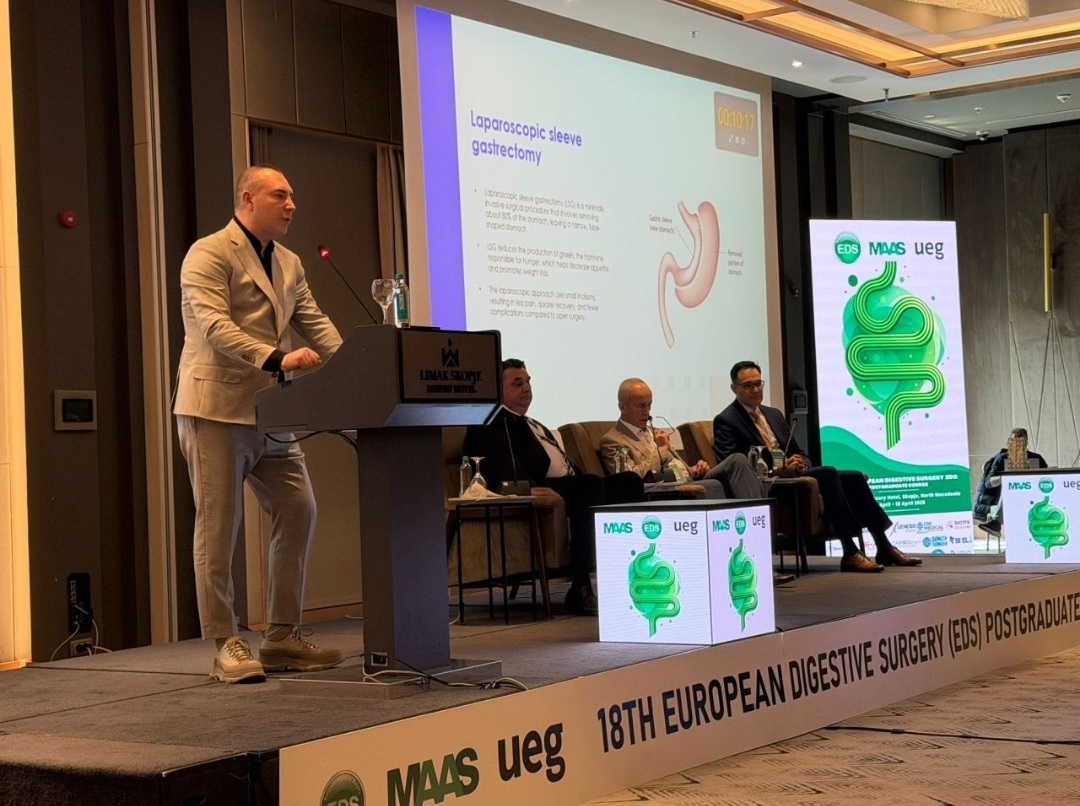
Kostovski has participated in international professional and scientific gatherings, while his public professional activity also includes engagement as a lecturer at international postgraduate courses.
That matters.
Because there is a difference between travelling somewhere to listen and standing before an international audience to teach.
At that moment, you are not merely learning from the world.
You are giving something back to the world.
And that is one of the most meaningful forms of a professional journey:
to receive knowledge and return it as knowledge.
SURGERY — WHERE EVERY SECOND CARRIES WEIGHT
Surgery does not forgive irresponsibility.
It requires a steady hand.
But even more than that, it requires a steady mind.
It demands concentration.
Discipline.
Courage.
Composure.
And something that cannot be obtained through a diploma alone:
a sense of the human being.
When a patient lies on an operating table, that person is not surrendering only a body.
The patient is surrendering trust.
Fear.
Hope.
The future.
That is why a surgeon must never see the patient merely as a case.
Before him lies a life.
THE PATIENT IS NOT A DIAGNOSIS
Modern medicine has numbers.
Images.
Laboratories.
Protocols.
Machines.
Algorithms.
But a human being is not a number.
A patient is not a code.
A patient is a person.
With a name.
With a family.
With fear.
With hope.
With a desire to continue living.
And that is why one calm sentence from a physician can sometimes be as important as the most sophisticated medical instrument:
“I am here.”
For the doctor, it may be only a sentence.
For a frightened human being, it can be an entire world.
SCIENCE WITH A HEART
Science without humanity can become cold.
Technology without conscience can become merely technology.
But science that serves humanity becomes something much greater.
It becomes hope.
Modern medicine should not have to choose between the human being and technology.
It must bring them together.
Humanity with technology.
Science with conscience.
Innovation with compassion.
Knowledge with responsibility.
That is where the true greatness of a modern physician can be seen.
WHEN HELP ASKS FOR NO REWARD
There are people who help because someone is watching.
And there are people who help because conscience tells them to.
The second kind of help is the purest.
It needs no audience.
No applause.
No camera.
Only one human being standing before another.
And this is precisely the kind of humanity that is hardest to record in a biography.
You cannot easily write down how many times you helped someone.
How many times you offered advice.
How many times you extended a hand.
How many times you stayed beside someone when life was at its hardest.
But these things remain in people’s memories.
And there, they have their greatest value.
BLOOD AND ORGAN DONATION — A PHILOSOPHY OF GIVING
His public professional activity has also included messages promoting blood donation and organ donation.
It is a powerful symbol.
To donate blood is to give a part of oneself so that another person may receive another chance.
To speak about organ donation is to speak about the possibility that one life may continue because of another.
This is medicine in one of its most noble forms.
To give so that another may live.
FATHERHOOD — THE DEEPEST HUMAN DIMENSION
But behind the scientist there is another man.
Behind the surgeon.
Behind the professor.
Behind the doctor of science.
Behind the teacher.
There is:
the father.
Perhaps that is where a person is most authentic.
In the operating room, the physician demonstrates expertise.
In science, intellect.
Before students, knowledge.
But before his child, there is no title behind which he can hide.
There remains only the father.
HIS DUCHESS
Every father has a most tender point.
His daughter.
To the world, she may simply be a daughter.
But to her father, she can be something much greater.
His Duchess.
Not as an official title.
Not as a matter of courtly rank.
But as a father’s metaphor.
A word through which a father expresses his deepest tenderness.
His pride.
His joy.
His concern.
His love.
And perhaps the most beautiful part of his life — something that can never be found in any scientific biography.
WHEN THE SCIENTIST BECOMES ONLY A FATHER
There comes a moment when all titles fall silent.
When the professor returns home.
When the scientist closes the book.
When the surgeon puts down the scalpel.
When the man closes the hospital door behind him.
And then there remains only:
the father.
Perhaps tired.
Perhaps carrying a thousand worries.
But before his daughter, he becomes once again the man who once held her hand.
And perhaps that is where the greatest human strength can be found.
Not in how much you can endure before the world.
But in how much tenderness you can preserve for those you love.
THE DUCHESS — A TITLE NO INSTITUTION CAN BESTOW
There are titles earned through diplomas.
Titles earned through scientific work.
Positions granted by decisions.
But there is one title no institution can bestow.
Not a university.
Not a state.
Not an institution.
Not a commission.
That title is:
father.
And to a father, his daughter can be:
his Duchess.
His greatest pride.
His deepest tenderness.
His quietest prayer.
ALBERT SCHWEITZER — “REVERENCE FOR LIFE”
There is a thought associated with Albert Schweitzer that perhaps corresponds most closely with this story:
“I am life which wills to live, in the midst of life which wills to live.”
Schweitzer built his moral philosophy around one great idea:
reverence for life.
And here it meets the essence of the medical profession.
The physician sees life.
The surgeon protects life.
The scientist searches for ways to protect it better.
The professor teaches others how to protect it.
And the father?
He loves the life of his child more than his own peace of mind.
That is why Schweitzer’s idea is more than philosophy.
In medicine, it becomes a daily moral obligation.
Respect life.
Protect life.
Help life.
DIRECTOR — ONLY ONE FUNCTION IN THE ENTIRE JOURNEY
And yes, today Prof. Dr. Ognen Kostovski also carries the managerial responsibility of a director.
But that is only one point in his biography.
Not his beginning.
Not his essence.
Not his greatest achievement.
Because a position can end.
The scientist remains.
The professor remains.
The surgeon remains.
The human being remains.
The father remains.
And that is precisely why the human being must always be greater than the position.
THE GREATEST PROFESSOR IS NOT AFRAID TO CREATE PEOPLE BETTER THAN HIMSELF
A true professor does not create copies.
He creates individuals.
Physicians who will think.
Physicians who will ask questions.
Physicians who will conduct research.
Physicians who will be braver than their generation.
Perhaps the greatest victory of a professor comes when one of his students eventually becomes better than he is.
Then the teacher has not been defeated.
The teacher has won.
Because his knowledge has continued to live.
A NAME IS BUILT OVER YEARS
In medicine, trust cannot be commanded.
It cannot be bought.
It cannot be declared.
It must be built.
Patient by patient.
Year by year.
Operation by operation.
Student by student.
Scientific paper by scientific paper.
Human being by human being.
And that is why the greatest reward for a physician is not applause.
Not the position.
Not the photograph.
Not the title.
It is the moment when someone says:
“Doctor, thank you.”
WHEN THE WHITE COAT BECOMES A BEACON
The white coat is white only in color.
The light comes from the person who wears it.
From knowledge.
From conscience.
From work.
From humanity.
From the ability to remain calm when another person is afraid.
From the ability to help when another person is suffering.
From the ability to teach another.
From the ability to give something of oneself without demanding anything in return.
Then the coat becomes a symbol.
Not of power over the human being.
But of service to the human being.
AGNUS DEI — THE LAMB OF GOD
Agnus Dei.
The Lamb of God.
I do not use this expression as a human title.
No human being is a saint.
No human being is without fault.
But as a metaphor, Agnus Dei carries a profound message:
Serve.
Help.
Be humble.
Protect life.
Use your strength for the sake of another.
That is why this title is not a crown for Prof. Dr. Ognen Kostovski.
It is a symbol of the ideal toward which medicine should aspire.
AND WHAT REMAINS?
One day, positions will pass.
Offices will change.
New machines will arrive.
New methods will emerge.
New generations will come.
But what will remain is:
the scientific work,
the knowledge,
the student,
the patient,
the colleague,
the person you helped,
and the child who will remember his father.
That is the true legacy.
Not what stands on a door.
But what remains in people.
FINALE — BEFORE ALL TITLES STANDS THE HUMAN BEING
Prof. Dr. Ognen Kostovski can be described in many ways.
Surgeon.
Doctor of science.
Scientist.
Researcher.
Professor.
Lecturer.
Teacher.
Humanitarian.
And a man entrusted with a leadership position.
But before all of these stands the human being, and behind all of them stands the heart.
Perhaps that is why the most beautiful image of a great physician is not when he stands before an audience.
It is not when he receives recognition.
It is not when he stands at a scientific conference.
It is not when he carries a professorial title.
It is when he closes the door at the end of his working day and returns home.
When he sees his daughter.
His Duchess.
And for one moment, all the titles fall silent.
The scientist falls silent.
The professor falls silent.
The surgeon falls silent.
And there remains only:
the father.
The man who loves.
The man who cares.
The man who worries about his child.
The man who is proud.
The man who may not say everything, but feels everything.
And then we understand:
the greatest title is not the one written before your name.
It is the one you carry in your heart.
For the patient — physician.
For the student — professor.
For medicine — scientist.
For the colleague — someone they can rely on.
But for his daughter —
father.
And for the father, his daughter —
his Duchess.
Perhaps that is where the entire meaning of this story comes together.
In the words of Albert Schweitzer:
reverence for life.
In the spirit of medicine:
service to humanity.
In science:
the endless search for something better.
In professorship:
the transmission of knowledge.
In humanity:
help without reservation.
And in fatherhood:
love without conditions.
Therefore:
AGNUS DEI.
THE LAMB OF GOD.
Not as a title.
Not as a crown.
Not as a declaration of perfection.
But as the deepest symbol of a human mission:
to use one’s strength for the life of another.
To use knowledge for good.
To use authority to help.
To use science in the service of humanity.
And to remain human when all other titles fall silent.
Because greatness does not belong to the person who stands highest.
Greatness belongs to the person who, when another is at their lowest, is willing to bend down beside them.
Greatness does not belong to the person who knows the most.
It belongs to the person who has turned knowledge into good.
Greatness does not belong to the person with the most titles.
It belongs to the person whose name someone speaks with gratitude.
And perhaps the greatest legacy of a physician is not what he has written in his biography.
It is what he has written into the lives of others.
In the patient who stood again.
In the student who learned.
In the colleague he helped.
In the science that continued to advance.
In the person to whom he gave hope.
And in the heart of his daughter, where, regardless of all titles, he will forever remain only one thing:
FATHER.
And she, to him,
his DUCHESS.
Then the white coat ceases to be merely a white coat.
It becomes a beacon.
A beacon for the patient.
A beacon for the student.
A beacon for the colleague.
A beacon for the human being.
And perhaps the most fitting sentence with which to conclude a story about the physician, scientist, professor and father is this:
When knowledge has a conscience, science has a heart, and power serves life, a person does not merely wear a white coat. He carries light.
AGNUS DEI.
THE LAMB OF GOD.
WHEN THE WHITE COAT BECOMES A BEACON.
