

Written by: Slobodan Tomic

Slobodan Tomic
A PORTRAIT OF THE ARCHPASTOR WHO HAS CARRIED THE RESPONSIBILITY OF THE SEE OF OHRID FOR MORE THAN A QUARTER OF A CENTURY
There are people whose names are written in history.
But there are also people whose lives become part of history.
In the spiritual life of a people, such personalities are recognized not merely by the office they hold, but by the burden they accept, the trials they endure, and the trace they leave in the souls of others.
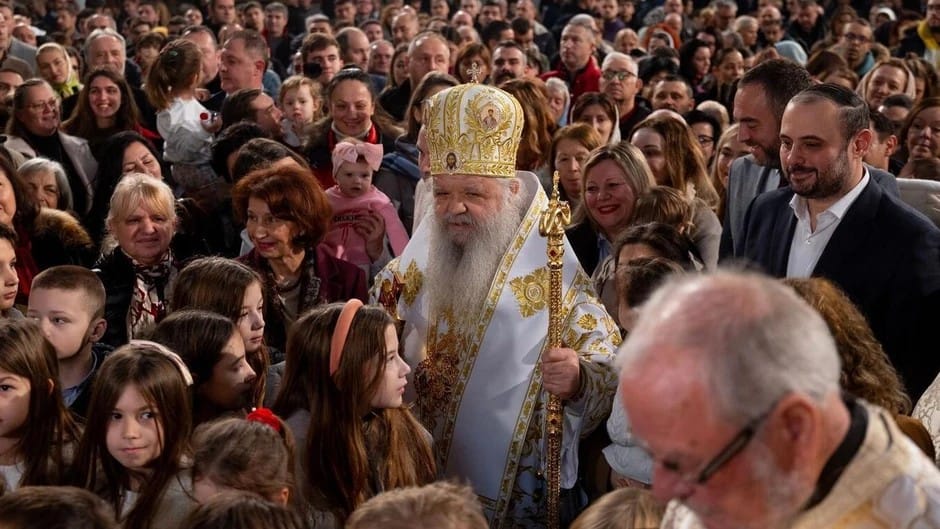
Such is the life journey of His Beatitude Stefan, Archbishop of Ohrid and Macedonia and of Justiniana Prima.
His story does not begin in an archiepiscopal palace.
It does not begin with a mitre.
It does not begin with an episcopal staff.
It begins in Dobrusevo.
In the family.
In childhood.
In faith.
In the quiet growth of a man who would later be called upon to assume one of the most demanding spiritual responsibilities of contemporary Macedonia.
And that is precisely why this portrait seeks not only to answer the question:
Who is His Beatitude Stefan?
But also a much greater one:
What does it mean to be a spiritual shepherd in a time when a shepherd is asked for patience, wisdom, courage and sacrifice?
FROM DOBRUSEVO TO OHRID
His Beatitude Stefan was born on May 1, 1955, in Dobrusevo, Bitola region, as Stojan Veljanovski, to Tale and Stojanka Veljanovski.
His life path turned toward theology at an early age.
In 1969, he enrolled at the Macedonian Orthodox Seminary “St. Clement of Ohrid” in Drachevo, graduating in 1974.
He then continued his studies at the Faculty of Theology in Belgrade, graduating in 1979.
But his thirst for theological knowledge did not end there.
In Bari, Italy, he continued his postgraduate studies at the Ecumenical-Patristic Institute “St. Nicholas,” where he obtained his master’s degree in 1982.
These were years of education, reading, research and spiritual maturation.
Then came another form of service: the service of a teacher.
He became a professor at the “St. Clement of Ohrid” Seminary and later a lecturer at the Faculty of Theology in Skopje.
Before becoming a spiritual leader, he became a man who educated future servants of the Church.
And here we encounter one of the most important threads running through his life:
Spiritual authority does not begin with a title.
It begins with knowledge.
With discipline.
With service.
With personal example.
With the ability to pass on what one has learned to the next generation.
THE MONASTIC PATH — WHEN LIFE BECOMES SERVICE
On July 3, 1986, at the Monastery of “St. Naum of Ohrid,” he was tonsured a monk.
Monasticism is not merely a change of name.
It is a change of the direction of one’s life.
It is the voluntary acceptance of a path of devotion.
Of prayer.
Of renunciation.
Of humility.
Of responsibility before God.
The man who enters monastic life knows that he has not chosen an easy road.
He has chosen the path of the Cross.
And the Cross is precisely one of the keys to understanding episcopal service.
For the episcopacy is not a crown of comfort.
It is the Cross of responsibility.
FROM BISHOP TO PRIMATE
In the years that followed, his ecclesiastical service continued through various responsibilities and episcopal duties.
Then came 1999.
The Church-People’s Council in Ohrid elected him Archbishop of the Macedonian Orthodox Church.
From that moment, his name became inseparably connected with the contemporary history of the Macedonian Orthodox Church – Ohrid Archbishopric.
Not because he is the only person who shaped that history.
But because, as its Primate, he assumed the responsibility of leading the Church through one of the most complex chapters of its modern existence.
That means more than holding an office.
It means standing in a place where every step carries weight.
Where every word can be interpreted.
Where every decision is viewed through the prism of history.
Where the personal becomes institutional.
And the institutional becomes historical.
A CHURCH IN A TIME OF TRIALS
To be the head of a Church in peaceful times is a responsibility.
To be its head in times of trial is a historical burden.
His Beatitude Stefan assumed this responsibility during a period when the status of the Macedonian Orthodox Church – Ohrid Archbishopric, its autocephaly and its place within the Orthodox world remained among the most sensitive questions for Macedonian Orthodox believers.
For years there were talks.
For years there were hopes.
For years there were disappointments.
For years there were prayers.
But the Church never ceased to live.
The Divine Liturgy continued.
Priests served.
Monks prayed.
Believers came to the churches.
Children were baptized.
Young people were married.
The departed were commemorated.
And the Church continued to bear witness.
Here lies one of the greatest mysteries of spiritual life:
History can be turbulent, but faith does not have to be loud.
Sometimes the greatest strength is revealed precisely through perseverance.
To continue.
To serve.
To pray.
To remain with the people.
THE SEE OF OHRID — A WEIGHT GREATER THAN THE TITLE
To be Archbishop of Ohrid and Macedonia and of Justiniana Prima means carrying a name behind which stands an immense spiritual and historical heritage.
Ohrid is not merely a city.
Ohrid is spiritual memory.
Ohrid is St. Clement.
Ohrid is St. Naum.
Ohrid is the centuries of Samuel’s legacy.
Ohrid is the written word.
Ohrid is books.
Ohrid is frescoes.
Ohrid is bells.
Ohrid is prayer.
Ohrid is the silence of monastery courtyards.
And therefore the archiepiscopal see is not merely a place of honor.
It is a place of covenant.
Behind the archpastor stand centuries.
Before the archpastor stand generations.
And in his hands rests the present.
That is an immense responsibility.
SAINT CLEMENT — A MEASURE OF TIME
When speaking of Macedonian Orthodox spirituality, it is impossible not to speak of St. Clement of Ohrid.
He did not spread literacy alone.
He spread faith.
He educated disciples.
He formed servants of the Church.
He created a spiritual culture.
His work was not created for one day.
It was created for centuries.
And here lies one of the deepest lessons for every spiritual leader:
A work is not measured by the applause of the day, but by the trace it leaves across generations.
It is not most important how many people praise you today.
What matters most is what remains of your work tomorrow.
2022 — A YEAR THAT ENTERED HISTORY
Then came 2022.
For the contemporary history of the Macedonian Orthodox Church – Ohrid Archbishopric, it was a year of profound change.
On May 9, 2022, the Ecumenical Patriarchate received the Macedonian Orthodox Church – Ohrid Archbishopric into Eucharistic and canonical communion.
On May 16, the Ecumenical Patriarchate announced that it recognized the Ohrid Archbishopric under the name “Ohrid.”
On June 5, 2022, the Serbian Orthodox Church announced that it accepted the autocephalous status of the Macedonian Orthodox Church – Ohrid Archbishopric and that a Tomos would be prepared.
For Macedonian believers, these dates are not merely ecclesiastical protocol.
They represent years of expectation that reached a historic outcome.
But the true believer knows:
When joy comes, the first word is not pride.
The first word is:
Glory to God.
STEFAN — THE ARCHPASTOR AND THE MAN
In every great spiritual portrait, there is a boundary that must not be crossed.
A man should not be turned into a myth.
But neither should his service be reduced to an ordinary function.
His Beatitude Stefan is a man.
But the service he carries is sacred.
And therefore the measure is not idealization.
The measure is the work.
The years.
The perseverance.
The responsibility.
The way the Cross is carried.
To be an archpastor means being present when things are easy, but even more so when they are difficult.
To be with the people when they rejoice.
And when they weep.
To listen when everyone is speaking.
And to know when silence is wiser than words.
SILENCE AS A FORM OF WISDOM
In a time when every word immediately becomes public, silence is often perceived as weakness.
But in the spiritual tradition, silence can be strength.
Not every truth must be spoken aloud.
Not every wisdom must be explained.
Not every battle must be accepted.
Sometimes a person says the most when he knows when to remain silent.
And a spiritual leader must know that words carry weight.
Especially when those words come from the See of Ohrid.
HIS WORD ABOUT TRUTH
In one of his interviews in 2024, His Beatitude Stefan sent a message under the title:
“Let Us Continue on the Path of Truth.”
And here our series and his words meet.
Because THE PATH OF TRUTH TO ETERNITY is not merely a beautiful title.
It is a spiritual commitment.
Truth is not always the easiest road.
But for the Christian, truth is not merely an idea.
Christ is the Truth.
Therefore, the path of truth is the path of faith, patience, repentance, forgiveness and perseverance.
REPENTANCE, LOVE OF GOD AND LOVE OF HUMANITY
In his Easter messages, repentance, love of God and love of humanity hold a particularly important place.
And this message is especially important today.
It is easy to speak about love for God.
It is harder to demonstrate love for another person.
It is easy to condemn another.
It is harder to forgive.
It is easy to present oneself as righteous.
It is harder to look into one’s own heart.
And Christianity demands precisely that:
first, we must cleanse our own heart.
THE WISDOM OF SAINT JOHN CHRYSOSTOM
Holy Tradition leaves us thoughts that do not grow old.
Saint John Chrysostom emphasized the strength and imperishability of the Church.
Not because the Church is a political power.
Not because it exercises authority over people.
But because its true strength is in Christ.
Empires were born and disappeared.
States were created and fell apart.
Rulers came and went.
But the prayer of the people continued.
And that is precisely why the church is stronger than daily politics.
AN ARCHBISHOP WHO SERVES, NOT RULES
In the true Christian understanding, a bishop is not a ruler over the people.
He is a servant of God and shepherd of his flock.
That is an enormous difference.
Power demands obedience.
The spiritual shepherd seeks salvation.
Power can command.
The shepherd must persuade through example.
Power can impose itself.
Faith is witnessed.
Therefore, the greatest weight of episcopal service is not in the staff held by the hand.
It is in the Cross carried by the soul.
THE CHURCH AS THE MEMORY OF A PEOPLE
The Church is not merely an institution.
For the believer, it is home.
It is the place where a person brings his fear.
His joy.
His pain.
His repentance.
His gratitude.
Into the church come those who have everything.
And those who have nothing.
The rich and the poor.
The strong and the weak.
The old and the young.
And before the altar, all are equal.
There, a person does not come to be important.
He comes to be human.
And therefore the Church is also memory.
It remembers births.
Baptisms.
Weddings.
Tears.
Funerals.
Feasts.
Prayers.
It remembers generations.
And when state archives fall silent, the bells still tell their part of the story.
HIS BEATITUDE STEFAN AND THE WEIGHT OF TIME
More than a quarter of a century at the head of a Church is no small matter.
It means watching generations change.
Watching children once baptized become parents.
Watching elderly believers depart.
Watching young people search for answers.
Watching the people rejoice.
Watching the people suffer.
And through all of it, once again proclaiming:
“Christ is Risen!”
For the Church does not live by daily circumstances.
It lives by hope in the Resurrection.
WHAT REMAINS AFTER A PERSON?
In the end, every title disappears.
Every person reaches the boundary of his earthly journey.
The vestments are removed.
The offices are left behind.
The doors are closed.
But the work remains.
The word that gave someone hope remains.
The prayer someone remembered remains.
The example remains.
Love remains.
And that is why true spiritual authority is not measured only by the time spent on the throne.
It is measured by what remains in the hearts of people.
WHERE DOES HIS GREATEST VALUE LIE?
It is not our task to idealize a man.
Nor is it the task of this portrait to turn the Archbishop into an untouchable figure.
A man is a man.
But the service is sacred.
And therefore the true measure is the work.
In the case of His Beatitude Stefan, his work is reflected through decades of ecclesiastical service, theological education, monasticism, episcopal ministry and primatial leadership.
His greatest historical responsibility was to stand at the head of the Macedonian Orthodox Church – Ohrid Archbishopric during the period that led to the major ecclesiastical developments of 2022.
THREE WORDS THAT SHOULD REMAIN
If only three words were to remain from this entire portrait, they would be:
FAITH.
Without faith, a person loses his way.
TRUTH.
Without truth, a person becomes a prisoner of error.
LOVE.
Without love, even truth can become a stone in the hand.
Christianity demands all three.
Faith gives us roots.
Truth gives us direction.
Love gives us meaning.
AND WHAT IS ETERNAL?
The office is not eternal.
The title is not eternal.
Man is not eternal.
The eternal things are God’s truth.
Christ’s love.
And the spiritual trace a person leaves when he serves sincerely.
And therefore every archpastor, regardless of the time in which he lives, should ask himself:
Will there be more faith or more division after me?
More love or more hatred?
More hope or more fear?
More prayer or more empty words?
These are the questions before eternity.
A FINAL PRAYER
Lord,
Guard Your Church.
Guard her bishops, priests, monks and faithful people.
Give them wisdom when times are difficult.
Give them strength when the Cross is heavy.
Give them humility when praise comes.
Give them courage when trials arrive.
And above all, give them love.
For without love, there is no true pastoral ministry.
THE FINAL WORD
His Beatitude Stefan began his life journey as Stojan Veljanovski from Dobrusevo.
He passed through theological education.
He became educated.
He embraced monastic life.
He served as a teacher.
He became a bishop.
And in 1999, he assumed the leadership of the Macedonian Orthodox Church.
From then until today, his name has been written into one of the most significant chapters of the contemporary history of the Macedonian Orthodox Church – Ohrid Archbishopric.
But the most important question is not what historiography will write.
The most important question is:
What will the people write in their hearts?
For books may turn yellow.
Bells may fall silent.
People come and go.
But what is done with faith and love can live far beyond the span of a human life.
Therefore, brothers and sisters,
this is not merely a portrait of an Archbishop.
It is a portrait of a service.
A portrait of an era.
A portrait of a spiritual responsibility.
A portrait of Ohrid.
A portrait of a tradition.
And a testimony that when a person chooses the path of faith, his life can become part of something greater than himself.
THE PATH OF TRUTH TO ETERNITY
HIS BEATITUDE STEFAN
May the Lord grant him health, wisdom, strength and peace as he continues his archpastoral service.
And may He grant the Macedonian Orthodox Church – Ohrid Archbishopric unity, love, spiritual strength and enduring life through the centuries.
Amen.
SHORT VERSION
Writing
THE PATH OF TRUTH TO ETERNITY
HIS BEATITUDE STEFAN
Archbishop of Ohrid and Macedonia and of Justiniana Prima
There are people whose names are written in history.
But there are also people whose lives become part of history.
His Beatitude Stefan, Archbishop of Ohrid and Macedonia and of Justiniana Prima, has carried the burden of the See of Ohrid for more than a quarter of a century.
His journey began in Dobrusevo, as Stojan Veljanovski. It continued through theological education, teaching, monastic life and episcopal service, until in 1999 he assumed the highest spiritual leadership of the Macedonian Orthodox Church.
This was not merely a path toward a title.
It was a path toward the Cross.
The See of Ohrid is not merely a place of honor. Behind it stand St. Clement, St. Naum, centuries of spiritual tradition, literacy, theology, churches, monasteries and prayer.
And before every archpastor stands one great question:
What will remain after him?
In 2022, Macedonian Orthodoxy entered a new historical chapter. For believers, those were years of expectation that reached a historic outcome.
But the true spiritual measure is not found only in historical dates.
It is found in faith.
In truth.
In love.
In the ability to remain with one’s people both when times are easy and when they are difficult.
For the office is not eternal.
The title is not eternal.
Man is not eternal.
Eternal are God’s truth, Christ’s love, and the spiritual trace a person leaves behind.
And therefore, this portrait is not merely the story of an Archbishop.
It is the story of a service.
Of a See.
Of a people.
Of an Ohrid.
And of a path that begins with faith, passes through the Cross, and leads toward eternity.
THE PATH OF TRUTH TO ETERNITY
HIS BEATITUDE STEFAN
May the Lord grant him health, wisdom, strength and peace as he continues his archpastoral service.
Amen!
