

Economy, energy, the diaspora and Bulgaria enter the same geopolitical equation
By Slobodan TOMIĆ

“He who controls energy controls space; he who understands space understands politics.”
Niccolò Machiavelli
Washington is sometimes just a city.
But sometimes Washington is a message.
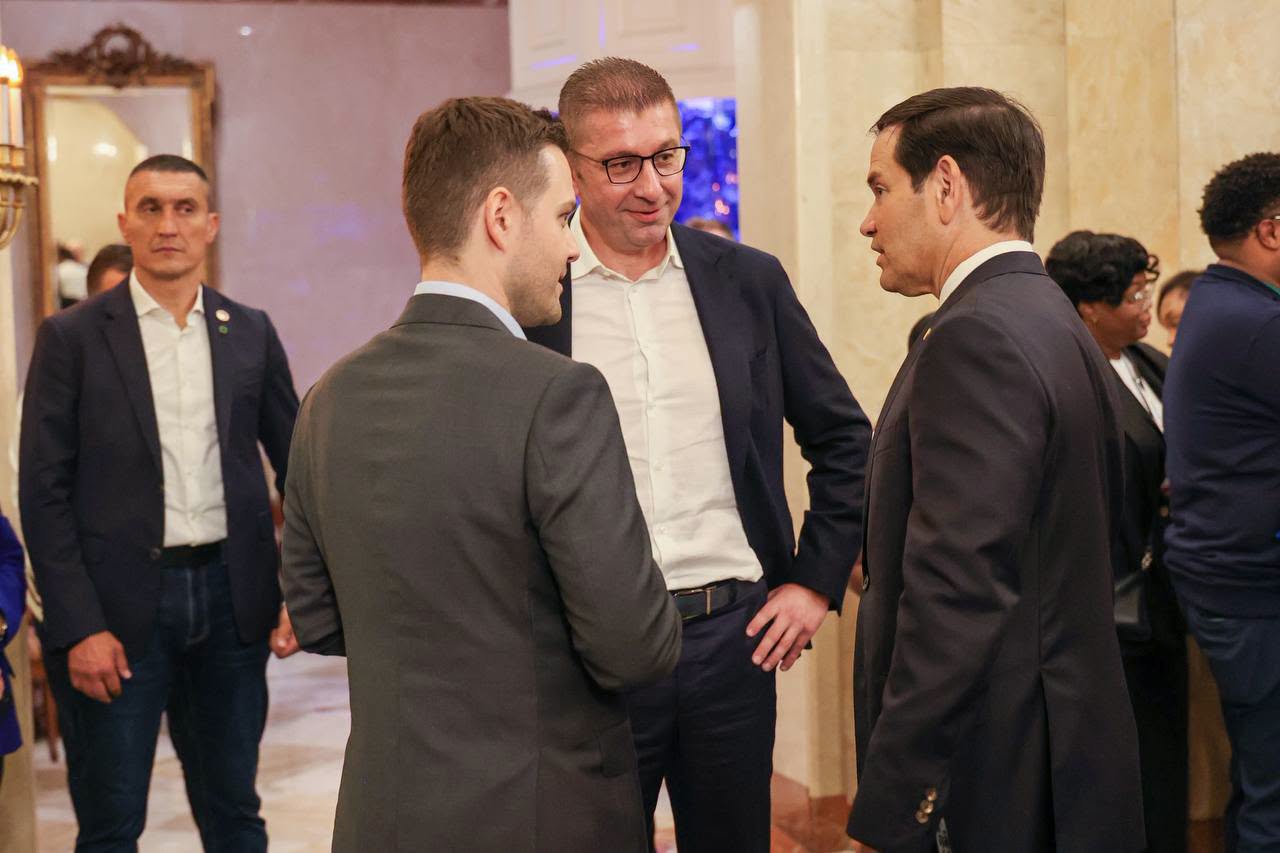
Hristijan Mickoski’s visit to the United States, based on the publicly available information, has opened several parallel fronts: capital, energy, infrastructure, technology, international politics and the relationship with the Macedonian diaspora.
The essence lies precisely in their interconnectedness.
That is why this visit should not be read merely through the figure of 4.3 percent GDP growth, nor solely through the discussions surrounding “Chebren” and “Galishte,” nor solely through Mickoski’s statement that Macedonia does not intend to enter a process with Bulgaria without a “predictable end.”
The real question is much larger:
What is Macedonia trying to become within the new geopolitical architecture of the Balkans?
From Washington, the messages can be read through at least three principal dimensions: economic, energy and diplomatic.
But following today’s meeting with Macedonians in New Jersey, a fourth dimension has emerged:
the diaspora as part of a broader state strategy.
And that is where the real political weight of the visit begins.
FROM A POLITICS OF WAITING TO A POLITICS OF POSITIONING
The most important message from Mickoski may have nothing to do with either investment or Bulgaria.
It is his argument that Macedonia should use international political engagement to try to recover positions which, in his assessment, were lost during the previous period.
That represents a fundamentally different political approach from one in which a small state simply receives conditions imposed by larger powers.
Mickoski did not announce from Washington any withdrawal from international agreements.
Quite the opposite.
He publicly stated that such a step is not realistic policy and that Macedonia does not exist in isolation from the rest of the world.
That is an important signal.
For a small European state, there are two extremes that can be equally problematic:
one is unconditional capitulation;
the other is isolation in the name of principle.
Mickoski is attempting to open a third path:
the agreements remain, dialogue remains, the European path remains — but the way Macedonia defends its own interests must become more active.
That is the essence of his formula.
“A PREDICTABLE END” — THE MOST IMPORTANT PHRASE FROM WASHINGTON
Within the entire Bulgarian question, one formula stands out:
“I will never enter a process without knowing that it has a predictable end.”
This does not mean that the process has been predetermined.
Nor does it mean that Macedonia has a guarantee regarding the outcome.
Politically, however, it means something else:
Macedonia is not asking merely for a process; it is asking for a process with a clear logic leading toward an identifiable result.
Mickoski has also spoken of trust and of a “two-way street.”
That matters because his position has not been presented as a rejection of dialogue.
Quite the opposite.
He has said that Macedonia is prepared to discuss the action plan concerning minorities, but wants an international factor — preferably a representative of the European Union — to be present in the process.
This is where the diplomatic calculation becomes significant.
If the dispute remains exclusively Macedonian-Bulgarian, it remains bilateral.
If the European Union becomes formally and substantively involved, the issue moves toward the European table.
And that is precisely the direction Mickoski is seeking.
BULGARIA IS NOT THE ONLY TABLE — THE EU IS THE THIRD CHAIR
This may be the most interesting diplomatic element emerging from Washington.
Mickoski is not calling for the talks to stop.
He is not calling for the agreements to be terminated.
He is not calling for Macedonia to abandon its European perspective.
He is asking for a third actor at the table.
The European Union.
That distinction should not be lost in day-to-day political interpretations.
The essence is this:
Skopje wants the dispute with Sofia to move into a European context rather than remain confined to a bilateral format.
That is the strategy being articulated.
Will it produce results?
That remains to be seen.
But as a diplomatic initiative, it is clearly defined.
And that is why the message from Washington carries greater weight than ordinary political rhetoric.
MICKOSKI AND AN UNCOMFORTABLE TRUTH: THE EUROPEAN PATH ALSO HAS CONDITIONS
Here, however, the other side must also be stated.
The European framework and the commitments already undertaken do not disappear because of an American visit.
Washington does not erase the European reality.
Nor should anyone create the false impression that a series of meetings in the United States automatically changes the EU negotiating framework.
It does not.
But it can change something else:
the way Macedonia conducts the political struggle surrounding that framework.
And this is where the distinction between a condition and a political strategy becomes important.
The condition exists.
But the political debate over guarantees, mechanisms, predictability and the future conduct of all sides continues.
MARTA KOS AND A PARALLEL EUROPEAN MOMENT
The timing is particularly interesting.
While Mickoski speaks from Washington about predictability, trust and the presence of the EU, European institutions are simultaneously preparing for a new phase in enlargement policy.
The European Union is not discussing Macedonia alone.
It is once again considering its own future as a broader political community.
That creates a new context.
But also a new responsibility for Macedonia.
Because a European perspective is not secured through diplomatic statements alone.
It requires reforms, institutions, the rule of law and the political capacity to fulfil commitments that have been undertaken.
WASHINGTON’S SECOND FRONT: CAPITAL
And now we arrive at what may prove far more consequential in the long term than daily diplomatic rhetoric.
Capital.
In Washington, Mickoski discussed with the U.S. Development Finance Corporation — DFC — possibilities connected with “Chebren” and “Galishte,” while the broader talks also covered infrastructure, energy, data investments and potential American private investment.
A clear distinction must be made here.
A discussion about an investment is not an investment.
Potential financing is not approved financing.
An announcement is not an agreement.
That is precisely why euphoria should be avoided.
But it would be equally wrong to underestimate the political value of opening these channels.
Because major projects do not begin with ribbon-cutting ceremonies.
They begin with a conversation.
Then comes the study.
Then financing.
Then the agreement.
Then implementation.
CHEBREN AND GALISHTE: FROM A DECADES-LONG STORY TO AMERICAN CAPITAL?
“Chebren” and “Galishte” have for years symbolized Macedonia’s struggle to turn major energy projects into reality.
That is why their reappearance in discussions with the DFC carries political weight.
But precisely here, the greatest realism is required.
If serious American interest develops, the projects could acquire not only a financial but also a geopolitical dimension.
If they remain only at the level of discussions, however, they will remain another major Macedonian energy announcement.
The difference will be made by implementation.
And that should be the criterion.
Not the slogan.
Not political marketing.
The result.
As of now, the publicly reported position is that DFC has expressed interest and that a communication channel has been established; there is not yet a signed financing agreement or a confirmed financing figure for “Chebren” and “Galishte.”
ENERGY BECOMES GEOPOLITICS
This is where the American visit and Macedonia’s energy strategy converge.
The gas interconnector with Greece.
The northern interconnector toward Serbia.
Connection to the wider European energy system.
Energy capacity.
Data centers.
Artificial intelligence.
At first glance, these issues appear separate.
In reality, they can form a single strategy:
energy + infrastructure + digital economy + American capital = a new model of economic positioning.
If it is implemented.
That final qualification is crucial.
Because Macedonia cannot live on geopolitical maps drawn on paper.
It must build infrastructure that makes it matter.
Mickoski has also described Macedonia as a potential energy crossroads within the high-voltage network and linked infrastructure development with resilience, security and the country’s geopolitical position.
DATA CENTERS: THE MOST AMBITIOUS PART OF THE STORY
Perhaps the most intriguing element of this entire picture is the question of data centers.
Why?
Because this is where Macedonia is attempting to move from the logic of conventional industry toward an economy built around higher value-added activity.
The government has been discussing potential investments with several companies, including infrastructure connected with artificial intelligence.
But again:
a discussion is not a contract.
And this is where the credibility of the entire economic strategy will ultimately be tested.
Can Macedonia create the conditions required for major technology investments?
Will there be sufficient electricity?
Will the grid be stable?
Will the infrastructure be adequate?
Will there be qualified personnel?
Will there be long-term political and institutional stability?
These are the questions that will provide the final answer.
KRSTOV DOL — HERE, AMERICAN FINANCIAL INVOLVEMENT IS ALREADY MORE CONCRETE
Compared with the announcements surrounding “Chebren,” “Galishte” and data centers, Krstov Dol represents a more concrete example.
The U.S. DFC has provided up to $5 million in project-development financing for the development and assessment phase of the antimony project.
That is important.
But it should not be presented as financing for an entire mine.
It is support for the development stage of the project.
This kind of precision is essential if Macedonia wants to be taken seriously by the international community.
Great powers are not impressed by great words. They are impressed by projects that are actually delivered.
The U.S. support for the Krstov Dol project has been publicly described in connection with the development of the antimony deposit near Kriva Palanka.
AMERICA AS AN ECONOMIC, NOT ONLY A SECURITY PARTNER
This represents another important shift in perspective.
For years, U.S.-Macedonian relations were viewed primarily through NATO, security and defense.
Now the economic component is becoming increasingly important.
Energy.
Critical minerals.
Infrastructure.
Technology.
Data centers.
Artificial intelligence.
That is a much broader definition of strategic partnership.
If concrete investments are ultimately realized, Macedonia could increasingly be viewed not only as a security point on the Balkans, but also as an economic and energy point.
AND THIS BRINGS US BACK TO BULGARIA
Because all roads lead back to geopolitics.
If Macedonia becomes:
energy-connected,
infrastructure-connected,
economically engaged with the United States,
regionally relevant,
and institutionally stronger,
then its negotiating weight may change.
Not automatically.
Not magically.
But it may change.
That is why economic strategy and diplomatic strategy should not be viewed as two separate policies.
They can become one and the same policy.
Economic power becomes diplomatic weight. And diplomatic positioning can, in turn, reinforce economic power.
THE BIGGEST TEST FOR MICKOSKI IS NOT IN WASHINGTON
And here we must be brutally realistic.
It is easiest to speak in Washington.
It is hardest to deliver in Skopje.
Washington can open a door.
But Macedonia must walk through it.
That means:
reforms;
faster procedures;
legal certainty;
stable energy;
infrastructure;
qualified personnel;
institutional discipline;
and, above all, implementation.
If the announced investment discussions do not produce concrete projects, the story returns to the beginning.
If the discussions over “Chebren” and “Galishte” do not produce a financing structure, we will once again be left with a project on paper.
If the political dialogue with Sofia does not produce a European mechanism with clear rules, then “a predictable end” will remain a powerful political formula rather than a political outcome.
That is why:
Washington is the beginning, not the finale.
BUT WASHINGTON IS NOT ONLY ABOUT CAPITAL
And this is where today’s New Jersey meeting introduces a new and highly significant dimension.
On Sunday, September 20, Mickoski attended the liturgy at the Sts. Kiril and Metodij Macedonian Orthodox Church in New Jersey and met with members of the Macedonian community from the New York and New Jersey region. Foreign Minister Timcho Mucunski accompanied him. The church itself lists September 20 as its Sunday liturgy date in Cedar Grove, New Jersey.
Mickoski’s message was direct:
“Wherever our people are, there is also a part of Macedonia.”
At first glance, this could be viewed simply as a ceremonial element of the visit.
But seen in a broader context, the message has political significance as well.
Because a Washington strategy cannot be only about Washington.
It cannot be only about Congress.
It cannot be only about the DFC.
It cannot be only about energy.
It cannot be only about Bulgaria.
There is also Macedonia beyond Macedonia’s borders.
There is a diaspora that for decades has preserved its connection with language, culture, church, family and homeland.
Today’s meeting in New Jersey therefore adds another dimension to the political picture of the visit.
Economic policy requires capital. Diplomacy requires partners. And national policy requires that people not be forgotten wherever they live.
That is why today’s New Jersey meeting is not a footnote.
It is part of the mosaic.
FROM WASHINGTON TO NEW YORK: THE NEXT BOARD
And now the visit enters its next phase.
Following Washington, the focus shifts toward New York and the 81st United Nations General Assembly, where the high-level week begins on September 21.
The American visit therefore does not end with the bilateral meetings in Washington.
It moves onto a much larger diplomatic stage.
New York creates space for meetings with heads of state and government and for bilateral contacts, particularly at a moment when world diplomacy converges around the United Nations.
That is where another dimension of the strategy will become visible:
Can Macedonia’s economic, energy and political interests be transformed into broader international partnerships?
That is the next square on the chessboard.
WHAT, IN FACT, DID MICKOSKI SIGNAL?
When all the pieces are brought together, the message can be read this way:
Macedonia will not abandon its agreements.
It will not abandon Europe.
It will not abandon dialogue.
But neither will it accept a process without a clear perspective.
At the same time, it will seek American capital, European connectivity, energy security, technological investment and a stronger relationship with the Macedonian diaspora.
That is the political matrix emerging from Washington.
And that is why the visit should not be judged merely by the number of documents signed.
What matters is what happens after the visit.
THE BIGGEST BATTLE IS FOR POSITION — NOT RHETORIC
Small states face one fundamental weakness in international politics.
Others often speak about them.
Less often do they speak with them.
And more rarely do they depend on them.
Macedonia’s long-term strategy must be to become a country that others have a reason to engage with.
Not because it is large.
But because it is important.
Energy-wise.
In security terms.
Infrastructure-wise.
Economically.
Regionally.
That is the long-term logic behind interconnectors, energy capacity, critical minerals and technological investment.
And it is precisely in that context that Washington should be read.
THE HISTORICAL POINT
Mickoski did not return from Washington with an automatic solution to the Bulgarian question.
He did not return with automatic American financing for every project.
He did not return with an automatic European guarantee.
But he did open something that may ultimately matter more than a single day’s political achievement:
space for a new strategy.
And in geopolitics, space is capital.
Those who know how to use it build position.
Those who do not once again become subjects of decisions made by others.
Therefore, the real test for Mickoski is not whether Washington sounded good.
It is whether the political and economic initiative launched in Washington can be transformed into a Macedonian result.
From “Chebren” to data centers.
From Krstov Dol to gas interconnectors.
From Bulgaria to Brussels.
From Brussels to Washington.
From Washington to New York.
From state institutions to the Macedonian diaspora in New Jersey.
All the lines converge at one point:
MACEDONIA’S POSITION.
And if there is one message to take from this visit, it is not that Macedonia has gained everything.
It is that Macedonia must begin thinking like a state that does not wait for someone else to define its position, but seeks to build that position itself.
That is a much harder form of politics.
But also a much more serious one.
FINAL THOUGHT
“The supreme art of war is to subdue the enemy without fighting.”
Sun Tzu
In Macedonian terms, this does not mean abandoning the struggle.
Quite the opposite.
It means choosing the right table, the right allies, the right arguments and the right moment.
Washington has shown that Mickoski wants Macedonia to operate on several geopolitical chessboards simultaneously.
Washington — for the strategic partnership.
DFC — for capital.
Energy — for infrastructure and strategic weight.
Brussels — for the European framework.
Sofia — for the political test.
New York — for global diplomacy.
New Jersey — for the Macedonian diaspora.
Now comes the hardest part:
to demonstrate that these boards are not merely diplomatic stages,
but can become
REAL MACEDONIAN RESULTS.
